
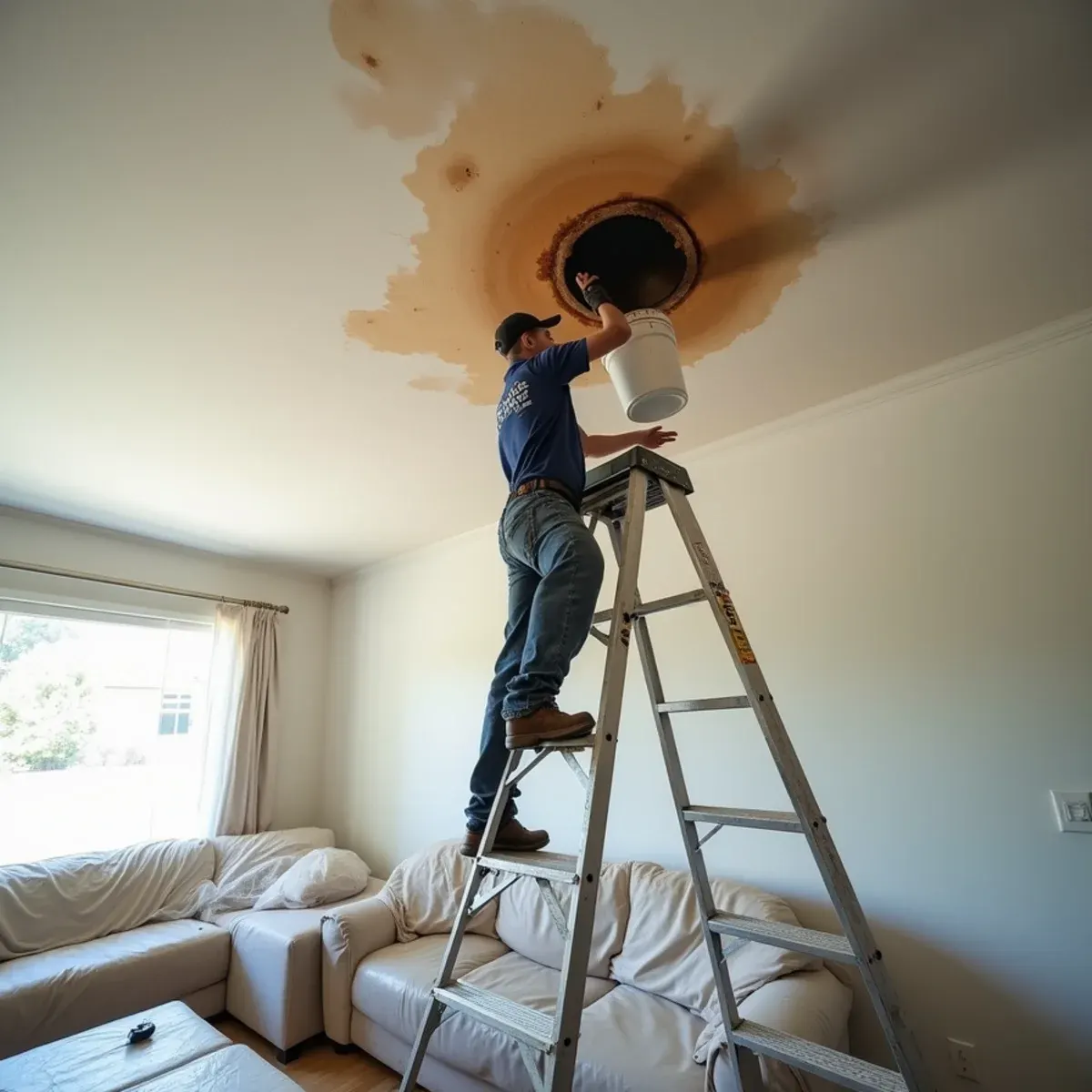
A sagging ceiling tile over a Paramount Boulevard shop floor and a bulging bedroom ceiling in a Clearwater bungalow are the same emergency handled two entirely different ways, and we get both calls on the same block. This city packs housing tightly between industrial and commercial corridors, so our crews arrive prepared for either. On the commercial side the roofs are flat with internal drains and overflow scuppers, and the classic failure is a plugged drain letting several inches of water pond on the deck until it finds a seam. That water then sits above a lay-in grid ceiling, over light fixtures and data cabling.
The residential side is dense 1945 to 1965 stock on small lots with very little room between buildings, and that matters more during emergency tarping than people expect. There is often no place to set a ladder on the side of the house we need, nowhere to stage material, and a neighbor's driveway five feet away. We work from the front or the alley, ballast tarps rather than nailing where we can, and plan the route in before the weather gets worse instead of improvising on a wet roof in the dark.
What Paramount Changes About Ceiling & Roof Leaks
1Plugged roof drains, not failed shingles
Flat commercial roofs along the corridors fail at the drain, not in the field. Debris blocks the outlet, water ponds, and the added weight plus standing depth pushes it through a lap or a penetration. First moves are clearing the drain and relieving the load on the deck. Ponded water is heavy, and a bulging grid ceiling underneath is a warning we take seriously before anyone works below it.
2De-energize before we touch the grid
Water above a lay-in ceiling sits on fixtures, conduit, and low-voltage cabling. We shut the affected circuits down before removing tile, drop the water in a controlled way into containment, and bag the saturated tile rather than trying to dry it. Grid tile is inexpensive to replace and never dries back to a clean, straight surface, so we do not pretend otherwise.
3Small lots leave no room to work
Paramount's residential lots run tight, with narrow side yards and almost no permeable ground. That constrains ladder placement for tarping, equipment staging, and where extraction water can safely go. We route hoses to a proper drain rather than the neighbor's slab, and we tell you honestly when a roof side cannot be safely tarped in current wind before we attempt it.
How the Work Runs
The method is the same one we use on every ceiling & roof leaks job, documented to the IICRC S500:2025 standard. Here it is in short — the full ceiling & roof leak water damage process explains each stage in detail.
- Emergency tarping or temporary dry-in
- Controlled relief of trapped water
- Trace the intrusion to its real source
- Remove wet insulation and compromised drywall
- Dry the attic and the ceiling assembly
- Restore the ceiling completely
The Paramount Background Worth Knowing
On a typical Paramount lot, the house, the driveway, the walkways and the rear slab cover most of the parcel. What is left is a narrow side yard, and everything that lands on the roof and the paving is supposed to leave through a couple of small area drains. That system has no margin. When a grate silts up, when a downspout dumps straight onto paving, or when the outlet at the curb has been crushed by a parked truck, the water has no soil to soak into and nowhere else to be. It ponds against the slab edge and comes in at the lowest threshold, which is usually a garage or a side door.
There is more on the housing stock, drainage and plumbing history of this city on our water damage restoration in Paramount page.
Paramount at a glance
- Dominant construction era
- 1945–1965
- Foundation type
- slab on grade
- Supply piping found here
- original galvanized steel, copper
- Drain line materials
- cast iron
- Terrain and water table
- flat, moderate water table
- Most common local failure
- residential and commercial losses on the same block, needing very different handling
- Highest-value local prevention
- clearing area drains before the season on lots with very little permeable ground
What It Costs in Paramount
We do not quote a number over the phone before seeing the property — anyone who does is guessing. The variables that actually move the price on a ceiling & roof leaks job are how long the leak has been active, ceiling texture and finish, attic access and insulation type, and they are broken down in full on the ceiling & roof leak water damage page. The assessment and the written estimate are free anywhere in Paramount, day or night, with no obligation.
Ceiling & Roof Leaks Questions from Paramount Homeowners
Often, yes, with a clear boundary. We contain and isolate the affected bay, de-energize the circuits above it, drop the wet tile into containment, and keep customers and staff out of that footprint while the rest of the floor keeps running. What we will not do is leave a ponded roof or a loaded ceiling grid over an occupied area. If the deck above is holding water, clearing that comes first and the area stays closed until it is done.
Clear the room and keep everyone out from underneath it, including pets. Move furniture if you can do it from the side. Put a bucket down if you can place it safely without standing under the bulge. Then call us — we relieve it deliberately, which is safer and preserves much more of the ceiling than letting it fail on its own.
We tarp immediately to stop the intrusion and coordinate the roofing repair with a licensed roofer, then handle all the interior restoration ourselves. You get one point of contact and one schedule instead of managing two trades during a storm week.
Almost certainly your area drains. Paramount lots have very little permeable ground, so everything that falls on the roof and the paving has to leave through a couple of small drains. If a grate silts up or the outlet is crushed, the water ponds against the slab and enters at the lowest threshold, which is usually the garage. Rodding the drains and checking the outlet before the season costs far less than drying the garage wall afterward.