
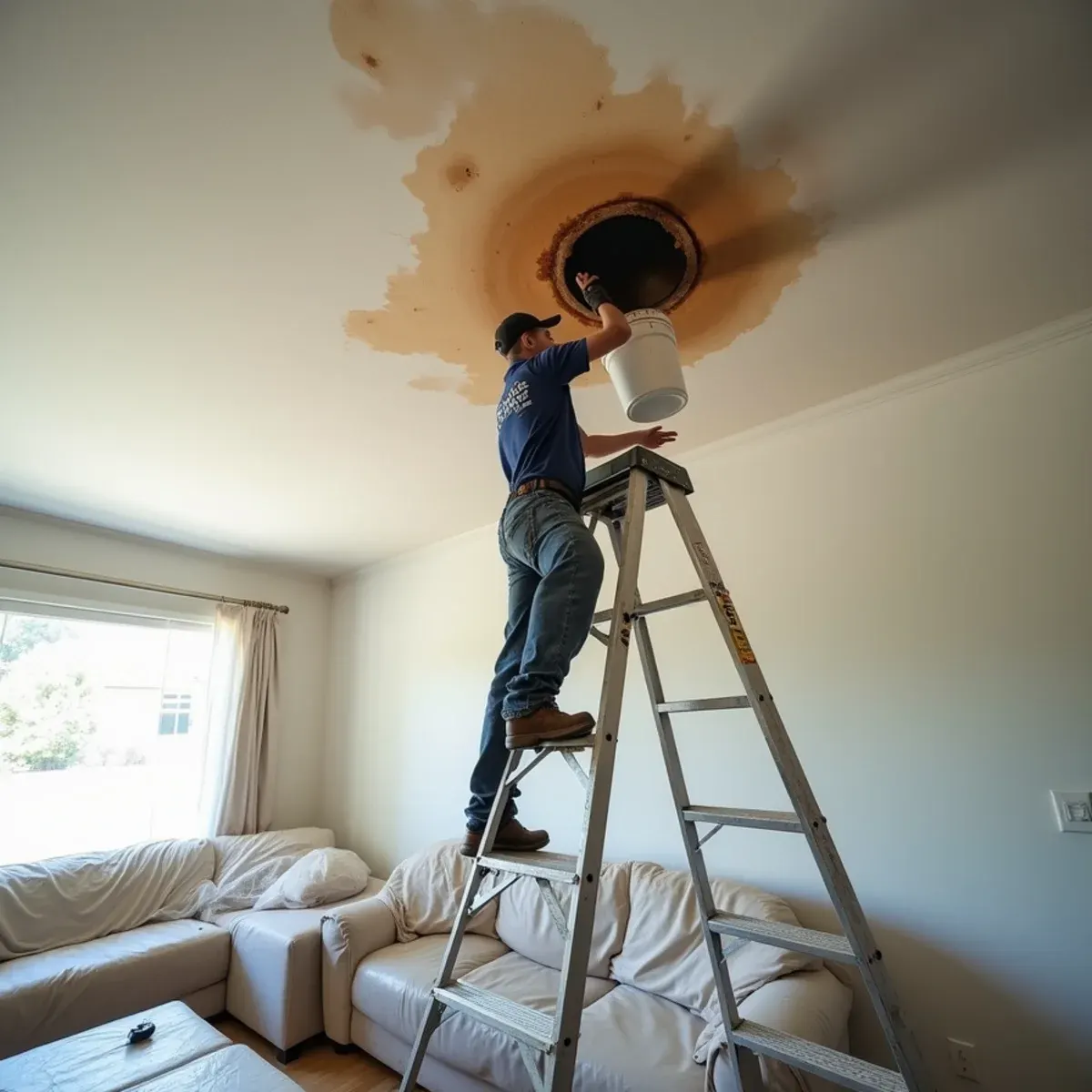
Seventeen thousand homes went up here between 1950 and 1953, at times a hundred a day, and they share far more than a decade. The roof pitch is low, the attic tapers to nothing at the eaves, and in a lot of these houses there is no practical way to crawl to the far corner of the ceiling plane. That single fact shapes the whole job. Tracing an intrusion in Lakewood is done with meters, thermal imaging and a deliberately placed access opening, not by a technician crawling to the wet spot and looking at it.
Where the water gets in is nearly as consistent as the floor plans. The kitchen, bath and laundry share plumbing walls in these homes, so the vent stacks all come through the roof within a few feet of each other. Those neoprene pipe boots have been baking under Southern California sun for decades, and they crack at the collar. Add six or seven decades of re-roofing over the same small area, each layer adding fasteners, and that cluster above your wet wall is the first place we look before anything else on the roof.
What Lakewood Changes About Ceiling & Roof Leaks
1Attics you cannot crawl
With a shallow pitch and a low heel at the eaves, much of a Lakewood attic is unreachable on hands and knees. Tearing out ceiling to gain access is the wrong answer. We locate the wet area from below with meters and imaging, then cut one access opening where the patch is easy and where drying equipment can be fed into the cavity toward the affected framing.
2Vent boots over the shared wet wall
Because kitchen, bath and laundry back onto common plumbing walls in this tract, the roof penetrations cluster. A cracked boot there stains a hallway or bathroom ceiling within a few feet, so a stain in that part of the house has a short list of likely causes. Replacing a boot is inexpensive. Finding out it failed three winters ago is not.
3Layer upon layer of roofing
Seventy years of re-covering means many of these roofs carry more than one layer, and each tear-off or overlay put fresh fasteners through old sheathing. Deck rot in Lakewood tends to show up at spots penetrated repeatedly rather than out in the open field. When we find soft sheathing at an entry point, that history is usually the reason.
How the Work Runs
The method is the same one we use on every ceiling & roof leaks job, documented to the IICRC S500:2025 standard. Here it is in short — the full ceiling & roof leak water damage process explains each stage in detail.
- Emergency tarping or temporary dry-in
- Controlled relief of trapped water
- Trace the intrusion to its real source
- Remove wet insulation and compromised drywall
- Dry the attic and the ceiling assembly
- Restore the ceiling completely
The Lakewood Background Worth Knowing
Galvanized steel supply piping was standard when Lakewood was built, and it fails in a specific and predictable way. The zinc coating protecting the steel wears through from the inside, the steel corrodes, and scale builds up on the interior wall — narrowing the pipe over decades. As the diameter shrinks, water velocity and turbulence increase, which accelerates the erosion at elbows and fittings until a thin spot lets go.
There is more on the housing stock, drainage and plumbing history of this city on our water damage restoration in Lakewood page.
Lakewood at a glance
- Dominant construction era
- 1950–1953
- Foundation type
- slab on grade
- Supply piping found here
- original galvanized steel
- Drain line materials
- cast iron
- Terrain and water table
- flat, moderate water table
- Most common local failure
- seventy-year-old galvanized supply lines letting go at a scaled, eroded fitting
- Highest-value local prevention
- repiping while walls are already open for a repair, rather than as a separate project later
What It Costs in Lakewood
We do not quote a number over the phone before seeing the property — anyone who does is guessing. The variables that actually move the price on a ceiling & roof leaks job are how long the leak has been active, ceiling texture and finish, attic access and insulation type, and they are broken down in full on the ceiling & roof leak water damage page. The assessment and the written estimate are free anywhere in Lakewood, day or night, with no obligation.
Ceiling & Roof Leaks Questions from Lakewood Homeowners
We work through controlled access rather than removal. Once meters and imaging tell us where the wet zone actually sits, we cut an opening at a spot that is easy to patch and use it to remove the saturated insulation and inject airflow into the cavity toward the affected framing. Wet blown-in insulation does come out, since it holds moisture against the joists, but the ceiling itself usually stays apart from the access point and any drywall that has lost integrity.
Clear the room and keep everyone out from underneath it, including pets. Move furniture if you can do it from the side. Put a bucket down if you can place it safely without standing under the bulge. Then call us — we relieve it deliberately, which is safer and preserves much more of the ceiling than letting it fail on its own.
We tarp immediately to stop the intrusion and coordinate the roofing repair with a licensed roofer, then handle all the interior restoration ourselves. You get one point of contact and one schedule instead of managing two trades during a storm week.
Have it assessed. Seventy-year-old galvanized has exceeded any reasonable service life, and declining pressure or rust-colored water means it is well along. If a repair is already opening walls, that is the cheapest moment you will ever get to repipe — the demolition and patching are already in the scope.