
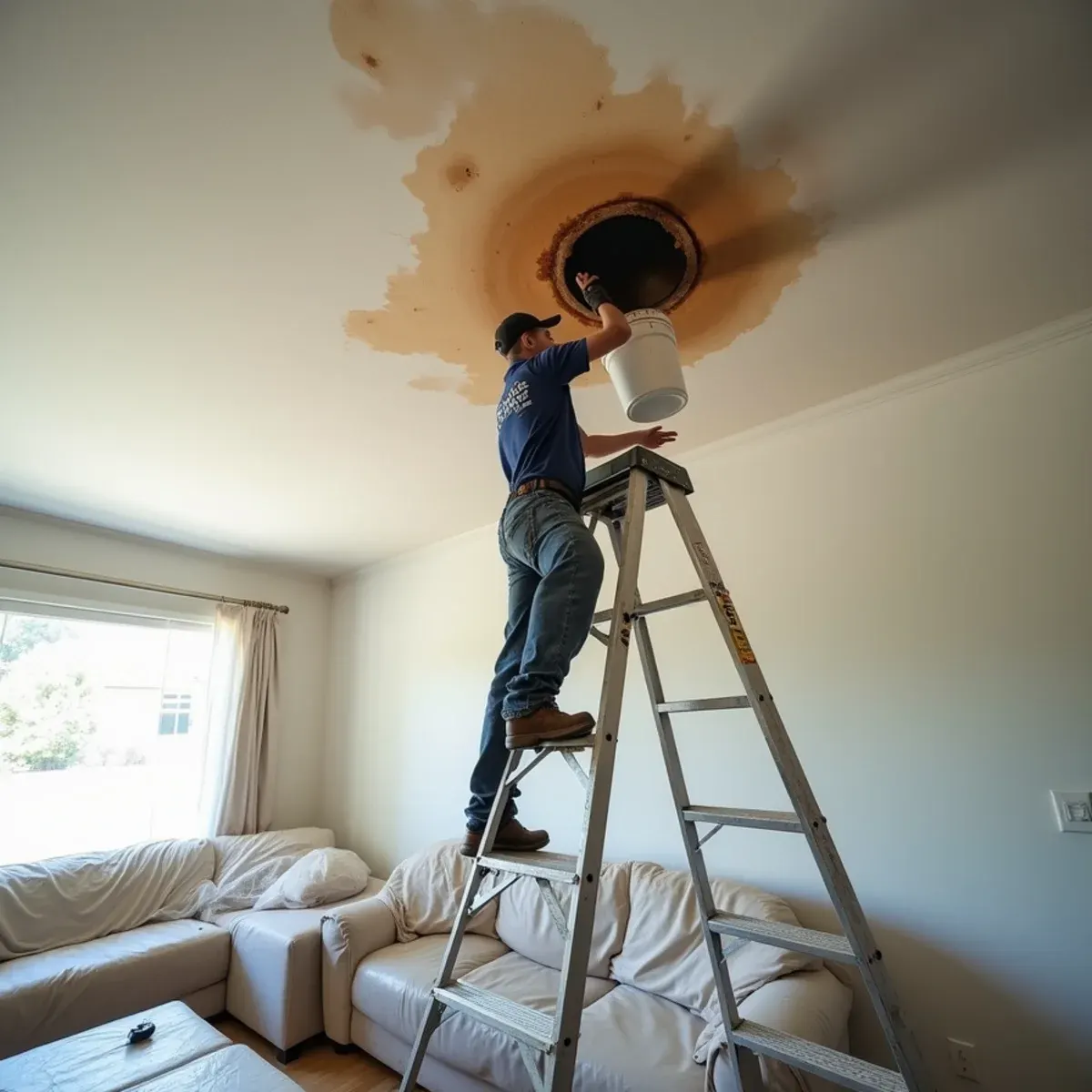
You are standing in your kitchen at eleven at night watching water come through the light fixture, and the problem is not in your apartment. In the stacked buildings that make up most of this city, your ceiling is your upstairs neighbor's floor, and the leak may be one or two units above that. Water follows the plumbing chase down through the building, and it picks up another unit for roughly every extra hour nobody stops it. In under a square mile with some of the highest density in Los Angeles County, that adds up quickly.
The other complication here is authority. Most residents rent, which means the person who can see the damage usually cannot approve the work, and the person who can approve it is asleep across town. That is not a reason to wait until morning. There is a specific short list of things a tenant can do tonight that materially changes the outcome, and doing them creates the written record that protects your belongings later. We are used to arriving on a manager's authorization at odd hours in these buildings and working around residents who are still living there.
What Hawaiian Gardens Changes About Ceiling & Roof Leaks
1Renters can document, not authorize
If you rent, you cannot commission repairs to someone else's building, but you can protect yourself. Notify management in writing, not just by phone, and note the time. Photograph the ceiling, the floor and your belongings before you move anything. Move what you can out from underneath. Your possessions are yours to claim regardless of what the building's policy covers.
2Plumbing stacks carry water down
These 1960s and 1970s buildings were framed around shared vertical stacks, so the chase behind the walls is an open path from the top of the building to the bottom. A failure up high wets units on the way down that have no plumbing problem of their own. We check the stack line above and below the reporting unit as a matter of course, not just the apartment that called.
3Top-floor units under one roof plane
For the upper units, the other source is the low-slope roof itself, often with one deck spanning the whole building. Ponding and failed penetrations put water into a ceiling that has nothing between it and the roof but a shallow cavity. Top-floor ceilings here go from stained to sagging faster than most people expect, so keep the room below clear.
How the Work Runs
The method is the same one we use on every ceiling & roof leaks job, documented to the IICRC S500:2025 standard. Here it is in short — the full ceiling & roof leak water damage process explains each stage in detail.
- Emergency tarping or temporary dry-in
- Controlled relief of trapped water
- Trace the intrusion to its real source
- Remove wet insulation and compromised drywall
- Dry the attic and the ceiling assembly
- Restore the ceiling completely
The Hawaiian Gardens Background Worth Knowing
In a multi-story apartment building, plumbing runs vertically through shared chases connecting stacked units. When a supply line or drain fails in that chase, water follows it downward through every unit below — and it does not stop politely at unit boundaries.
There is more on the housing stock, drainage and plumbing history of this city on our water damage restoration in Hawaiian Gardens page.
Hawaiian Gardens at a glance
- Dominant construction era
- 1950–1975
- Foundation type
- slab on grade
- Supply piping found here
- galvanized steel, copper, shared vertical stacks
- Drain line materials
- cast iron
- Terrain and water table
- flat, moderate water table
- Most common local failure
- stack failures that travel down through every unit below, expanding by one unit for roughly every extra hour of delay
- Highest-value local prevention
- immediate written notice to management, because in a stacked building the clock does more damage than the water
What It Costs in Hawaiian Gardens
We do not quote a number over the phone before seeing the property — anyone who does is guessing. The variables that actually move the price on a ceiling & roof leaks job are how long the leak has been active, ceiling texture and finish, attic access and insulation type, and they are broken down in full on the ceiling & roof leak water damage page. The assessment and the written estimate are free anywhere in Hawaiian Gardens, day or night, with no obligation.
Ceiling & Roof Leaks Questions from Hawaiian Gardens Homeowners
Get people and belongings out from under it, since a loaded ceiling can let go without warning. Kill the breaker for that room if water is near a light or fan. Text or email management so there is a timestamped written record, and photograph everything before you move it. Then knock on the door above if it is safe to do so, because the fastest way to stop the water is often somebody upstairs turning off a valve. Call us and we can coordinate with your manager from there.
Clear the room and keep everyone out from underneath it, including pets. Move furniture if you can do it from the side. Put a bucket down if you can place it safely without standing under the bulge. Then call us — we relieve it deliberately, which is safer and preserves much more of the ceiling than letting it fail on its own.
We tarp immediately to stop the intrusion and coordinate the roofing repair with a licensed roofer, then handle all the interior restoration ourselves. You get one point of contact and one schedule instead of managing two trades during a storm week.
Photograph and video everything before moving anything, notify your property manager in writing immediately, and move belongings out of the affected area if it is safe to do so. Do not wait for the neighbor upstairs to act — the damage compounds every hour and the written timeline protects you.