
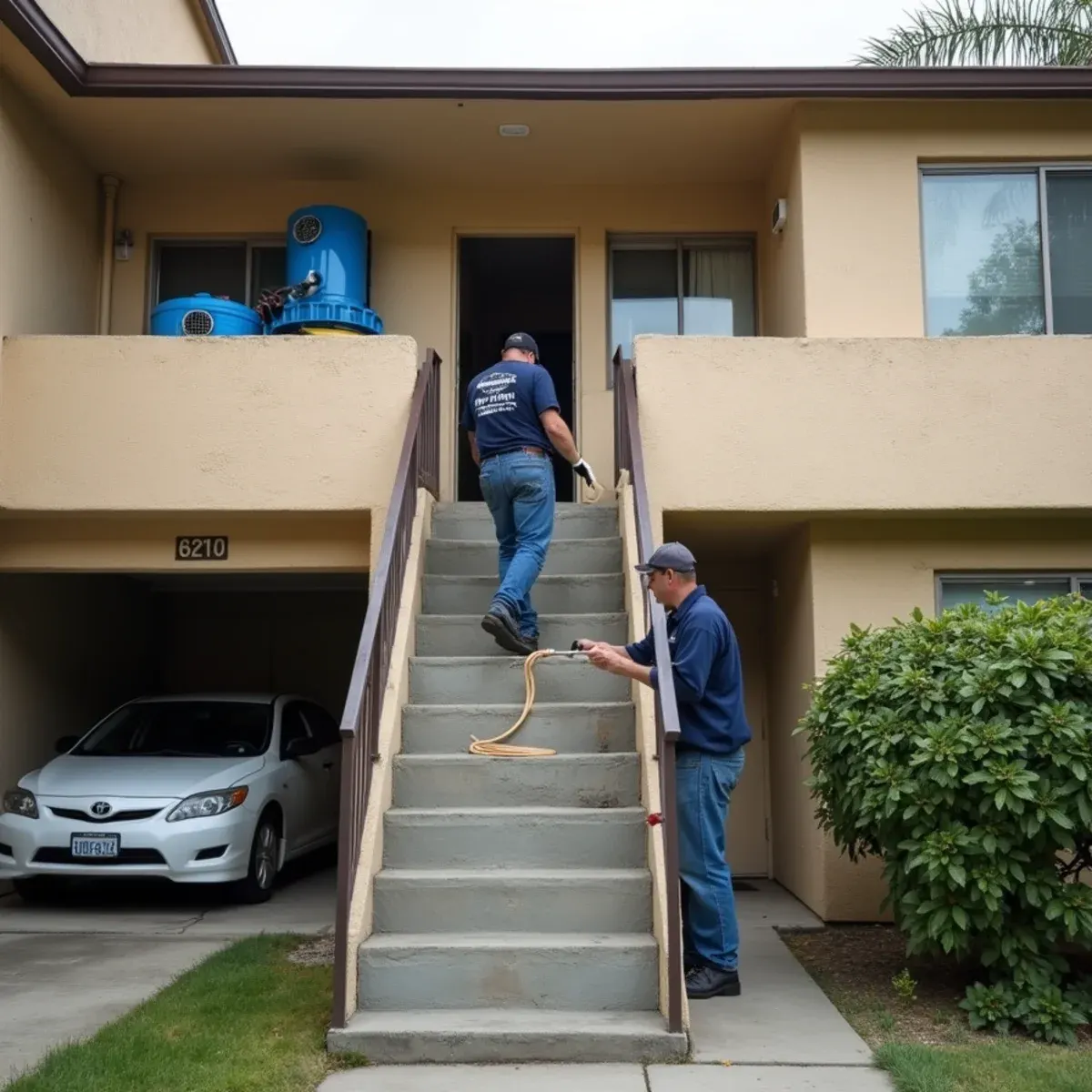
Hawaiian Gardens is the smallest city in Los Angeles County by area — under a square mile — and one of the most densely populated per acre in the region. That density is the defining fact of our work here.
A large share of the housing is apartments and multi-family buildings, much of it from the 1960s and 1970s with shared plumbing stacks and common walls. That means a single supply line failure does not affect one household; it affects a column of them, and it does so quickly.
We are about eight minutes away, which matters in a dense multi-family environment more than almost anywhere else. In a detached house, a thirty-minute difference in response time is measured in square footage of wet drywall. In a stacked apartment building, it is measured in how many additional units the water reached.
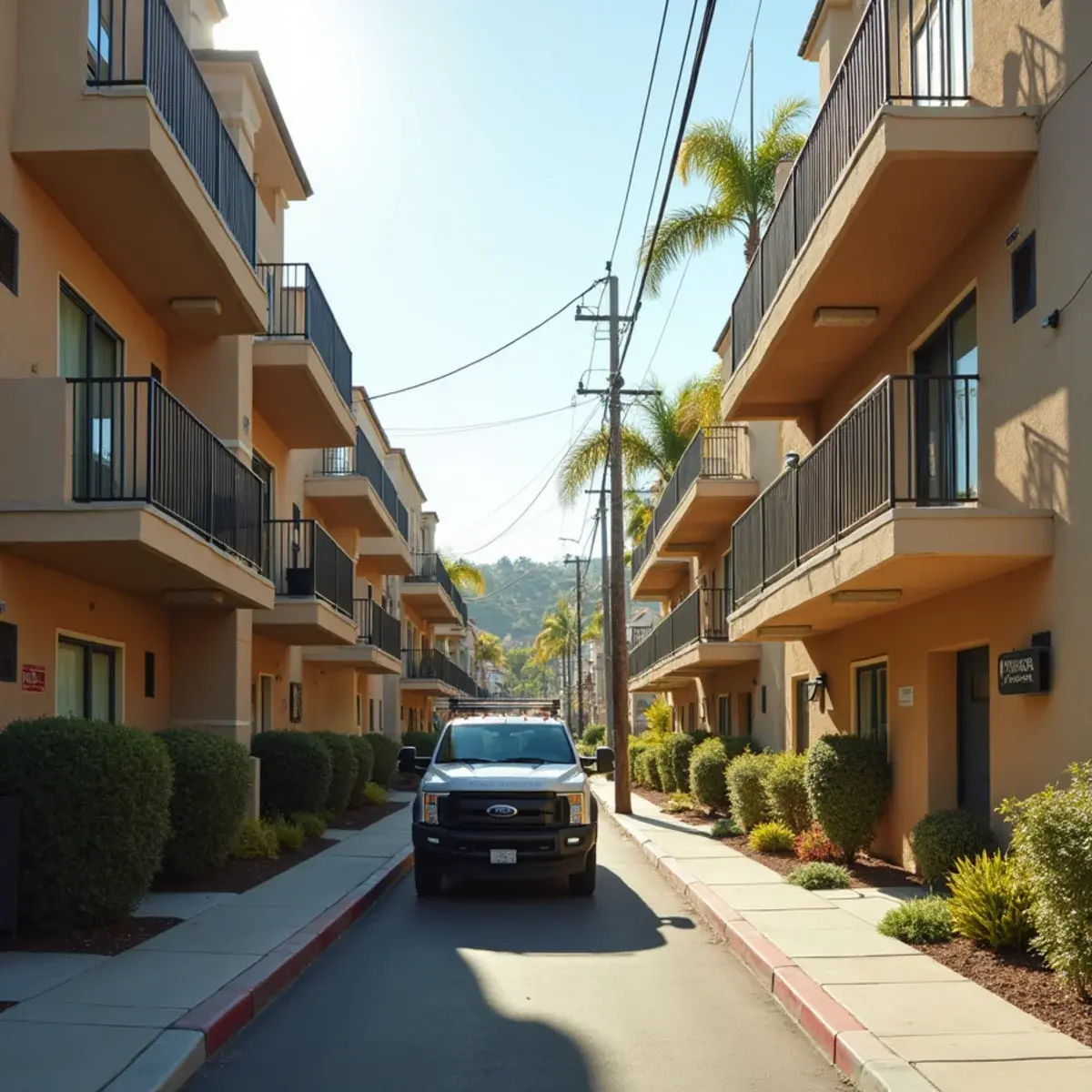
How Water Moves Through a Stacked Building
In a multi-story apartment building, plumbing runs vertically through shared chases connecting stacked units. When a supply line or drain fails in that chase, water follows it downward through every unit below — and it does not stop politely at unit boundaries.
That produces two practical consequences. First, the tenant who notices the problem is frequently not the tenant who has it. Water appearing in a first-floor ceiling regularly originates two or three floors up, and finding the actual source means working up the stack with moisture meters rather than assuming the wettest unit is the origin.
Second, the affected area expands with every minute of delay. A failure caught in fifteen minutes might affect two units. The same failure caught in two hours routinely affects five or six, along with the common corridor. This is why we do not treat a multi-family call as a lower priority than a single-family one — the clock is doing considerably more damage.
Renters: What to Do and What You Are Entitled To
Most of the people we help in Hawaiian Gardens are renters, and renters get worse outcomes from water damage than owners do — not because of the damage itself but because of uncertainty about the process.
The immediate steps: photograph and video everything before you move anything, notify your property manager in writing the same day even if you also call, move belongings out of the affected area if you can do so safely, and keep a copy of every message. That written timeline is what protects you later.
On responsibility: the building's structure is generally the owner's problem and your personal belongings are generally yours, which is what renters insurance is for — it is typically inexpensive and it is the difference between replacing your things and absorbing the loss. If a unit becomes genuinely uninhabitable, California habitability law is on your side, and a documented written timeline is what makes that argument work. Landlords and managers: getting a crew out fast is the cheapest thing you can do here. A two-hour delay in a stacked building routinely doubles the scope.
Neighborhoods and Landmarks We Cover in Hawaiian Gardens
We work throughout Hawaiian Gardens — every neighborhood, every street, residential and commercial. If your address is in the city, we cover it.
Neighborhoods & corridors
- Carson Street area
- Norwalk Boulevard corridor
- Pioneer Boulevard area
- 226th Street area
Landmarks nearby
- The Gardens Casino
- Lee Ware Park
- C. Robert Lee Activity Center
- Carson Street corridor
- Norwalk Boulevard
Why Hawaiian Gardens Residents Call Us First
Any restoration company can put Hawaiian Gardens on a service-area list. What matters at 2 a.m. is how far the truck has to come and whether the crew has opened a wall in a house like yours before.
About 8 minutes west
We dispatch from 6122-6182 Katella Ave in Cypress — not from a regional depot and not from a call centre that sells your job to whoever bids for it. That is the whole reason the 60-minute commitment is one we can put in writing.
Stack failures travel straight down
In a stacked building the loss expands by roughly one unit per hour of delay. The clock does more damage than the water.
Eight minutes west
On a shared-stack loss that response time is the difference between two affected units and five.
- 20+ years restoring Orange County homes
- IICRC Certified Firm
- Licensed, Bonded & Insured
- We bill your insurance company directly
- IICRC S500:2025 compliant on every job
- 100% satisfaction guarantee — in writing, on every job
Hawaiian Gardens Water Damage Questions
Photograph and video everything before moving anything, notify your property manager in writing immediately, and move belongings out of the affected area if it is safe to do so. Do not wait for the neighbor upstairs to act — the damage compounds every hour and the written timeline protects you.
Generally the building structure is the owner's responsibility and your personal belongings are yours, which is what renters insurance covers. Specifics depend on the lease and the cause. Thorough same-day documentation is what keeps that from becoming a dispute, and we document each unit as its own file for exactly that reason.
Usually fifteen to twenty minutes — it is about eight minutes of driving from our Cypress base. In a dense multi-family environment that speed matters more than anywhere, because every additional hour means additional units affected.
Call your building manager to shut the stack down and call us in the same minute. In a stacked building the loss expands by roughly one unit for every extra hour, so the delay does more damage than the original failure. Move what you can out from under it, photograph everything before you touch anything, and do not puncture a bulging ceiling yourself — that section is holding water and it can come down all at once.