
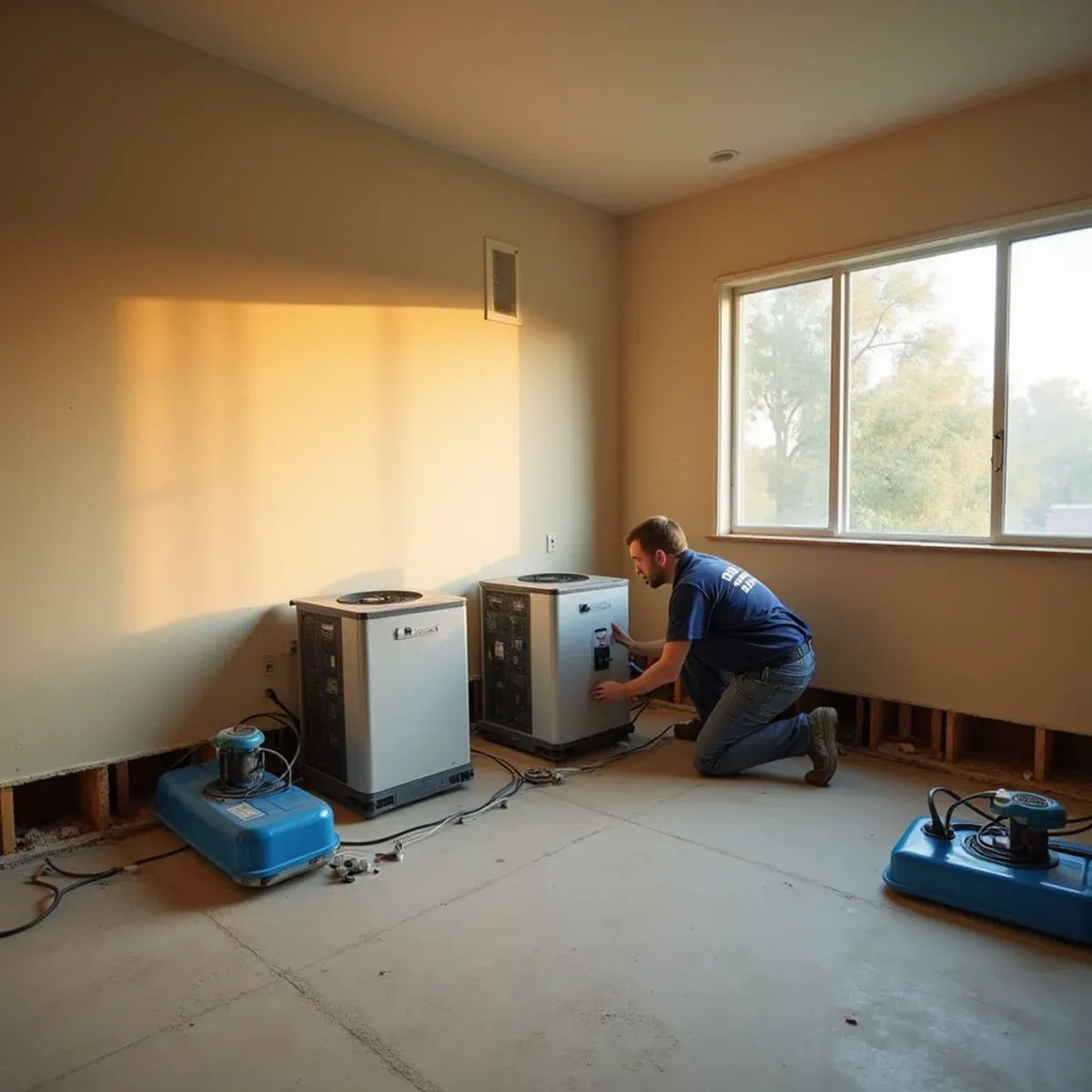
You're on the ground floor, your ceiling is dripping, and the leak isn't yours. That's the ordinary Hawaiian Gardens loss. This is the smallest city in Los Angeles County by area and one of the most densely populated per acre, with a large share of 1960s and 70s apartments built around shared vertical plumbing stacks. Water follows the chase straight down, and by the time the tenant who notices makes a call, the units in between are already wet. Every extra hour tends to add another unit to the drying job.
Most people here rent, which means the person standing in the water usually isn't the person who can authorize anything. We start with what can be started: stop the spread, get equipment into whatever units we can access, and document each one on its own. Separate moisture maps, separate photos, separate daily logs. When four wet units belong to one owner but four different renters' contents policies, that documentation is the only thing keeping the claim from becoming an argument. Older panels here also cap how much equipment a single unit can run.
What Hawaiian Gardens Changes About Structural Drying
1Water follows the stack, not the floor plan
In a building organized around a shared vertical stack, the wet path is the chase, and every unit it passes has a wet wall whether or not anyone has noticed yet. We meter the chase wall on each floor from the failure downward, including units that look completely fine. The unit reporting the problem is frequently the last one in the chain, not the first.
2One drying log per unit, from hour one
Each affected unit gets its own readings, photos and record of what equipment ran and when. Weeks later, when the owner's policy and several renters' policies are being sorted out, that per-unit record establishes which structure was actually wet. Combining everything into one building-wide report saves us time and costs residents money, so we don't do it.
3Written notice to management starts the clock
As a tenant, your text or email to the office is the timestamp that matters, and in a stacked building delay does more damage than the water itself. Send it in writing, note the time, and photograph what you can see. That record helps us and helps you, particularly if access to the units above yours takes longer than it should.
How the Work Runs
The method is the same one we use on every structural drying job, documented to the IICRC S500:2025 standard. Here it is in short — the full structural drying & dehumidification process explains each stage in detail.
- Establish the dry standard
- Calculate the load and build the chamber
- Place air movers for surface evaporation
- Run LGR dehumidification to capture the moisture
- Monitor and adjust daily
- Verify, document, and demobilize
The Hawaiian Gardens Background Worth Knowing
In a multi-story apartment building, plumbing runs vertically through shared chases connecting stacked units. When a supply line or drain fails in that chase, water follows it downward through every unit below — and it does not stop politely at unit boundaries.
There is more on the housing stock, drainage and plumbing history of this city on our water damage restoration in Hawaiian Gardens page.
Hawaiian Gardens at a glance
- Dominant construction era
- 1950–1975
- Foundation type
- slab on grade
- Supply piping found here
- galvanized steel, copper, shared vertical stacks
- Drain line materials
- cast iron
- Terrain and water table
- flat, moderate water table
- Most common local failure
- stack failures that travel down through every unit below, expanding by one unit for roughly every extra hour of delay
- Highest-value local prevention
- immediate written notice to management, because in a stacked building the clock does more damage than the water
What It Costs in Hawaiian Gardens
We do not quote a number over the phone before seeing the property — anyone who does is guessing. The variables that actually move the price on a structural drying job are size of the drying chamber, class of water intrusion, material types involved, and they are broken down in full on the structural drying & dehumidification page. The assessment and the written estimate are free anywhere in Hawaiian Gardens, day or night, with no obligation.
Structural Drying Questions from Hawaiian Gardens Homeowners
We can take emergency steps right away to stop the spread and protect your belongings, and we document everything from the moment we arrive. Running equipment inside the building's structure normally needs the owner or management to authorize it, since it's their property. What speeds that up more than anything is written notice from you with a time on it. Give us that and your photos, and we'll work the approval while the loss is still small.
Three to five days covers most residential losses. Saturated hardwood, plaster, or a concrete slab can run seven or more. We will give you an estimated window after the first readings and update you daily — and equipment comes out when the numbers say so, not on a fixed schedule.
We would rather you did not. Drying is a continuous process, and every hour off extends the total run — which usually costs more than the sleep is worth. If noise is genuinely unmanageable we can often reconfigure the chamber or reposition units to reduce it. Talk to us instead of unplugging them.
Photograph and video everything before moving anything, notify your property manager in writing immediately, and move belongings out of the affected area if it is safe to do so. Do not wait for the neighbor upstairs to act — the damage compounds every hour and the written timeline protects you.