
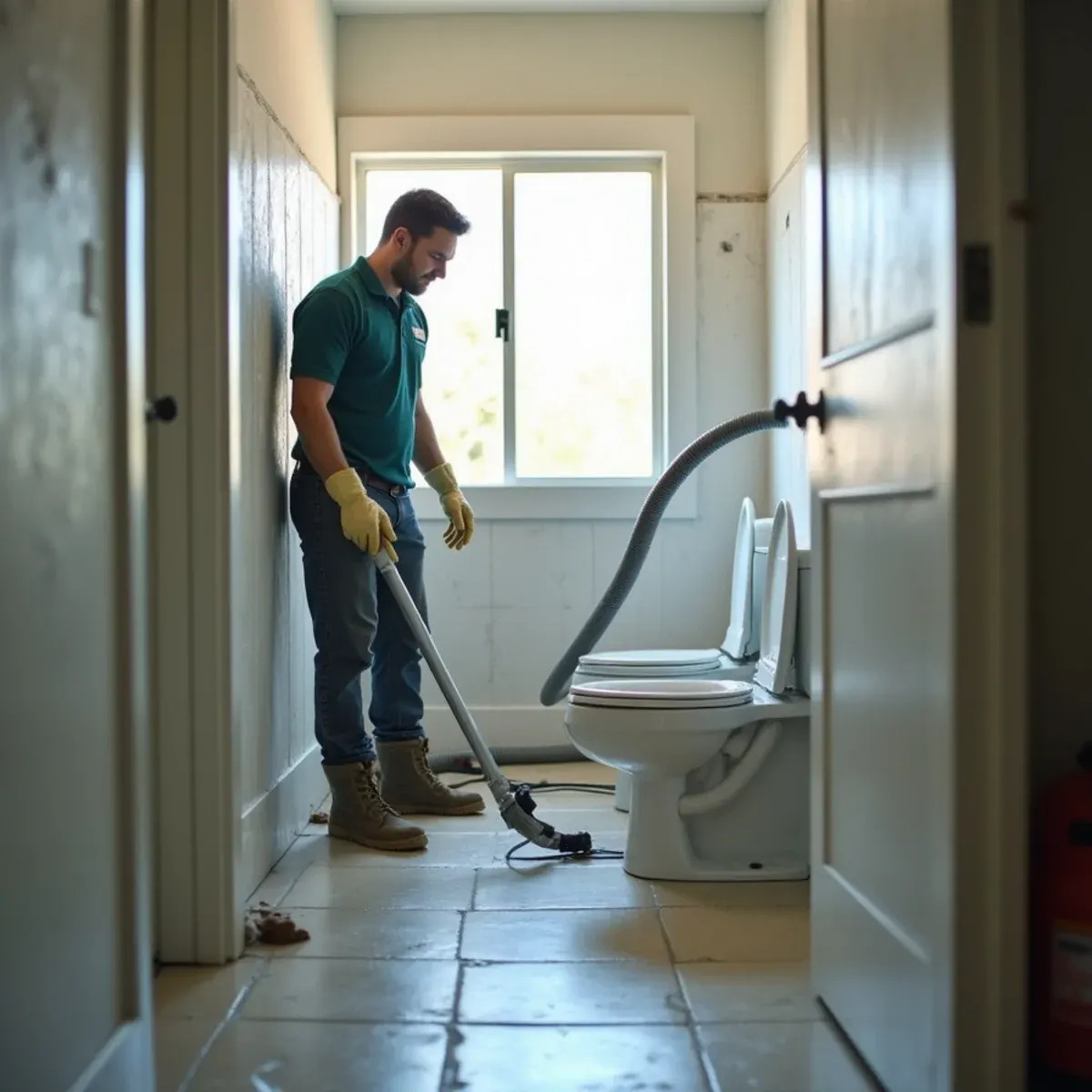
Time is the whole variable here. Hawaiian Gardens is the smallest city in Los Angeles County by area, under a square mile, and among the most densely populated per acre, built out with stacked apartment buildings whose units share vertical plumbing stacks. A toilet overflow on an upper floor does not stay in that unit. It finds the stack penetration or the floor edge and works its way down, and in practice the loss grows by roughly one more unit for every extra hour before somebody shuts the water off and picks up a phone.
Most residents here rent, which adds a step nobody wants in an emergency. The tenant calls the manager, the manager calls the owner, and the owner calls a restoration company. Every handoff is measured in units. If you are the tenant, close the angle stop behind the toilet, get everything off the floor, and tell your manager the water is already going downstairs, because that sentence moves faster than a routine maintenance ticket. We will work directly with whoever holds the building policy once we are on site, and we document each unit as its own loss.
What Hawaiian Gardens Changes About Toilet Overflow
1Shared stacks carry water between units
The apartment buildings here group bathrooms around a common vertical stack, so the penetration through each floor is a ready-made path. Water leaving an upper unit reaches the ceiling below through that opening, then travels the ceiling cavity and drops again. By the third floor down it can be showing up in a unit whose occupants have no idea anything happened above them.
2Renter to manager to owner costs hours
The chain of calls is the single biggest driver of loss size in this city, more than the volume of water. We take calls directly from tenants and will start the assessment while ownership is being reached, because the alternative is waiting through a chain of voicemails while the damage expands. Nothing gets demolished without the right authorization, but extraction and containment can begin.
3Per-unit documentation for a split claim
When one overflow damages four units, the claim splits across the building policy and several renters' policies. Each unit gets its own moisture map, its own dated photos and its own itemized scope from us. That keeps adjusters from arguing over a single combined number, and it keeps a tenant's contents claim from disappearing inside the building's structural claim.
How the Work Runs
The method is the same one we use on every toilet overflow job, documented to the IICRC S500:2025 standard. Here it is in short — the full toilet overflow cleanup process explains each stage in detail.
- Stop the water, stabilize the room
- Determine the category before scoping
- Extract, then remove only what must go
- Pull the toilet, inspect the flange
- Dry the subfloor and the ceiling below
- Disinfect to category, verify, reset
The Hawaiian Gardens Background Worth Knowing
In a multi-story apartment building, plumbing runs vertically through shared chases connecting stacked units. When a supply line or drain fails in that chase, water follows it downward through every unit below — and it does not stop politely at unit boundaries.
There is more on the housing stock, drainage and plumbing history of this city on our water damage restoration in Hawaiian Gardens page.
Hawaiian Gardens at a glance
- Dominant construction era
- 1950–1975
- Foundation type
- slab on grade
- Supply piping found here
- galvanized steel, copper, shared vertical stacks
- Drain line materials
- cast iron
- Terrain and water table
- flat, moderate water table
- Most common local failure
- stack failures that travel down through every unit below, expanding by one unit for roughly every extra hour of delay
- Highest-value local prevention
- immediate written notice to management, because in a stacked building the clock does more damage than the water
What It Costs in Hawaiian Gardens
We do not quote a number over the phone before seeing the property — anyone who does is guessing. The variables that actually move the price on a toilet overflow job are the category of the water, how far it traveled from the base, what your floor is built from, and they are broken down in full on the toilet overflow cleanup page. The assessment and the written estimate are free anywhere in Hawaiian Gardens, day or night, with no obligation.
Toilet Overflow Questions from Hawaiian Gardens Homeowners
Call us. In Hawaiian Gardens' stacked buildings, the units below you are getting wet while a maintenance request sits in a queue, so the useful move is to shut the angle stop behind the toilet, notify your manager, and get us rolling at the same time. We will not tear anything out without the owner's authorization, but we can extract standing water, set containment and document your contents, which protects your claim regardless of who ends up paying for the structure.
Clear water lowers the health risk, not the drying requirement. Clean water still soaks into carpet pad, particle board, and the cut edge of subfloor around the flange, and it still causes swelling and mold growth if it stays. What clean water does change is the scope: no containment, no PPE, usually no demolition. If it stayed on sealed tile and you got it up quickly, you may genuinely be fine. If it reached anything porous, it needs real drying.
Three checks. Did the water rise in the bowl without anyone flushing it? Does another fixture gurgle, drain slowly, or fill up when you run water elsewhere in the house? Is there visible soil or a sewer odor in what came out? Any one of those points at the main line. A stuck fill valve, by contrast, gives you clear water, a bowl that overflows steadily, and a tank you can hear running continuously.
Photograph and video everything before moving anything, notify your property manager in writing immediately, and move belongings out of the affected area if it is safe to do so. Do not wait for the neighbor upstairs to act — the damage compounds every hour and the written timeline protects you.