
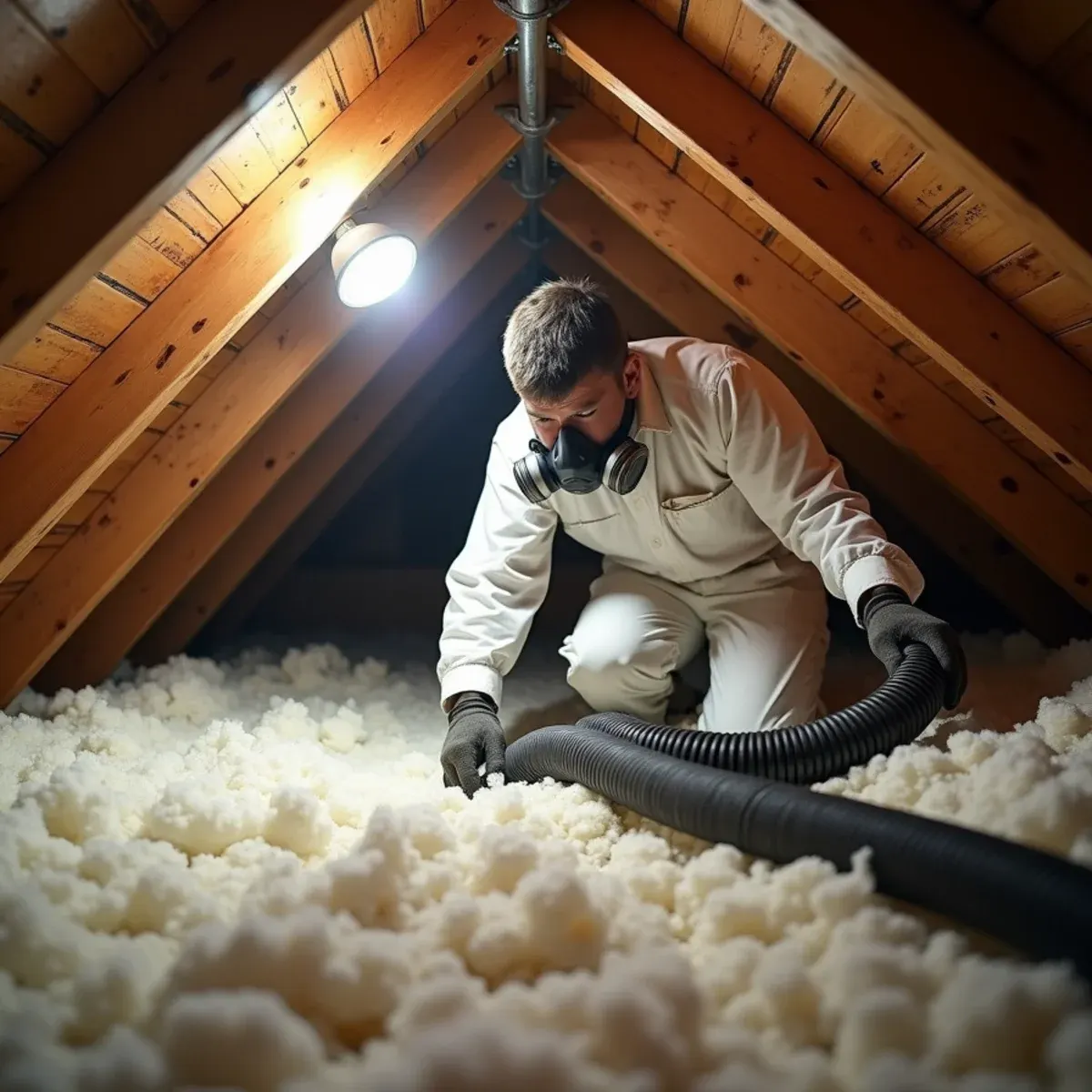
Ask two Tustin homeowners to describe their attic and you will get two unrelated answers. In Old Town, the 1880s-to-1920s houses have steep rafter attics over raised foundations, board sheathing underfoot and insulation added long after the fact, usually unevenly and usually by hand. Through the middle of the city, 1960s-to-1980s slab tract puts a furnace or air handler up in the attic with a primary pan, a secondary pan if the installer was thorough, and a condensate line that has been dripping into fiberglass since the last time anybody opened the hatch.
Then there is Tustin Legacy, built on the former Marine Corps Air Station after 2005. Those attics are the opposite problem. Deep blown-in at modern R-value, radiant-barrier decking, tight air sealing and an air handler on a framed platform. Deep insulation holds far more water than the thin 1970s layer three miles west, and the tighter the assembly, the less it dries on its own. When a pan overflows in a Legacy house we are removing more material, not less. We dispatch as fast as conditions allow.
What Tustin Changes About Attic & Insulation
1Legacy attics hold more water
Post-2005 Tustin homes carry blown-in deep enough that a pan overflow saturates a thick column of material rather than a thin mat. It weighs more, it holds longer, and radiant-barrier decking plus tighter air sealing means the attic does not shed that moisture by itself. Expect a larger removal volume and a longer dry-down than the same square footage in an older tract.
2Old Town rafters give no plane
The Victorians and Craftsman houses in Old Town have steep rafter attics with no flat working floor, narrow hatches and original board sheathing that shows daylight at the seams. Removal there is hand and hose work, not a straight vacuum job, and every step has to land on framing. Slower, quieter, and much easier on the plaster below.
31970s retrofit A/C and pan overflows
The tract belt through the middle of Tustin took attic-mounted cooling on houses framed before that was standard. Secondary pans are shallow, float switches are often missing or bypassed, and the condensate line runs a long way to daylight. When it plugs, the overflow lands directly in the insulation under the platform, and the ceiling below tells you weeks later.
How the Work Runs
The method is the same one we use on every attic & insulation job, documented to the IICRC S500:2025 standard. Here it is in short — the full attic water damage & insulation replacement process explains each stage in detail.
- Map the wet area before touching it
- Contain the hatch and protect the path
- Vacuum out the saturated insulation
- HEPA vacuum and treat the plane
- Dry the deck, joists, and top plates
- Reinstall insulation and check the details
The Tustin Background Worth Knowing
You can usually place your house without paperwork. Foundation vents around the perimeter and a floor that sits a step or two above grade means a raised foundation and a crawl space, which puts you in the Old Town generation. A slab sitting flush at grade with no vents puts you in the tract era. If you have a second-floor laundry, a tankless heater, or a manifold of colored plastic tubing in a closet, you are in the Legacy generation. Each of those buildings has an entirely different weak point, and knowing yours is most of the battle.
There is more on the housing stock, drainage and plumbing history of this city on our water damage restoration in Tustin page.
Tustin at a glance
- Dominant construction era
- 1880–2020
- Foundation type
- mixed on grade
- Supply piping found here
- original pre-war piping in Old Town, under-slab copper, modern PEX in Tustin Legacy
- Drain line materials
- cast iron, clay, ABS
- Terrain and water table
- flat, moderate water table
- Most common local failure
- wildly different failure modes street to street, because the era of the house decides everything
- Highest-value local prevention
- knowing which of the three Tustins your house belongs to before assuming any advice applies
What It Costs in Tustin
We do not quote a number over the phone before seeing the property — anyone who does is guessing. The variables that actually move the price on a attic & insulation job are how much of the attic got wet, clearance, access, and layout, the type of insulation up there, and they are broken down in full on the attic water damage & insulation replacement page. The assessment and the written estimate are free anywhere in Tustin, day or night, with no obligation.
Attic & Insulation Questions from Tustin Homeowners
That is the goal, and it matters more here than in an older tract because the house was designed around that insulation depth. We record what is in your attic before removal, note the type and measured depth, and reinstall to the same value with eave baffles kept clear so the venting still works. Documenting the original depth up front is also what keeps the conversation with your adjuster short when the invoice arrives.
Only the affected area plus a margin back to dry, lofted material. If the wet section covers a small part of the attic, that is all that comes out. Once it reaches roughly half the plane, replacing the whole field usually costs less than blending old and new to an even depth, and it leaves you with one consistent R-value instead of a patchwork ceiling that performs unevenly room to room.
Most attics take a few days once the wet insulation is out, but we will not promise a number on day one, and you should be careful with anyone who does. Plywood sheathing dries at a different rate than old plank decking, a sealed attic dries faster than a heavily vented one, and marine-layer mornings slow everything down. The daily readings decide when equipment leaves, not the calendar.
New plumbing removes corrosion from the list, not everything else. What fails in Legacy-era homes is connections and appliances: braided washer hoses, refrigerator ice-maker lines, angle stops, dishwasher fittings, and water heaters that are now well into their service life. Second-floor laundry rooms are the biggest single change from older Tustin housing, because a failure up there drains through two ceilings instead of across a garage slab. Age protects you from one category of failure and none of the others.