
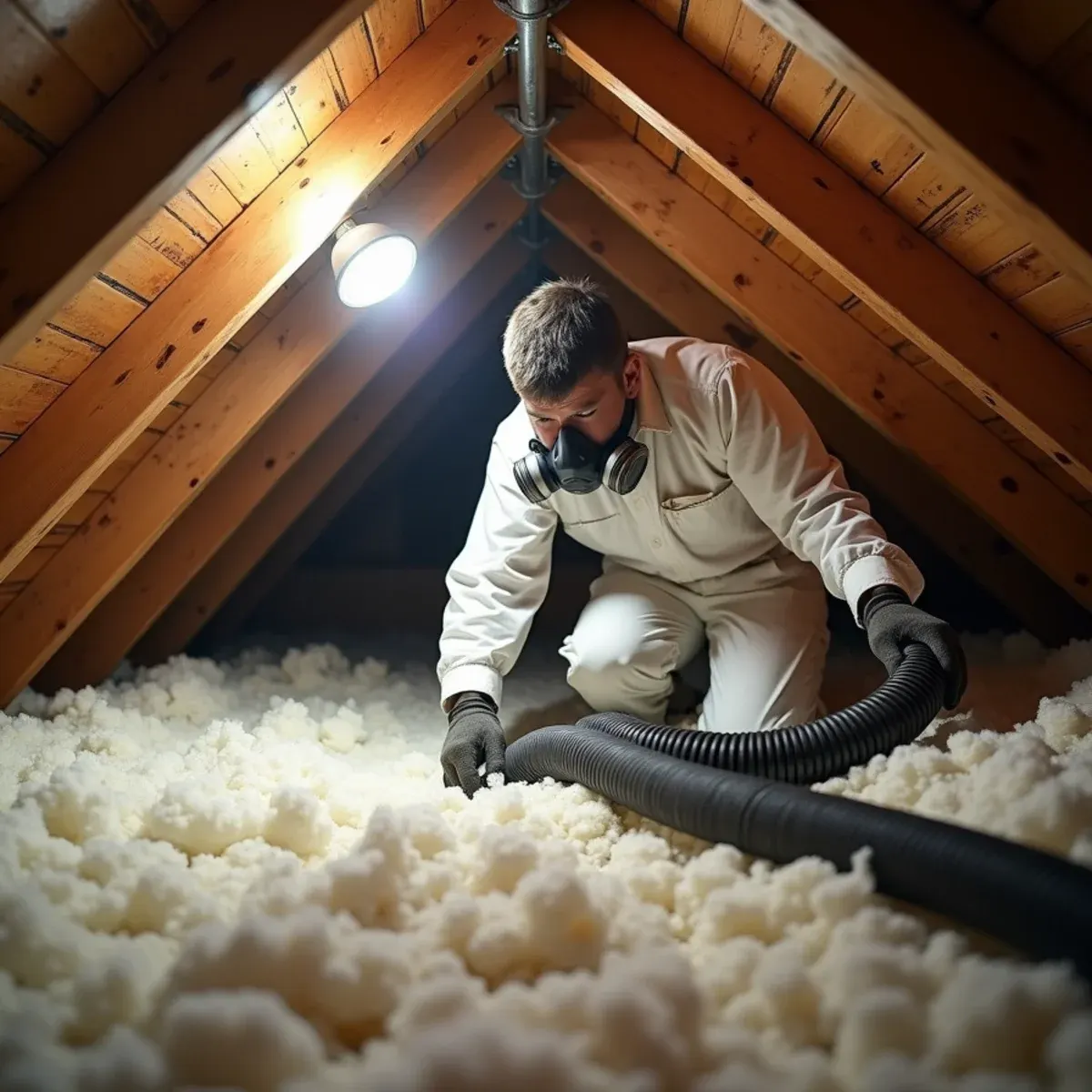
Before we pull anything in Costa Mesa, we check whether there is a leak at all. Marine influence here is strong and the water table is shallow, and in the right conditions the underside of a roof deck will sweat overnight, drip onto the insulation below and produce every symptom of a roof failure with a perfectly sound roof above it. Eastside makes that worse. Those 1920s-to-1940s cottages sit on raised foundations under heavy tree canopy, and a shaded roof never gets the afternoon heat that would burn the moisture back off.
The rest of the city splits again. Mesa Verde is 1960s slab tract with attic-mounted equipment and conventional blown-in. The Westside mixes housing with light industrial, so we are as likely to be in a shop ceiling as an attic. Whatever the building, drying takes longer within a few miles of the Santa Ana River mouth than it does inland. Outside air simply is not dry enough to help, and open vents with a couple of box fans will stall out. Contained drying with dehumidification is the only thing that actually finishes here.
What Costa Mesa Changes About Attic & Insulation
1Marine air won't dry an attic
The standard advice to open everything up and let it breathe assumes dry outside air. On a coastal morning in Costa Mesa there is no such thing. Pushing humid air across a wet roof deck moves moisture around without removing it, and the fibers stay damp for weeks. We contain the attic and run dehumidification, then verify with meter readings rather than by touch, because touch lies in this climate.
2Blocked eave baffles cause repeat condensation
A lot of Costa Mesa condensation problems started when somebody blew insulation into the eaves and choked off intake ventilation. Without airflow at the eave, the deck sweats every cool night and the insulation below never gets a chance. When we reinstall, baffles go back in clear and stay clear, because getting the R-value right and the venting wrong just puts you back here next winter.
3Eastside cottages: shallow attics, deep shade
The small Eastside cottages have low-pitch attics with very little clearance and heavy tree canopy overhead. Between the shade, the marine layer and a raised foundation adding moisture from below, those houses hold damp on both sides of the living space. We often check the crawl space the same visit, because treating the attic while the subfloor feeds humidity upward is half a job.
How the Work Runs
The method is the same one we use on every attic & insulation job, documented to the IICRC S500:2025 standard. Here it is in short — the full attic water damage & insulation replacement process explains each stage in detail.
- Map the wet area before touching it
- Contain the hatch and protect the path
- Vacuum out the saturated insulation
- HEPA vacuum and treat the plane
- Dry the deck, joists, and top plates
- Reinstall insulation and check the details
The Costa Mesa Background Worth Knowing
Under a raised Eastside cottage there is bare soil, and that soil is supposed to stay dry because the foundation vents exchange air with the outside. That system depends on the outside air being drier than the space under the house. For a good part of the year in Costa Mesa it is not. The marine layer holds humidity high through the night and well into the morning, so the crawl space never gets the dry stretch it needs, and moisture that arrives from a plumbing drip, a downspout, or an irrigation line just accumulates.
There is more on the housing stock, drainage and plumbing history of this city on our water damage restoration in Costa Mesa page.
Costa Mesa at a glance
- Dominant construction era
- 1920–1980
- Foundation type
- mixed on grade
- Supply piping found here
- original 1920s–1940s piping on the Eastside, galvanized steel, under-slab copper
- Drain line materials
- cast iron, clay
- Terrain and water table
- coastal-flat, shallow water table
- Most common local failure
- crawl-space moisture under Eastside cottages, held in by a marine layer that slows every natural drying process
- Highest-value local prevention
- confirming crawl-space vents are actually open and that the ground under the house is dry
What It Costs in Costa Mesa
We do not quote a number over the phone before seeing the property — anyone who does is guessing. The variables that actually move the price on a attic & insulation job are how much of the attic got wet, clearance, access, and layout, the type of insulation up there, and they are broken down in full on the attic water damage & insulation replacement page. The assessment and the written estimate are free anywhere in Costa Mesa, day or night, with no obligation.
Attic & Insulation Questions from Costa Mesa Homeowners
Maybe not. That pattern, damp high near the ridge with nothing showing below, is classic condensation on the underside of the deck rather than water coming through it. Near the coast the deck cools overnight, moisture condenses on it and drips into the insulation directly beneath. We check the deck, the vent intake at the eaves and the moisture readings before recommending any roof work. If it is condensation, the answer is ventilation and drying, not a new roof.
Only the affected area plus a margin back to dry, lofted material. If the wet section covers a small part of the attic, that is all that comes out. Once it reaches roughly half the plane, replacing the whole field usually costs less than blending old and new to an even depth, and it leaves you with one consistent R-value instead of a patchwork ceiling that performs unevenly room to room.
Most attics take a few days once the wet insulation is out, but we will not promise a number on day one, and you should be careful with anyone who does. Plywood sheathing dries at a different rate than old plank decking, a sealed attic dries faster than a heavily vented one, and marine-layer mornings slow everything down. The daily readings decide when equipment leaves, not the calendar.
Almost always the crawl space. On these raised 1920s to 1940s houses the soil under the floor stays damp when the foundation vents are blocked and the marine layer keeps outside air humid overnight. That moisture moves up through the subfloor and into the rooms above it. Before assuming anything, walk your perimeter and see whether a planter, a poured patio or landscaping has covered the vents that are supposed to be breathing.