
The most useful thing you can tell us about a Tustin house is the year it went up. A bungalow near Old Town has a raised floor, original drain lines and a hundred years of repairs layered on top. A 1970s house off Newport Avenue sits on slab with copper buried in it. A Columbus Square or Tustin Legacy home has PEX, modern drainage and a slab poured within the last twenty years. Same city, same storm, three completely different ways for water to get in and hide.
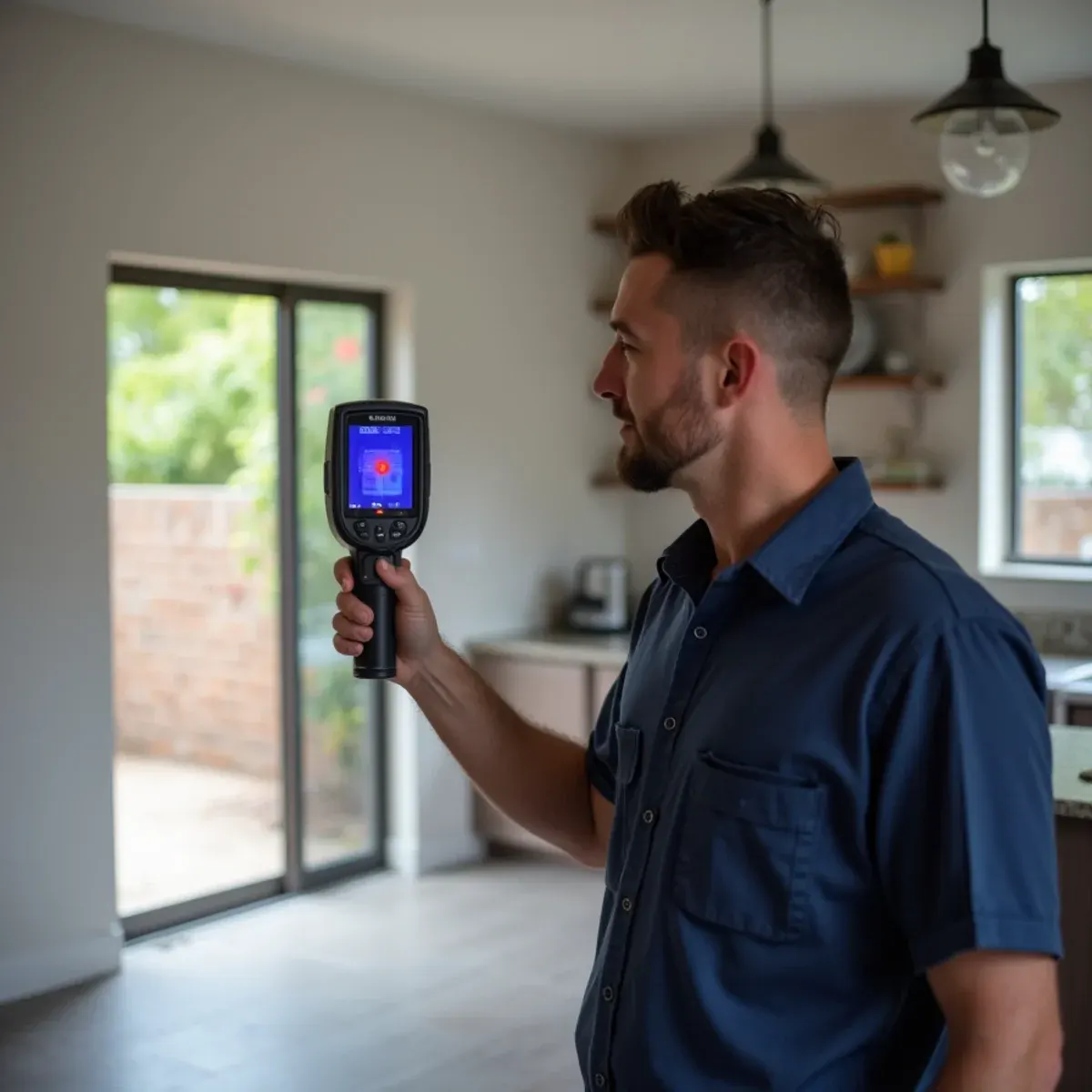
So the inspection changes accordingly. In Old Town we work from the crawl space up. In the midcentury tracts we run a thermal sweep of the floor slab and an isolation test at the meter to see whether anything is losing pressure while the house sits still. In Legacy, leaks are rarely the piping — they're fittings, water heater pans, second-floor laundry stacks and stucco penetrations, which need different attention entirely. Either way you get written findings, and we tell you plainly when we find nothing.
What Tustin Changes About Inspection & Leak Detection
1Old Town's raised floors read differently
A pre-war Tustin house lets water disappear into the crawl space instead of showing on a finish. We take readings under the floor and along the mudsill, and we look at where later bathrooms and laundry hookups were cut into original framing. Those retrofits are where most of the long-running leaks we find in Old Town actually start.
2Slab-era tracts and the meter test
Between roughly 1960 and 1985, Tustin built out on slab with copper below it. Those lines are now at the age where pinholes start. The isolation test is simple: shut the house down, watch the meter, then isolate the supply side to see whether the loss sits under the slab or past a fixture. It takes time to do honestly, and we take it.
3Newer Legacy homes fail at fittings
Post-2005 construction around Columbus Grove and The District doesn't usually fail at the pipe. It fails at a connection — an upstairs laundry box, a fridge line, a shower pan, a water heater in an interior closet. Thermal imaging finds those fast, because the wet path runs down through framing in a pattern we can read from the wall face.
How the Work Runs
The method is the same one we use on every inspection & leak detection job, documented to the IICRC S500:2025 standard. Here it is in short — the full water damage inspection & leak detection process explains each stage in detail.
- Talk through the history
- Thermal imaging survey
- Confirm with moisture meters
- Supply-side isolation testing
- Written findings with images
- Options, not a sales pitch
The Tustin Background Worth Knowing
You can usually place your house without paperwork. Foundation vents around the perimeter and a floor that sits a step or two above grade means a raised foundation and a crawl space, which puts you in the Old Town generation. A slab sitting flush at grade with no vents puts you in the tract era. If you have a second-floor laundry, a tankless heater, or a manifold of colored plastic tubing in a closet, you are in the Legacy generation. Each of those buildings has an entirely different weak point, and knowing yours is most of the battle.
There is more on the housing stock, drainage and plumbing history of this city on our water damage restoration in Tustin page.
Tustin at a glance
- Dominant construction era
- 1880–2020
- Foundation type
- mixed on grade
- Supply piping found here
- original pre-war piping in Old Town, under-slab copper, modern PEX in Tustin Legacy
- Drain line materials
- cast iron, clay, ABS
- Terrain and water table
- flat, moderate water table
- Most common local failure
- wildly different failure modes street to street, because the era of the house decides everything
- Highest-value local prevention
- knowing which of the three Tustins your house belongs to before assuming any advice applies
What It Costs in Tustin
We do not quote a number over the phone before seeing the property — anyone who does is guessing. The variables that actually move the price on a inspection & leak detection job are standard moisture inspection — no charge, electronic slab leak location, pre-purchase moisture survey, and they are broken down in full on the water damage inspection & leak detection page. The assessment and the written estimate are free anywhere in Tustin, day or night, with no obligation.
Inspection & Leak Detection Questions from Tustin Homeowners
Often, yes. Newer construction fails at connections rather than at pipe, and a slow fitting leak behind a laundry wall or under a second-floor shower can run quietly for a year without ever touching the slab. We scan the wet walls, the water heater closet, and the ceiling below every upstairs fixture, then hand you written findings. If everything reads dry, you've spent nothing and you know it. That's a reasonable outcome for a free survey.
The standard moisture inspection is — thermal imaging, moisture mapping, and written findings, with no obligation. Specialized services like electronic slab leak location, a full pre-purchase survey, or lab sampling carry a fee, and we tell you the number before we start.
Twenty to forty minutes for a targeted check of a specific concern. A comprehensive whole-home survey for a real estate transaction runs about ninety minutes to two hours.
New plumbing removes corrosion from the list, not everything else. What fails in Legacy-era homes is connections and appliances: braided washer hoses, refrigerator ice-maker lines, angle stops, dishwasher fittings, and water heaters that are now well into their service life. Second-floor laundry rooms are the biggest single change from older Tustin housing, because a failure up there drains through two ceilings instead of across a garage slab. Age protects you from one category of failure and none of the others.