
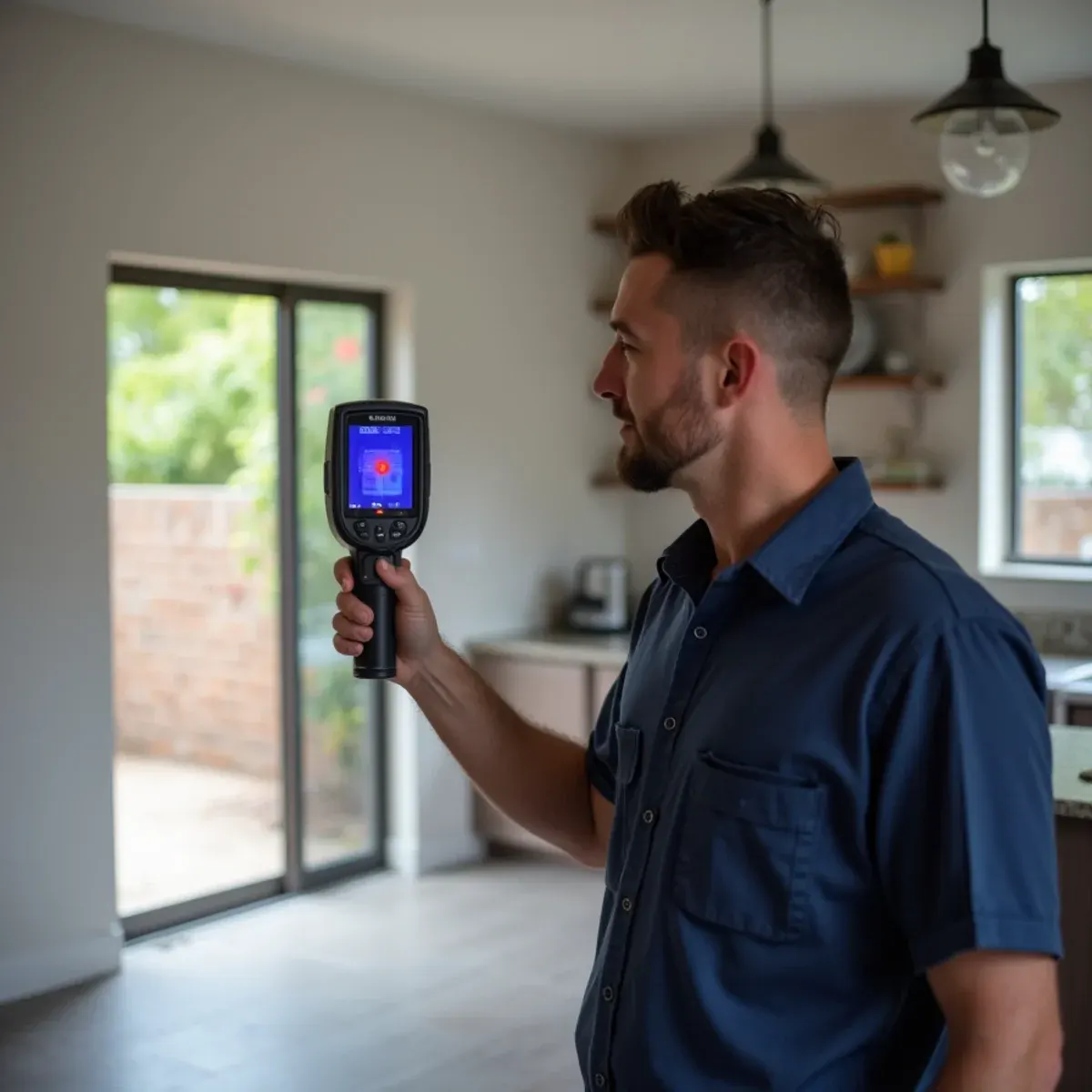
A leak under a raised-foundation house in Old Towne doesn't announce itself. There's no puddle on the floor, no stain on a ceiling. The water drips into the dirt beneath the joists and stays there, and the first sign is usually a musty smell in a back bedroom or a floorboard that gives slightly underfoot. By then it's been running for weeks. That's why our inspection in the square mile radiating out from the Plaza starts under the house, not inside it — with a light, a moisture meter, and a look at the subfloor from below.
Outside the historic district, Orange is a different building. The postwar tracts through El Modena and out toward Santiago Hills sit on slab with copper running under the concrete, and there the inspection is a thermal scan of the floor plus a supply-side isolation test at the meter. Orange Park Acres adds its own wrinkle: half-acre equestrian lots with heavy irrigation that has to come off the meter before any pressure test tells the truth. Serrano Heights is newer still. We ask what you own before we decide how to look at it.
What Orange Changes About Inspection & Leak Detection
1Crawl spaces hide leaks for weeks
Under a raised foundation, water has somewhere to go. It soaks into the soil, wicks up the posts and girders, and never reaches a surface you'd notice. We take moisture readings on the subfloor from underneath and thermal-scan the framing rather than guessing from inside. On Old Towne houses we also check where a century of added bathrooms tapped into the original lines.
2Original piping under National Register houses
Much of Old Towne still carries early galvanized supply and a patchwork of later repairs, which behaves differently under an isolation test than a clean copper system does. Pressure drops slowly, and slowly is easy to misread. We hold the test longer on these houses and write down what we actually observed rather than rounding it to a yes or no.
3Pre-purchase surveys on Chapman-area rentals
A lot of Old Towne housing near Chapman University has been rented for decades and converted room by room. Before you buy one, a moisture survey tells you whether the crawl space is dry, whether past leaks were repaired or just painted over, and whether the subfloor has taken damage. We give you written findings you can hand to your agent or your inspector.
How the Work Runs
The method is the same one we use on every inspection & leak detection job, documented to the IICRC S500:2025 standard. Here it is in short — the full water damage inspection & leak detection process explains each stage in detail.
- Talk through the history
- Thermal imaging survey
- Confirm with moisture meters
- Supply-side isolation testing
- Written findings with images
- Options, not a sales pitch
The Orange Background Worth Knowing
A slab leak announces itself eventually because concrete has nowhere to put the water. A crawl-space leak has somewhere to put it. Dirt absorbs a slow drip almost indefinitely, so the loss never produces the one thing homeowners watch for, which is water on a floor. Meanwhile the humidity under the house climbs, the fiberglass insulation between the joists soaks up moisture and sags, the subfloor picks up that moisture from below, and mold begins on the joists where it is invisible and undisturbed. Everything about this failure is built to stay quiet.
There is more on the housing stock, drainage and plumbing history of this city on our water damage restoration in Orange page.
Orange at a glance
- Dominant construction era
- 1888–1975
- Foundation type
- mixed on grade
- Supply piping found here
- original turn-of-century piping, galvanized steel, under-slab copper
- Drain line materials
- cast iron, clay
- Terrain and water table
- flat, moderate water table
- Most common local failure
- crawl-space leaks under raised-foundation historic homes, running for weeks because water drips into the dirt instead of pooling on a floor
- Highest-value local prevention
- an annual crawl-space inspection, which almost nobody does and which catches nearly everything early
What It Costs in Orange
We do not quote a number over the phone before seeing the property — anyone who does is guessing. The variables that actually move the price on a inspection & leak detection job are standard moisture inspection — no charge, electronic slab leak location, pre-purchase moisture survey, and they are broken down in full on the water damage inspection & leak detection page. The assessment and the written estimate are free anywhere in Orange, day or night, with no obligation.
Inspection & Leak Detection Questions from Orange Homeowners
No. Nothing we do to find water requires opening a wall. Thermal imaging reads surface temperature, moisture meters press against the finish, and the crawl-space work happens under the house through the existing access. On lath-and-plaster walls we use a pinless meter so there are no pinholes in original finishes. If findings later point to demolition, we tell you exactly where and why first, and S500 asks for removing the least material that still gets the structure dry.
The standard moisture inspection is — thermal imaging, moisture mapping, and written findings, with no obligation. Specialized services like electronic slab leak location, a full pre-purchase survey, or lab sampling carry a fee, and we tell you the number before we start.
Twenty to forty minutes for a targeted check of a specific concern. A comprehensive whole-home survey for a real estate transaction runs about ninety minutes to two hours.
Pick a dry day, open the hatch, and use a good flashlight. You are looking at the soil directly under the bathrooms, kitchen, and laundry for dark damp patches, at the insulation for sagging or fallen batts, and at the piers and foundation vents for rust or white staining. Trust your nose as much as your eyes. If the access is too tight or you would rather not go under, we will do the inspection and photograph what is down there.