
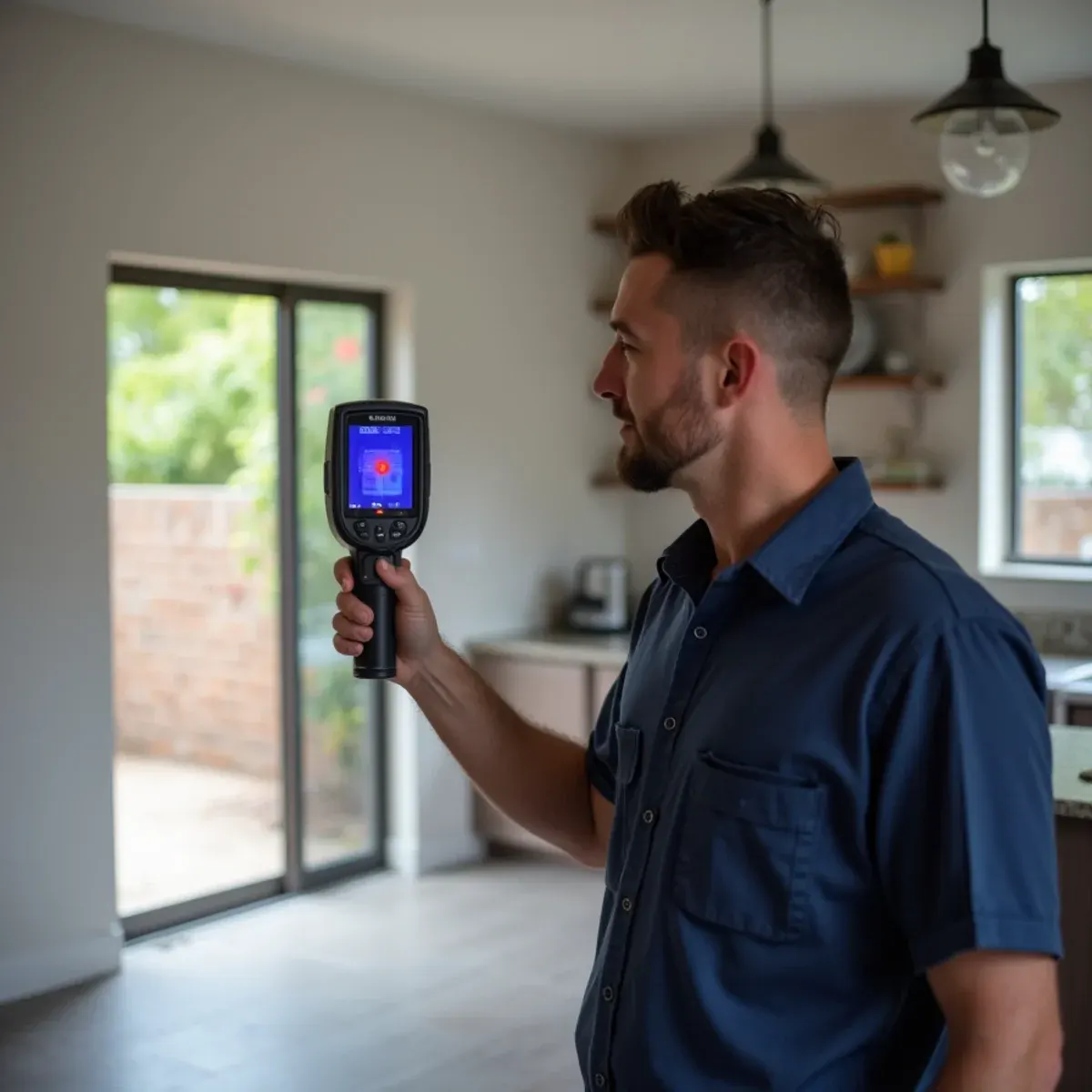
You noticed a damp patch in a hallway, and it isn't near anything. That's the ordinary way a Villa Park leak introduces itself. These are large custom houses on half-acre lots, built between 1962 and the mid-eighties, and the supply lines under them run a long way — from a meter near the street, under the slab, out to a wing of the house a hundred feet from the front door. A pinhole in the middle of that run doesn't wet a bathroom floor. It wets whatever is above it.
The other complication is the landscaping. A half-acre of mature planting in Villa Park runs a lot of irrigation, and on many of these properties the sprinklers were never separated from the domestic meter. That makes a standard isolation test meaningless until we sort it out — a stuck valve reads exactly like a slab leak. So we start by proving what's actually on the meter, then shut the house down, then scan. It takes longer than a tract house. It has to.
What Villa Park Changes About Inspection & Leak Detection
1Long supply runs, distant symptoms
In a sprawling single-story plan, the wet spot and the failure can be forty feet apart. Water follows the path of least resistance under the slab — along a plumbing trench, a utility chase, or the gravel bed — and surfaces wherever the concrete is thinnest or a crack lets it up. We scan the whole run, not just the room you noticed.
2Irrigation must come off the meter
Before any pressure test means anything on a half-acre lot, we need the landscape off the domestic line. If there's no separate irrigation meter or isolation valve, we shut the controller down and test in a window when nothing is programmed to run. Skipping that step is how people end up paying to jackhammer a slab over a broken sprinkler lateral.
3A small city with no commercial buffer
Villa Park is almost entirely single-family — one small center by City Hall and the library, and no industrial base. That means we're never working around a commercial tenant's schedule here, and we can usually get to a house as fast as conditions allow. It also means there's little municipal storm infrastructure absorbing runoff for you; your lot handles its own water.
How the Work Runs
The method is the same one we use on every inspection & leak detection job, documented to the IICRC S500:2025 standard. Here it is in short — the full water damage inspection & leak detection process explains each stage in detail.
- Talk through the history
- Thermal imaging survey
- Confirm with moisture meters
- Supply-side isolation testing
- Written findings with images
- Options, not a sales pitch
The Villa Park Background Worth Knowing
In a tract, the plumbing sits where it sat in the last four houses we worked on. In Villa Park it is wherever the plan put it in 1974, and there is rarely a drawing left to consult. That is why locating a leak here can take longer than a homeowner expects. Water from a pinhole travels the path of least resistance under the slab and surfaces wherever the soil and the concrete let it, which on a plan this size can be an entire room away from the break. Guessing at the wet spot is how people end up cutting the wrong floor.
There is more on the housing stock, drainage and plumbing history of this city on our water damage restoration in Villa Park page.
Villa Park at a glance
- Dominant construction era
- 1962–1985
- Foundation type
- slab on grade
- Supply piping found here
- under-slab copper
- Drain line materials
- cast iron, ABS
- Terrain and water table
- rolling, moderate water table
- Most common local failure
- long under-slab runs in large custom floor plans, where a leak can sit far from any fixture and take longer to locate
- Highest-value local prevention
- separating irrigation from the domestic meter so a leak test actually means something
What It Costs in Villa Park
We do not quote a number over the phone before seeing the property — anyone who does is guessing. The variables that actually move the price on a inspection & leak detection job are standard moisture inspection — no charge, electronic slab leak location, pre-purchase moisture survey, and they are broken down in full on the water damage inspection & leak detection page. The assessment and the written estimate are free anywhere in Villa Park, day or night, with no obligation.
Inspection & Leak Detection Questions from Villa Park Homeowners
Finding it, yes. The whole inspection is non-invasive — thermal imaging over the floor, moisture meters on the surface, and pressure isolation at the meter. Nothing gets cut to locate a leak. Repairing it is a separate question, and on a long under-slab run in a Villa Park floor plan, rerouting overhead through the attic is often far less destructive to hardwood than opening the slab. We'll show you where the line runs before you decide.
The standard moisture inspection is — thermal imaging, moisture mapping, and written findings, with no obligation. Specialized services like electronic slab leak location, a full pre-purchase survey, or lab sampling carry a fee, and we tell you the number before we start.
Twenty to forty minutes for a targeted check of a specific concern. A comprehensive whole-home survey for a real estate transaction runs about ninety minutes to two hours.
Start by taking irrigation out of the equation, because on a half-acre lot it is the largest variable you have. Shut the controller off for a full day, then read the meter twice with nothing running in the house. If the leak indicator is still moving, the loss is on the domestic side and worth locating. If it stops, you have a landscape valve or lateral line problem, which is a different and much cheaper trade.