
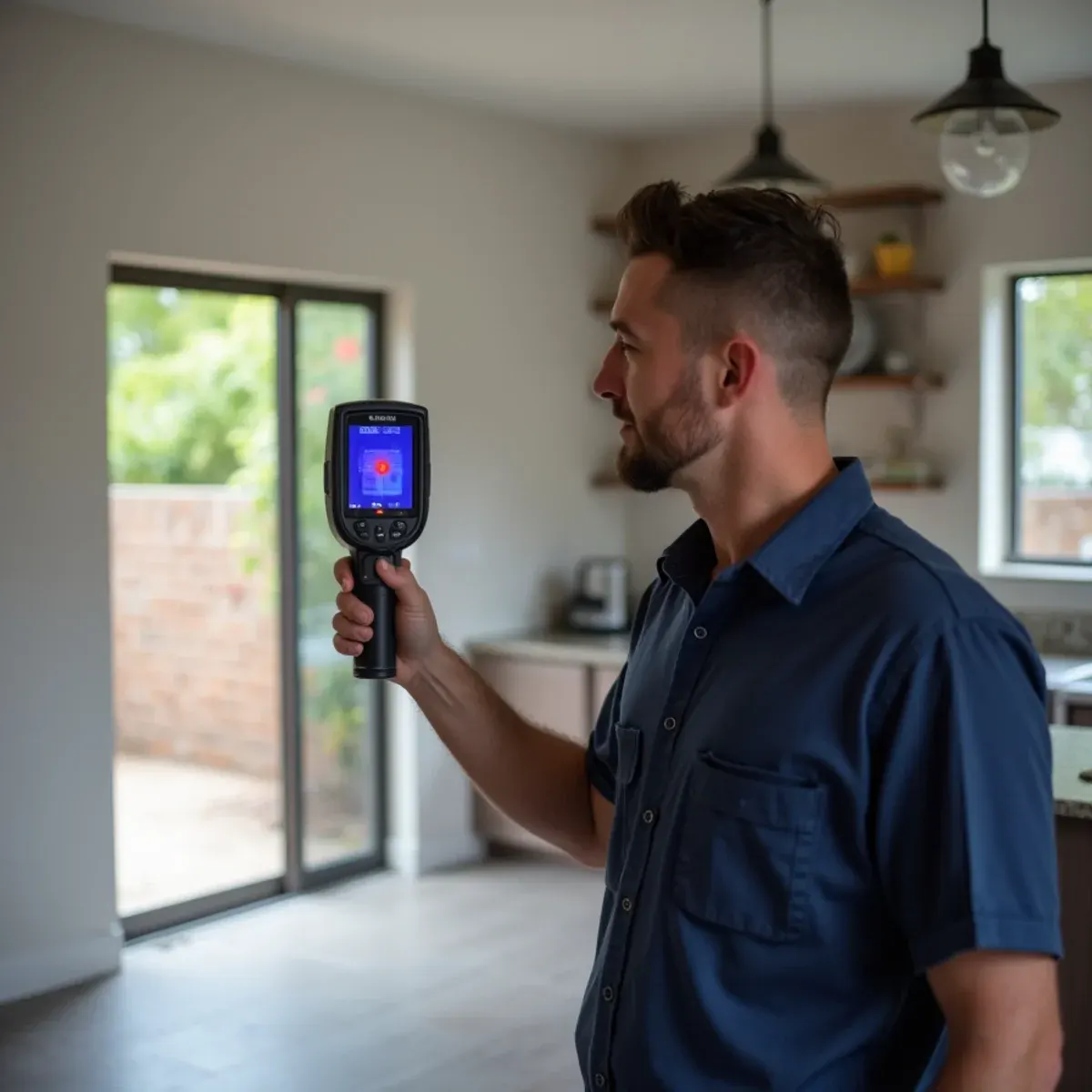
A manufactured home doesn't leak the way a stick-built house does. Under the floor there's a belly wrap — a membrane slung beneath the joists to hold insulation — and when a supply line above it fails, the water doesn't drain out. It pools in the wrap and sits there against particleboard decking. The first thing an owner notices is a soft spot underfoot near a bathroom or the water heater, sometimes months later. Carson has an unusually large mobile home park population, and that failure is one of the most common things we're called for here.
The rest of the city is conventional: 1950s to 1970s slab tract through Scottsdale, Carson Park and Victoria, with galvanized and under-slab copper both near the end of their reasonable service life. Add a shallow water table and heavy industry immediately adjacent — refineries and logistics along the Del Amo corridor — and you get a city where the right inspection method genuinely depends on the address. We ask what kind of structure you're in before we load the truck, and we'd rather ask twice than show up wrong.
What Carson Changes About Inspection & Leak Detection
1Belly wrap holds water out of sight
On a manufactured home, a supply leak above the belly wrap has nowhere to drain. Water collects in the membrane, soaks the insulation, and swells the particleboard decking from underneath while the finish floor still looks fine. Any soft spot in the floor should be metered, not walked past. We check from below where the skirting allows and read through the floor where it doesn't.
2Shallow table under postwar Carson tracts
The water table sits close to the surface across much of the city, which means slab moisture readings need interpretation rather than a snap call. Broad, even dampness across a large floor area usually points to vapor moving up through mid-century concrete; a concentrated warm reading points to a hot-water line under the slab. We take enough readings to tell them apart before recommending anything.
3Industrial neighbors affect water category
With refineries, tank farms and heavy logistics adjacent to housing, water that has run across industrial ground before entering a structure can't be assumed clean. Under S500 that pushes the category up, which changes what gets dried and what gets removed. When a loss involves exterior water in these corridors, we document the source and category rather than defaulting to the friendliest assumption.
How the Work Runs
The method is the same one we use on every inspection & leak detection job, documented to the IICRC S500:2025 standard. Here it is in short — the full water damage inspection & leak detection process explains each stage in detail.
- Talk through the history
- Thermal imaging survey
- Confirm with moisture meters
- Supply-side isolation testing
- Written findings with images
- Options, not a sales pitch
The Carson Background Worth Knowing
Manufactured homes are built with the floor deck, usually particleboard or OSB, sitting on a steel frame, with batt insulation below it and a vapor barrier belly wrap stapled underneath to hold everything in place. Supply lines run through that cavity. When one leaks, the water does not run out onto the ground where you would see it. The belly wrap catches and holds it, the insulation soaks it up, and you now have a sealed reservoir under your floor with no path to evaporate. It can sit there for months before anything shows upstairs.
There is more on the housing stock, drainage and plumbing history of this city on our water damage restoration in Carson page.
Carson at a glance
- Dominant construction era
- 1950–1975
- Foundation type
- slab on grade
- Supply piping found here
- galvanized steel, under-slab copper, manufactured-home supply lines
- Drain line materials
- cast iron
- Terrain and water table
- flat, shallow water table
- Most common local failure
- manufactured-home underfloor leaks trapped in the belly wrap, alongside conventional 1960s slab failures
- Highest-value local prevention
- treating any soft spot in a manufactured-home floor as moisture until a meter proves otherwise
What It Costs in Carson
We do not quote a number over the phone before seeing the property — anyone who does is guessing. The variables that actually move the price on a inspection & leak detection job are standard moisture inspection — no charge, electronic slab leak location, pre-purchase moisture survey, and they are broken down in full on the water damage inspection & leak detection page. The assessment and the written estimate are free anywhere in Carson, day or night, with no obligation.
Inspection & Leak Detection Questions from Carson Homeowners
Yes. We take moisture readings through the floor covering and, where the skirting gives access, get underneath to look at the belly wrap and see whether it's holding water. Thermal imaging often shows the pooled area as a distinct cool shape under the floor. If the decking is saturated, we'll tell you honestly — swollen particleboard usually doesn't recover, and knowing that early keeps a small repair from becoming a whole floor.
The standard moisture inspection is — thermal imaging, moisture mapping, and written findings, with no obligation. Specialized services like electronic slab leak location, a full pre-purchase survey, or lab sampling carry a fee, and we tell you the number before we start.
Twenty to forty minutes for a targeted check of a specific concern. A comprehensive whole-home survey for a real estate transaction runs about ninety minutes to two hours.
By locating it rather than arguing about it. The dividing line is the connection point where the park's service meets your home. Upstream of that is the park's responsibility, downstream is yours. We open the belly wrap where water is pooling, trace the wet path back to its source, and photograph what we find with the connection in frame. That documentation settles the question. Guessing from where the wet spot showed up inside is unreliable, because water travels along the frame first.