
Signal Hill is a 365-foot hill surrounded entirely by Long Beach, and its steepness changes what water damage looks like. On flat ground, storm water ponds and soaks in slowly. Here it moves — down engineered lots, along terrace drains, behind retaining walls — and it arrives at a foundation with velocity. That produces intrusion in places you wouldn't expect: through a wall penetration halfway up a slope, at the junction between an upper and lower level, or behind a retaining wall whose weep holes stopped draining years ago.
The building stock is unusually mixed for so small a city. Older hillside houses date to the 1920s oil boom and still carry original piping. The townhomes and condos built through the 1990s and 2000s on former oil land have PEX, modern drainage, and engineered slopes with walls and terrace drains that need maintaining. Active wells still sit among the housing. Our inspection starts by identifying which of those you're in, then works the slope above you before we interpret anything the meters say inside.
What Signal Hill Changes About Inspection & Leak Detection
1Velocity, not ponding, drives intrusion here
Water moving down a steep grade doesn't wait to soak in. It finds the gap at a wall penetration, the top of a retaining wall, or the seam where a terrace drain overflows, and it enters under pressure. Interior readings from that kind of event look different — narrow, deep, following a framing path — so we trace it back outside rather than guessing at a pipe.
2Retaining wall weeps and terrace drains
Most of the newer hillside housing depends on drainage built into the slope: subdrains behind walls, weep holes, v-ditches, terrace inlets. They work invisibly until they don't. We check them as part of any inspection after a storm, because a wall with plugged weeps holds a column of water against your structure and will keep doing it every wet season.
31920s hillside houses on original piping
The older housing near Hilltop and around Discovery Well Park still runs early galvanized in places, sometimes with rerouted repairs from several eras stacked on top of each other. Isolation testing on those systems takes patience — pressure drops slowly and unevenly. We hold the test long enough to be sure, and we tell you what we could and couldn't confirm.
How the Work Runs
The method is the same one we use on every inspection & leak detection job, documented to the IICRC S500:2025 standard. Here it is in short — the full water damage inspection & leak detection process explains each stage in detail.
- Talk through the history
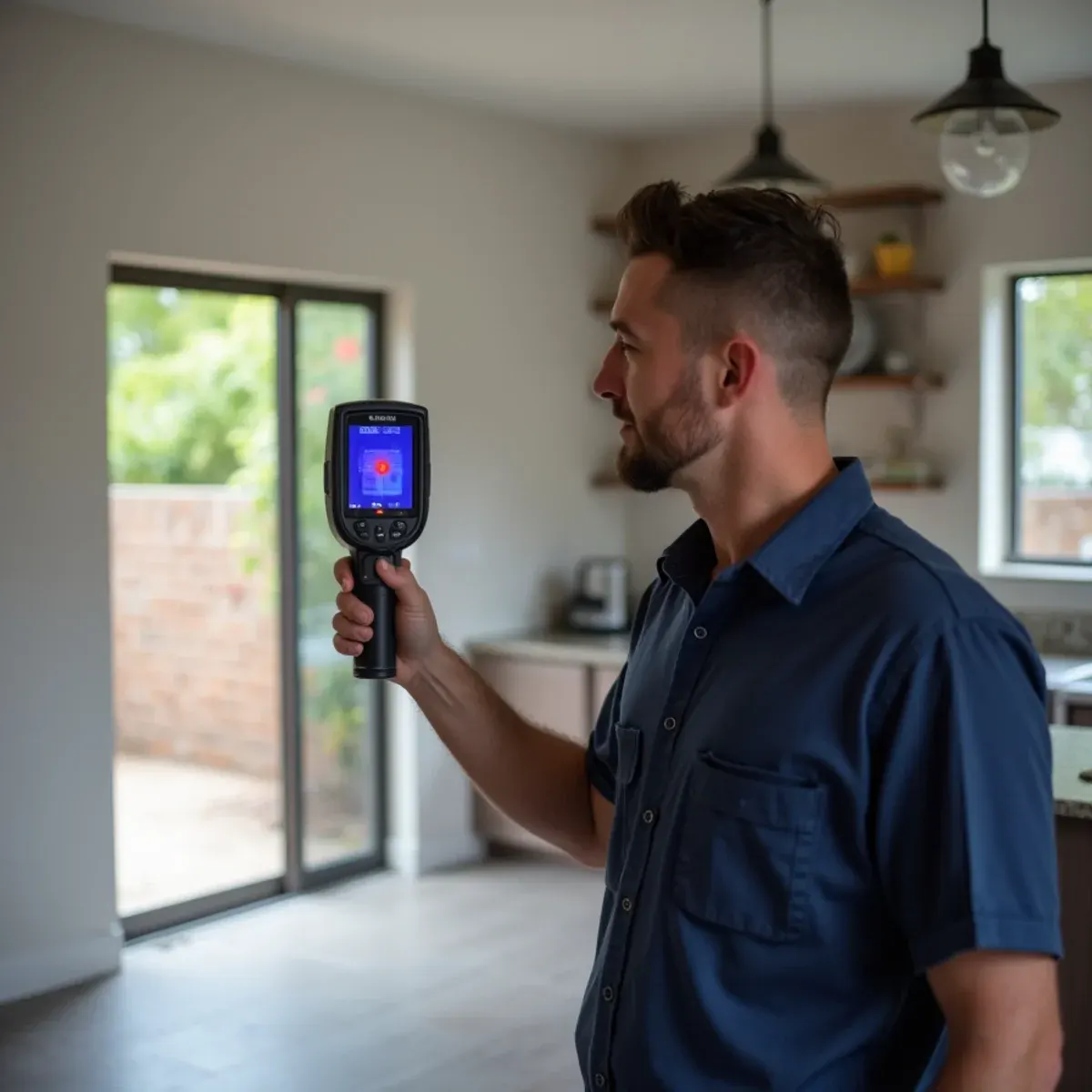
- Thermal imaging survey
- Confirm with moisture meters
- Supply-side isolation testing
- Written findings with images
- Options, not a sales pitch
The Signal Hill Background Worth Knowing
On these lots the drainage is engineered rather than natural. Terrace drains catch water partway down a slope, v-ditches carry it around a pad instead of across it, and retaining walls have weep holes with a gravel drain behind them so pressure never builds in the soil. All of that works until something clogs. Then a retaining wall stops being a wall and starts being a dam, and saturated soil pushes water through the joints and into whatever sits on the other side, which is usually a garage, a storage room, or the back of a lower level.
There is more on the housing stock, drainage and plumbing history of this city on our water damage restoration in Signal Hill page.
Signal Hill at a glance
- Dominant construction era
- 1920–2005
- Foundation type
- mixed on grade
- Supply piping found here
- original 1920s piping, galvanized steel, modern PEX in newer hillside builds
- Drain line materials
- cast iron, ABS
- Terrain and water table
- hillside-mixed, deep water table
- Most common local failure
- slope drainage and retaining-wall failures on steep lots, where water arrives with velocity rather than ponding
- Highest-value local prevention
- keeping terrace drains, v-ditches and retaining-wall weeps clear before the first storm
What It Costs in Signal Hill
We do not quote a number over the phone before seeing the property — anyone who does is guessing. The variables that actually move the price on a inspection & leak detection job are standard moisture inspection — no charge, electronic slab leak location, pre-purchase moisture survey, and they are broken down in full on the water damage inspection & leak detection page. The assessment and the written estimate are free anywhere in Signal Hill, day or night, with no obligation.
Inspection & Leak Detection Questions from Signal Hill Homeowners
Outside, above you. We look at the wall's weep holes, the terrace drain and inlet above it, and where surface water enters your lot, because on a slope like that a plugged subdrain will keep the wall saturated all season. Then we meter the bedroom wall to see how high and how wide the moisture goes. Slope water reads low and lateral; a supply leak reads as a point that climbs. The findings say which we found.
The standard moisture inspection is — thermal imaging, moisture mapping, and written findings, with no obligation. Specialized services like electronic slab leak location, a full pre-purchase survey, or lab sampling carry a fee, and we tell you the number before we start.
Twenty to forty minutes for a targeted check of a specific concern. A comprehensive whole-home survey for a real estate transaction runs about ninety minutes to two hours.
Start uphill. On this hill the cause is almost never at the place the water got in. Walk the slope above your pad and check the terrace drains, the v-ditch and the retaining wall weep holes. A weep that has been painted or stuccoed over is common and completely disables the drain behind the wall. Then look at where the uphill property discharges. Fixing the entry point without finding the redirect just moves the problem a few feet.