
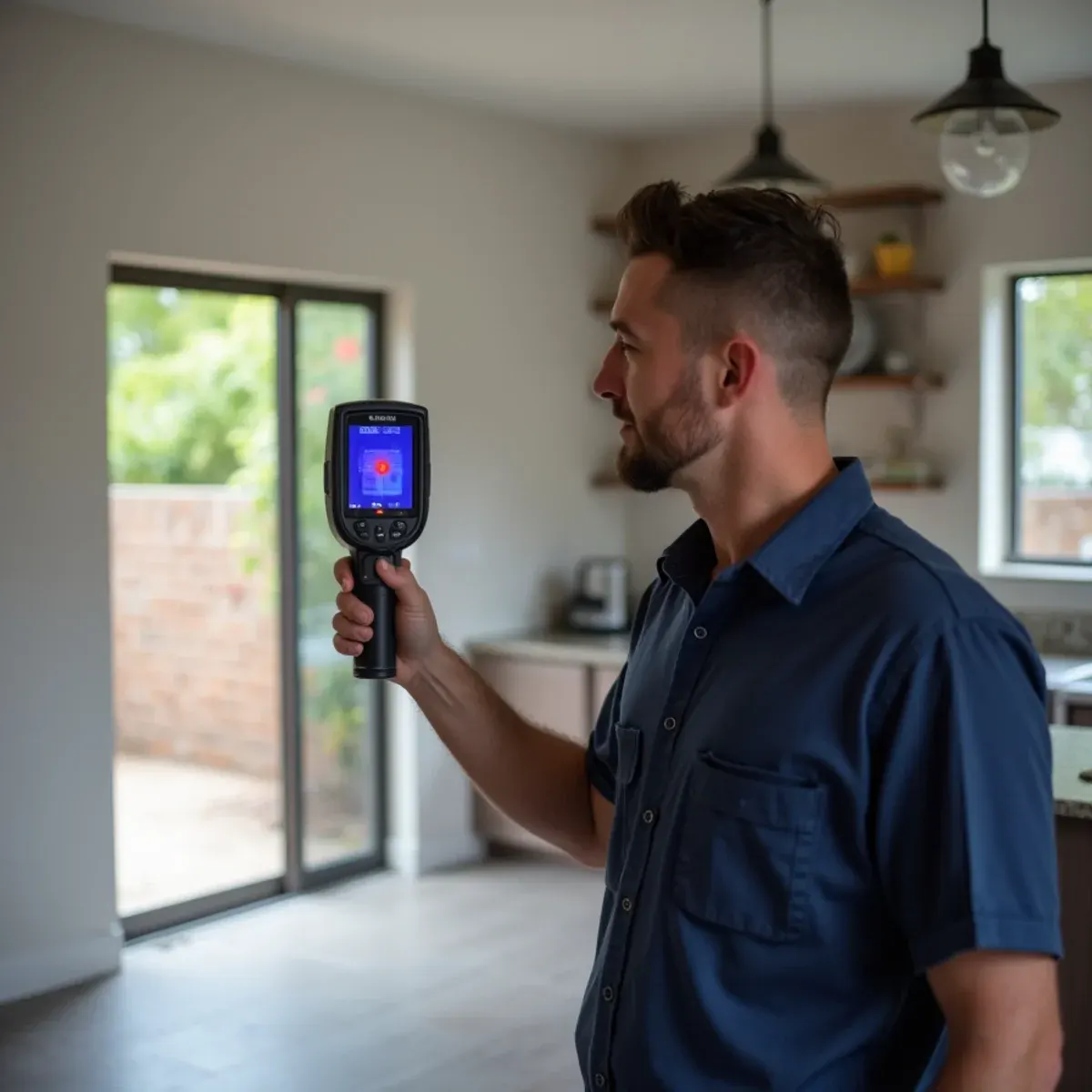
Plaster does not behave like drywall, and in Santa Ana that difference decides how much of your house survives. In Floral Park, French Park and Washington Square, walls are lime plaster keyed to wood lath — the wet material squeezed through the lath gaps when it was applied and hardened into hooks behind it. Those keys are what hold the wall up. Soak the assembly and the keys soften. Give it long enough and the plaster releases from the lath in sheets, which is not a drying problem anymore, it's a reconstruction problem in a district where matching the original is difficult and sometimes reviewable.
So the clock matters more here than in a postwar tract, and our inspection is built around finding out fast how deep the water actually went. Surface readings on plaster are close to useless. We take depth measurements, establish a dry standard elsewhere in the same house, and photograph thermal patterns that show the wet footprint inside the wall. Underfoot there's usually old-growth oak or fir with no modern equivalent, worth the effort of proper documentation before anyone writes it off. This is also the county's oldest city, so early-century supply piping and clay laterals show up regularly on the same properties.
What Santa Ana Changes About Inspection & Leak Detection
1Plaster holds water drywall never would
A plaster wall can carry several times the moisture of gypsum board and gives it up far more slowly, which is why refrigerant dehumidification alone often stalls out on these houses. The inspection needs to tell you not just that the wall is wet but how deep and how much, because that determines whether desiccant capacity is required and whether the plaster can be saved in place.
2Old-growth flooring with no modern match
The oak and fir in these homes came from timber that isn't commercially available now — tighter grain, different dimensions, often face-nailed. Replacing it means visible compromise. So we meter flooring at the board face and at the subfloor, map the wet area with thermal imaging, and give you honest readings about which sections have a realistic chance of drying flat and which are already past it.
3Preservation review shapes the written findings
In the designated districts, exterior work and some interior work go through historic review. That means your documentation needs to show what was affected and why any proposed removal is necessary, not just that something got wet. We write findings with that audience in mind — labeled images, room-by-room readings, specific materials named — so the paperwork holds up with both the carrier and the city.
How the Work Runs
The method is the same one we use on every inspection & leak detection job, documented to the IICRC S500:2025 standard. Here it is in short — the full water damage inspection & leak detection process explains each stage in detail.
- Talk through the history
- Thermal imaging survey
- Confirm with moisture meters
- Supply-side isolation testing
- Written findings with images
- Options, not a sales pitch
The Santa Ana Background Worth Knowing
Lath and plaster is wood strips nailed across the studs with several coats of plaster troweled over them. The plaster that squeezes through the gaps between lath forms keys that hook over the wood and hold the whole wall in place. That construction is why plaster walls last a century — and why they behave so differently from drywall when wet.
There is more on the housing stock, drainage and plumbing history of this city on our water damage restoration in Santa Ana page.
Santa Ana at a glance
- Dominant construction era
- 1900–1970
- Foundation type
- mixed on grade
- Supply piping found here
- original early-century piping, galvanized steel, copper
- Drain line materials
- cast iron, clay
- Terrain and water table
- flat, moderate water table
- Most common local failure
- plaster key failure, where wet plaster softens and releases from the wood lath holding it to the wall
- Highest-value local prevention
- starting aggressive drying within hours on any plaster loss — waiting is the one thing that costs you the wall
What It Costs in Santa Ana
We do not quote a number over the phone before seeing the property — anyone who does is guessing. The variables that actually move the price on a inspection & leak detection job are standard moisture inspection — no charge, electronic slab leak location, pre-purchase moisture survey, and they are broken down in full on the water damage inspection & leak detection page. The assessment and the written estimate are free anywhere in Santa Ana, day or night, with no obligation.
Inspection & Leak Detection Questions from Santa Ana Homeowners
That's exactly what it's for. We measure moisture at depth rather than at the surface, check whether the plaster is still firmly keyed to the lath by sounding it, and look for the soft, drummy areas that mean the keys have already let go. Firmly keyed plaster with moisture still in the assembly is usually a drying candidate with enough dehumidification capacity. Plaster that's released is not, and we'll tell you straight.
The standard moisture inspection is — thermal imaging, moisture mapping, and written findings, with no obligation. Specialized services like electronic slab leak location, a full pre-purchase survey, or lab sampling carry a fee, and we tell you the number before we start.
Twenty to forty minutes for a targeted check of a specific concern. A comprehensive whole-home survey for a real estate transaction runs about ninety minutes to two hours.
Usually, if drying starts quickly. Plaster holds much more water than drywall and dries far more slowly, so it needs more equipment and often desiccant dehumidification. The risk is the plaster keys softening and releasing from the lath, which is why waiting is the one thing that genuinely costs you the wall.