
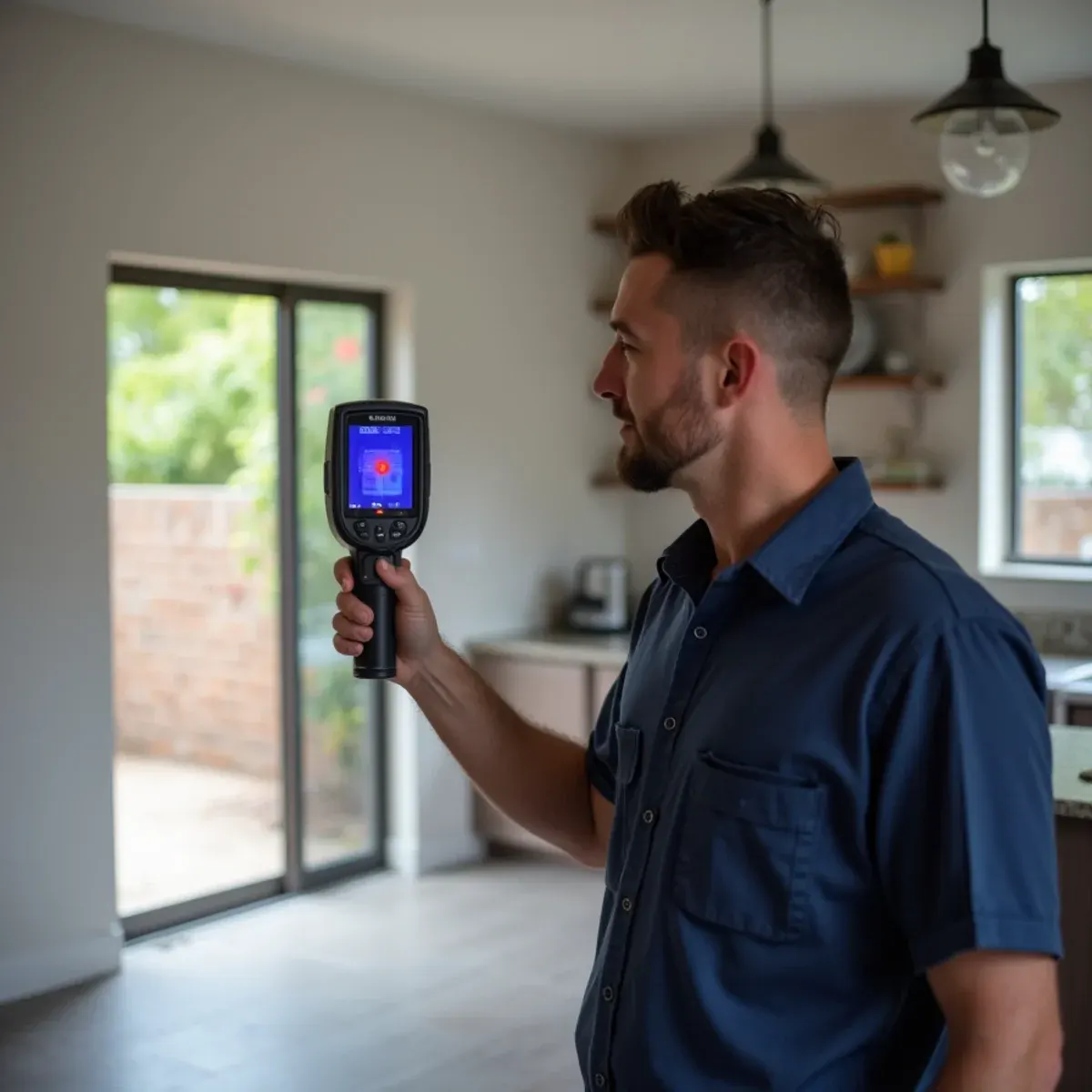
The city is named for what's underneath it. This was Gospel Swamp — wetland, drained and filled before the tracts went in through the sixties and seventies — and it still has one of the shallowest water tables in Orange County. That single fact drives most of what we find here. Slab vapor emission is a routine background condition in Fountain Valley, not an anomaly, and a moisture meter placed on a floor near Brookhurst will read elevated in houses where nothing has ever gone wrong. Homeowners get told they have a slab leak when what they have is the ground.
The distinction is worth real money, so we take it seriously. An active pressurized leak fails an isolation test and produces a reading pattern that concentrates toward a source. Vapor emission is even, diffuse, and the supply system holds pressure all day. We run both checks before anyone recommends jackhammering a floor. The second thing this ground does is drainage. Fountain Valley is dead flat — genuinely flat, not gently graded — so water that can't get into a yard drain doesn't run off. It sits, and it sits against the house, which is why we walk the perimeter and check the drains on every inspection here.
What Fountain Valley Changes About Inspection & Leak Detection
1Vapor emission versus an actual leak
Both show up as a wet slab. Only one needs a plumber. We look at pattern first — a leak concentrates, vapor is broad and uniform — then confirm with supply-side isolation testing, which tells us whether your pressurized lines actually hold. If they hold and the pattern is diffuse, the finding is the water table, and we write that plainly so nobody sells you a slab repair you don't need.
2Dead-flat ground ponds against the house
With no grade to work with, a blocked yard or area drain doesn't send water somewhere else. It holds it where it fell, often within a few feet of the foundation, where it soaks in and raises the moisture load under the slab. Clearing those drains before the wet season is the highest-value thing most homeowners here can do, and it takes an afternoon.
3Testing a slab before flooring goes down
Most of the flooring failures we're called to look at in Fountain Valley trace back to a floor installed over a slab nobody tested. Adhesive releases, laminate cups, engineered wood delaminates, and it happens months after the install when the installer is long gone. In-situ relative humidity probes in the slab give a number the manufacturer will actually accept for warranty purposes.
How the Work Runs
The method is the same one we use on every inspection & leak detection job, documented to the IICRC S500:2025 standard. Here it is in short — the full water damage inspection & leak detection process explains each stage in detail.
- Talk through the history
- Thermal imaging survey
- Confirm with moisture meters
- Supply-side isolation testing
- Written findings with images
- Options, not a sales pitch
The Fountain Valley Background Worth Knowing
Groundwater beneath Fountain Valley sits close enough to the surface that moisture vapor migration up through concrete slabs is a routine background condition rather than an anomaly. Homeowners here regularly describe a slab that feels cool and damp, or a closet on an exterior wall that never quite feels dry, without any leak at all.
There is more on the housing stock, drainage and plumbing history of this city on our water damage restoration in Fountain Valley page.
Fountain Valley at a glance
- Dominant construction era
- 1960–1980
- Foundation type
- slab on grade
- Supply piping found here
- under-slab copper
- Drain line materials
- cast iron
- Terrain and water table
- flat, shallow water table
- Most common local failure
- slab vapor emission mistaken for a leak, and flooring failures caused by installing over an untested slab
- Highest-value local prevention
- clearing the yard and area drains before the season, because a blocked drain on dead-flat ground ponds water against the house
What It Costs in Fountain Valley
We do not quote a number over the phone before seeing the property — anyone who does is guessing. The variables that actually move the price on a inspection & leak detection job are standard moisture inspection — no charge, electronic slab leak location, pre-purchase moisture survey, and they are broken down in full on the water damage inspection & leak detection page. The assessment and the written estimate are free anywhere in Fountain Valley, day or night, with no obligation.
Inspection & Leak Detection Questions from Fountain Valley Homeowners
Almost certainly vapor coming up through the slab. On this ground, moisture moves continuously out of the concrete, and if the floor went down without a tested slab and an adequate vapor retarder, the wood takes it on from below and cups. The plumbers were right — there may be nothing to find. We can put in-situ RH probes in the slab and give you a number, which is what determines whether the replacement floor survives.
The standard moisture inspection is — thermal imaging, moisture mapping, and written findings, with no obligation. Specialized services like electronic slab leak location, a full pre-purchase survey, or lab sampling carry a fee, and we tell you the number before we start.
Twenty to forty minutes for a targeted check of a specific concern. A comprehensive whole-home survey for a real estate transaction runs about ninety minutes to two hours.
The city sits on former wetland with one of the shallowest water tables in Orange County, so moisture vapor migrating up through slabs is a normal background condition here rather than a defect. It matters most when installing flooring over the slab, which is why we test with in-situ RH probes before anything goes back down.