
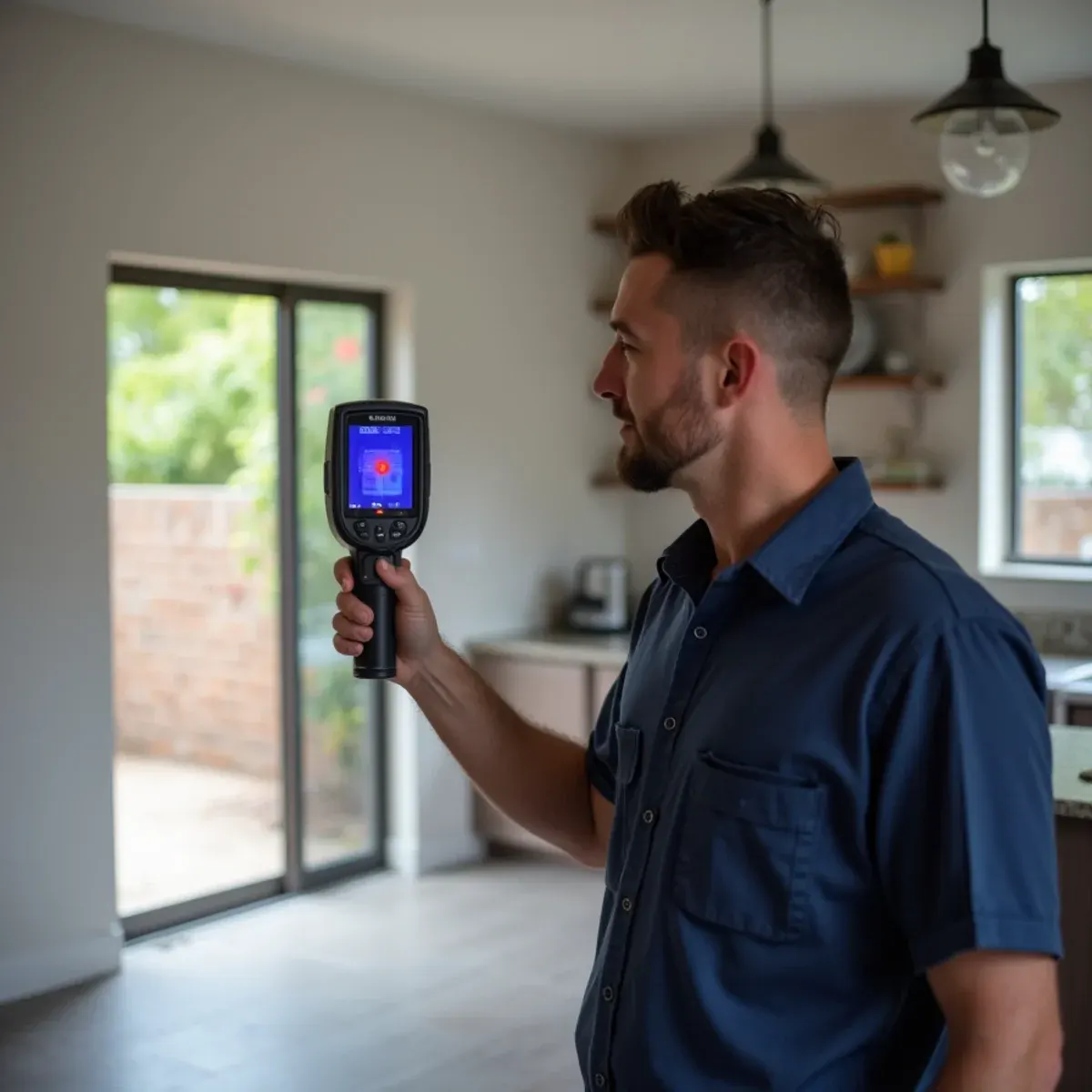
A high moisture reading on a Westminster slab does not automatically mean you have a leak. That's the single most useful thing we can tell a homeowner here. The city sits low and flat near the Bolsa Chica channel over a shallow water table, and slabs in this ground carry a higher baseline moisture load than slabs a few miles inland. Vapor moves up through the concrete continuously. A meter laid on that floor reads elevated whether or not a pipe has ever failed, and plenty of homeowners have paid to chase a leak that was never there.
Telling the two apart is the actual job. A pressurized supply leak has a shape — a warm or cool gradient with a center, readings that climb toward a point, and a supply system that won't hold isolation pressure. Slab vapor emission is diffuse and even, and the plumbing holds fine. So we scan, we meter, and we run supply-side isolation testing before anyone talks about opening concrete. The same physics is why so many flooring failures happen here, from Sigler Park to the streets off Bolsa Avenue: new floor over an untested slab, and six months later the adhesive lets go.
What Westminster Changes About Inspection & Leak Detection
1In-situ RH testing before any new floor
Surface meters read the top few millimeters of concrete. What ruins a floor is the relative humidity deep inside the slab, and the only way to know that is an in-situ probe left in a drilled hole to equilibrate. On Westminster ground we consider this the default, not an extra step. It is also the test most flooring installers skip and most manufacturers require for warranty.
2Restaurant kitchens along Bolsa Avenue
Little Saigon has one of the densest concentrations of independent restaurants in Southern California, almost all in older buildings that were never designed around a commercial kitchen. Grease loads the cast-iron waste line, the pipe narrows, and a back-of-house floor floods on a Friday night. We camera the waste line and meter the floor structure, and we schedule around service so a closure doesn't come out of the inspection.
3Shallow ground near the Bolsa Chica channel
Low elevation and a high table mean standing water outside drains slowly and the soil under the slab stays damp between storms. That affects drying times after any loss and it affects what flooring makes sense in a rebuild. It also means a perimeter that ponds is worth fixing on its own merits, before it has anything to do with a plumbing failure.
How the Work Runs
The method is the same one we use on every inspection & leak detection job, documented to the IICRC S500:2025 standard. Here it is in short — the full water damage inspection & leak detection process explains each stage in detail.
- Talk through the history
- Thermal imaging survey
- Confirm with moisture meters
- Supply-side isolation testing
- Written findings with images
- Options, not a sales pitch
The Westminster Background Worth Knowing
Westminster's shallow groundwater means many slabs here carry a higher baseline moisture load than slabs a few miles inland. In an undamaged home with breathable flooring that is usually a non-issue. It becomes an issue in two situations.
There is more on the housing stock, drainage and plumbing history of this city on our water damage restoration in Westminster page.
Westminster at a glance
- Dominant construction era
- 1950–1970
- Foundation type
- slab on grade
- Supply piping found here
- under-slab copper, galvanized steel
- Drain line materials
- cast iron
- Terrain and water table
- coastal-flat, shallow water table
- Most common local failure
- flooring installed over a slab that was never tested and is still releasing vapor
- Highest-value local prevention
- in-situ slab relative humidity testing before any new floor goes down
What It Costs in Westminster
We do not quote a number over the phone before seeing the property — anyone who does is guessing. The variables that actually move the price on a inspection & leak detection job are standard moisture inspection — no charge, electronic slab leak location, pre-purchase moisture survey, and they are broken down in full on the water damage inspection & leak detection page. The assessment and the written estimate are free anywhere in Westminster, day or night, with no obligation.
Inspection & Leak Detection Questions from Westminster Homeowners
Often it's the ground, not a leak — that's a normal reading on Westminster slabs. We confirm it by running supply-side isolation testing to see whether your pressurized lines hold, and by looking at the moisture pattern: a leak concentrates toward a source, vapor emission is broad and even. If the plumbing holds and the pattern is diffuse, you don't need a plumber. You need a proper in-situ RH number and the right underlayment.
The standard moisture inspection is — thermal imaging, moisture mapping, and written findings, with no obligation. Specialized services like electronic slab leak location, a full pre-purchase survey, or lab sampling carry a fee, and we tell you the number before we start.
Twenty to forty minutes for a targeted check of a specific concern. A comprehensive whole-home survey for a real estate transaction runs about ninety minutes to two hours.
Westminster has a shallow water table, so slabs here carry more baseline moisture than slabs further inland. Normally that is harmless, but it matters when installing flooring over the slab and it means drying after a loss takes longer. We test with in-situ relative humidity probes before any new floor goes down.