
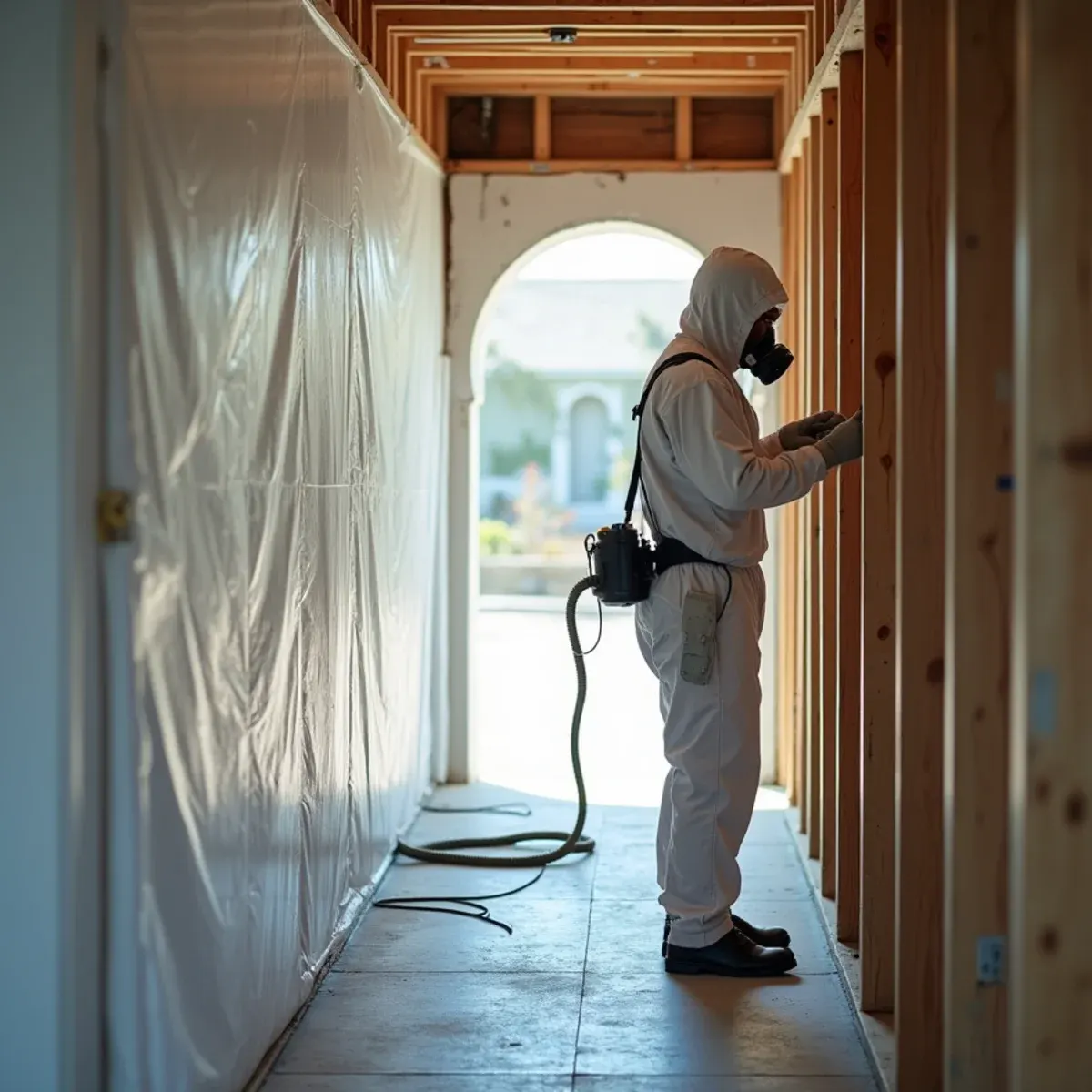
The first question we ask on a Tustin mold call isn't where the water is. It's what year the house was built. Old Town, off Main and El Camino Real, is 1880s-to-1920s construction on raised foundations, where growth develops on subfloor and joists in air you never breathe directly until it reaches a floor register. Tustin Ranch and the 1960s-to-1980s tracts through the middle are slab, so the same volume of water goes sideways into wall bases and under flooring instead of down.
Then there's Tustin Legacy, built on the former Marine Corps Air Station since 2005, along with Columbus Square and Columbus Grove. Those homes have PEX, modern drainage and a tighter building envelope, which is good until a supply fitting weeps inside a sealed wall cavity that has no way to dry itself out. Same city, three different problems. We come from Cypress, roughly eighteen minutes northwest, and dispatch as fast as conditions allow rather than promising a clock.
What Tustin Changes About Mold Remediation
1Old Town's crawl space runs the job
Under the pre-war houses near Main Street, the source is almost always below the floor and the smell is the only symptom for weeks. Containment down there is different work — we're setting negative air in a vented dirt space, removing contaminated insulation and treating framing, and the moisture correction includes what the ground itself is holding, not just the pipe.
2Tustin Legacy's tight envelope holds moisture
Post-2005 construction here is air-sealed well enough that a small leak inside a wall cavity does not evaporate its way out. Growth stays hidden behind paint that looks perfect while the sheathing side of the drywall goes. On these homes we take cavity readings through small inspection openings before deciding anything, because the visible surface tells you almost nothing.
31970s and 1980s tract shower pans
The middle-era Tustin tracts are slab with mortar-bed shower pans that are now well past forty years old. A failed pan wicks into the adjoining wall and the hallway closet behind it, which is why growth so often turns up on the far side of a bathroom wall. Correcting that source means the pan gets addressed, not just the drywall.
How the Work Runs
The method is the same one we use on every mold remediation job, documented to the IICRC S500:2025 standard. Here it is in short — the full mold remediation & removal process explains each stage in detail.
- Inspection and moisture source identification
- Testing where it is warranted
- Containment and negative pressure
- Removal of contaminated material
- HEPA cleaning and antimicrobial application
- Verification before containment comes down
The Tustin Background Worth Knowing
You can usually place your house without paperwork. Foundation vents around the perimeter and a floor that sits a step or two above grade means a raised foundation and a crawl space, which puts you in the Old Town generation. A slab sitting flush at grade with no vents puts you in the tract era. If you have a second-floor laundry, a tankless heater, or a manifold of colored plastic tubing in a closet, you are in the Legacy generation. Each of those buildings has an entirely different weak point, and knowing yours is most of the battle.
There is more on the housing stock, drainage and plumbing history of this city on our water damage restoration in Tustin page.
Tustin at a glance
- Dominant construction era
- 1880–2020
- Foundation type
- mixed on grade
- Supply piping found here
- original pre-war piping in Old Town, under-slab copper, modern PEX in Tustin Legacy
- Drain line materials
- cast iron, clay, ABS
- Terrain and water table
- flat, moderate water table
- Most common local failure
- wildly different failure modes street to street, because the era of the house decides everything
- Highest-value local prevention
- knowing which of the three Tustins your house belongs to before assuming any advice applies
What It Costs in Tustin
We do not quote a number over the phone before seeing the property — anyone who does is guessing. The variables that actually move the price on a mold remediation job are square footage of affected material, where it is, containment complexity, and they are broken down in full on the mold remediation & removal page. The assessment and the written estimate are free anywhere in Tustin, day or night, with no obligation.
Mold Remediation Questions from Tustin Homeowners
Yes, and it changes what we look for. Tustin Ranch is slab-on-grade, so water spreads laterally under flooring and up into the bottom several inches of wall rather than dropping into a crawl space. Growth usually starts behind baseboard, in cabinet toe kicks, and under carpet pad. In Old Town the same leak feeds a subfloor you never see. Different inspection, different containment, different point where we can call the source corrected.
On a hard, non-porous surface like tile or glass, bleach handles surface growth. On drywall, wood, or anything porous it does not — the water content soaks in and can feed further growth while the chlorine stays on the surface. Porous material with real growth needs to be removed, not treated.
Usually not for visible growth with an obvious cause — you can see the problem and the work would be identical regardless of species. Testing is worthwhile when there is odor but nothing visible, when you need documentation for a claim or dispute, or when you want independent verification that the job was done right.
New plumbing removes corrosion from the list, not everything else. What fails in Legacy-era homes is connections and appliances: braided washer hoses, refrigerator ice-maker lines, angle stops, dishwasher fittings, and water heaters that are now well into their service life. Second-floor laundry rooms are the biggest single change from older Tustin housing, because a failure up there drains through two ceilings instead of across a garage slab. Age protects you from one category of failure and none of the others.