
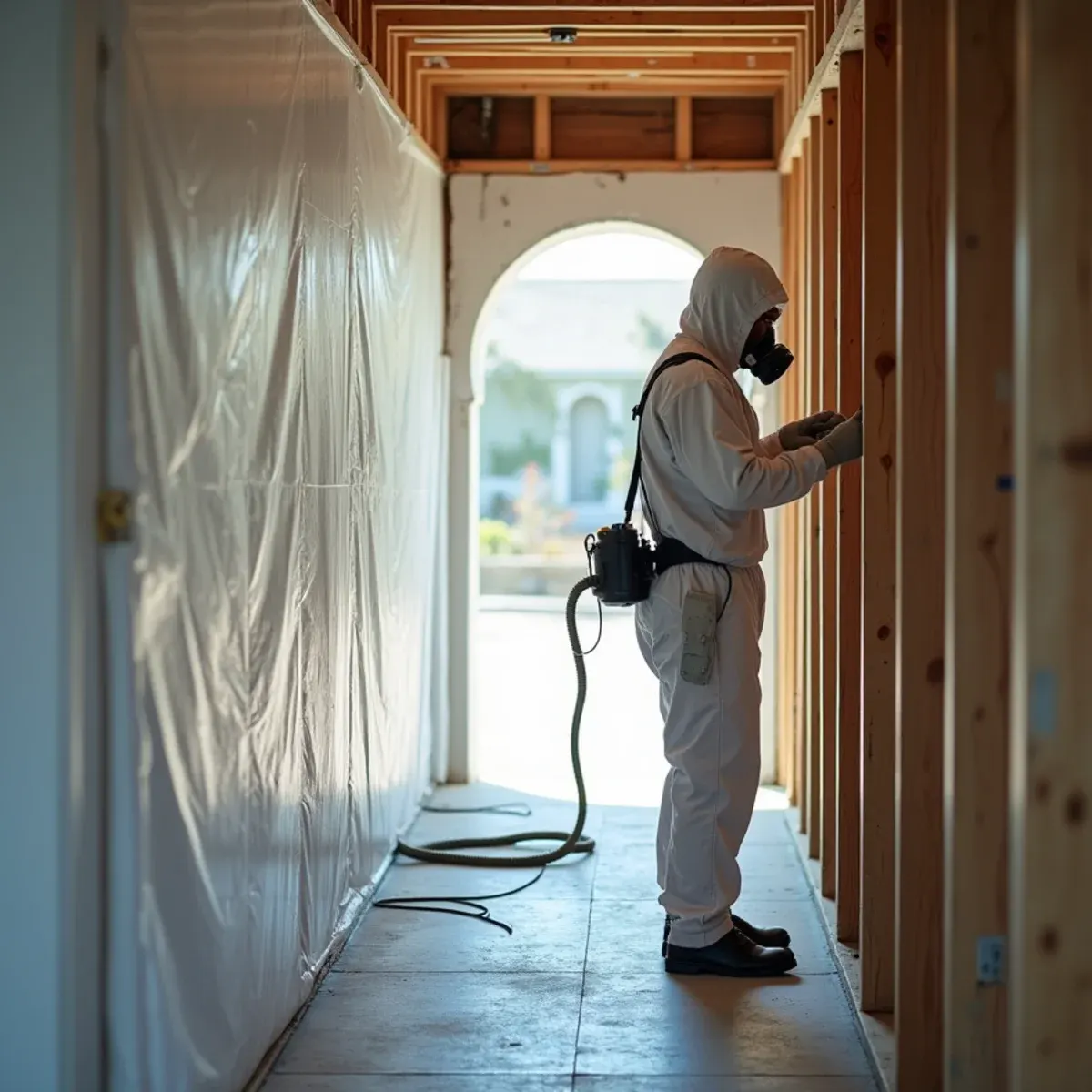
Old Towne is roughly a square mile of 1880s-to-1920s houses on raised foundations, and the crawl space under those floors is where most of our mold work in Orange begins. A supply line weeps into dirt instead of pooling on a floor, nobody sees it, and by the time a musty smell reaches the living room the joists and subfloor have been damp for a month or more. We start under the house, not at the baseboard, because the baseboard is only where the odor finally surfaced.
Outside the historic district the city changes completely. El Modena, Santiago Hills and Serrano Heights are postwar and later slab tract, where growth shows up behind a shower wall or along the path of an under-slab copper leak instead of under a floor. Orange Park Acres adds half-acre equestrian lots with irrigation heavy enough to keep soil wet against stucco most of the year. We're about thirteen minutes west of the Plaza and dispatch as fast as conditions allow, day or night.
What Orange Changes About Mold Remediation
1Crawl spaces do the hiding here
Under a raised Old Towne foundation there's dirt, not concrete, and often no vapor barrier at all. Water from a weeping supply line soaks into that soil and keeps feeding the joists and subfloor above it long after the drip itself stops. Correcting the source in these houses usually means the plumbing repair plus a real ground cover, or the same growth returns by the next humid stretch.
2Original plaster changes the removal plan
Old Towne walls are lath and plaster, not drywall, and plaster does not come out in tidy sheets. We map moisture and growth before we open anything, because a four-foot cut in original plaster is not something a homeowner gets back cheaply. Where readings and the S500:2025 criteria allow, we clean and dry sound framing in place and keep removal to the contaminated porous material.
3Irrigation on Orange Park Acres lots
Half-acre equestrian properties run a lot of water. Sprinklers hitting stucco, planters built up above the slab edge and shallow drip lines keep exterior walls damp with no plumbing failure anywhere inside. When we find growth on the inside face of an exterior wall out there, the moisture source is usually outdoors, and it gets corrected before containment comes down.
How the Work Runs
The method is the same one we use on every mold remediation job, documented to the IICRC S500:2025 standard. Here it is in short — the full mold remediation & removal process explains each stage in detail.
- Inspection and moisture source identification
- Testing where it is warranted
- Containment and negative pressure
- Removal of contaminated material
- HEPA cleaning and antimicrobial application
- Verification before containment comes down
The Orange Background Worth Knowing
A slab leak announces itself eventually because concrete has nowhere to put the water. A crawl-space leak has somewhere to put it. Dirt absorbs a slow drip almost indefinitely, so the loss never produces the one thing homeowners watch for, which is water on a floor. Meanwhile the humidity under the house climbs, the fiberglass insulation between the joists soaks up moisture and sags, the subfloor picks up that moisture from below, and mold begins on the joists where it is invisible and undisturbed. Everything about this failure is built to stay quiet.
There is more on the housing stock, drainage and plumbing history of this city on our water damage restoration in Orange page.
Orange at a glance
- Dominant construction era
- 1888–1975
- Foundation type
- mixed on grade
- Supply piping found here
- original turn-of-century piping, galvanized steel, under-slab copper
- Drain line materials
- cast iron, clay
- Terrain and water table
- flat, moderate water table
- Most common local failure
- crawl-space leaks under raised-foundation historic homes, running for weeks because water drips into the dirt instead of pooling on a floor
- Highest-value local prevention
- an annual crawl-space inspection, which almost nobody does and which catches nearly everything early
What It Costs in Orange
We do not quote a number over the phone before seeing the property — anyone who does is guessing. The variables that actually move the price on a mold remediation job are square footage of affected material, where it is, containment complexity, and they are broken down in full on the mold remediation & removal page. The assessment and the written estimate are free anywhere in Orange, day or night, with no obligation.
Mold Remediation Questions from Orange Homeowners
Not always, and we don't decide before we measure. Plaster on wood lath can sometimes be cleaned and dried when growth is surface-level and the framing behind it reads dry. What forces removal is contaminated porous material — soaked insulation, saturated plaster keys, or growth inside a cavity we can't reach and verify. If that's what inspection shows, we cut to the smallest defensible line, photograph it, and document the work for your insurer and any historic review.
On a hard, non-porous surface like tile or glass, bleach handles surface growth. On drywall, wood, or anything porous it does not — the water content soaks in and can feed further growth while the chlorine stays on the surface. Porous material with real growth needs to be removed, not treated.
Usually not for visible growth with an obvious cause — you can see the problem and the work would be identical regardless of species. Testing is worthwhile when there is odor but nothing visible, when you need documentation for a claim or dispute, or when you want independent verification that the job was done right.
Pick a dry day, open the hatch, and use a good flashlight. You are looking at the soil directly under the bathrooms, kitchen, and laundry for dark damp patches, at the insulation for sagging or fallen batts, and at the piers and foundation vents for rust or white staining. Trust your nose as much as your eyes. If the access is too tight or you would rather not go under, we will do the inspection and photograph what is down there.