
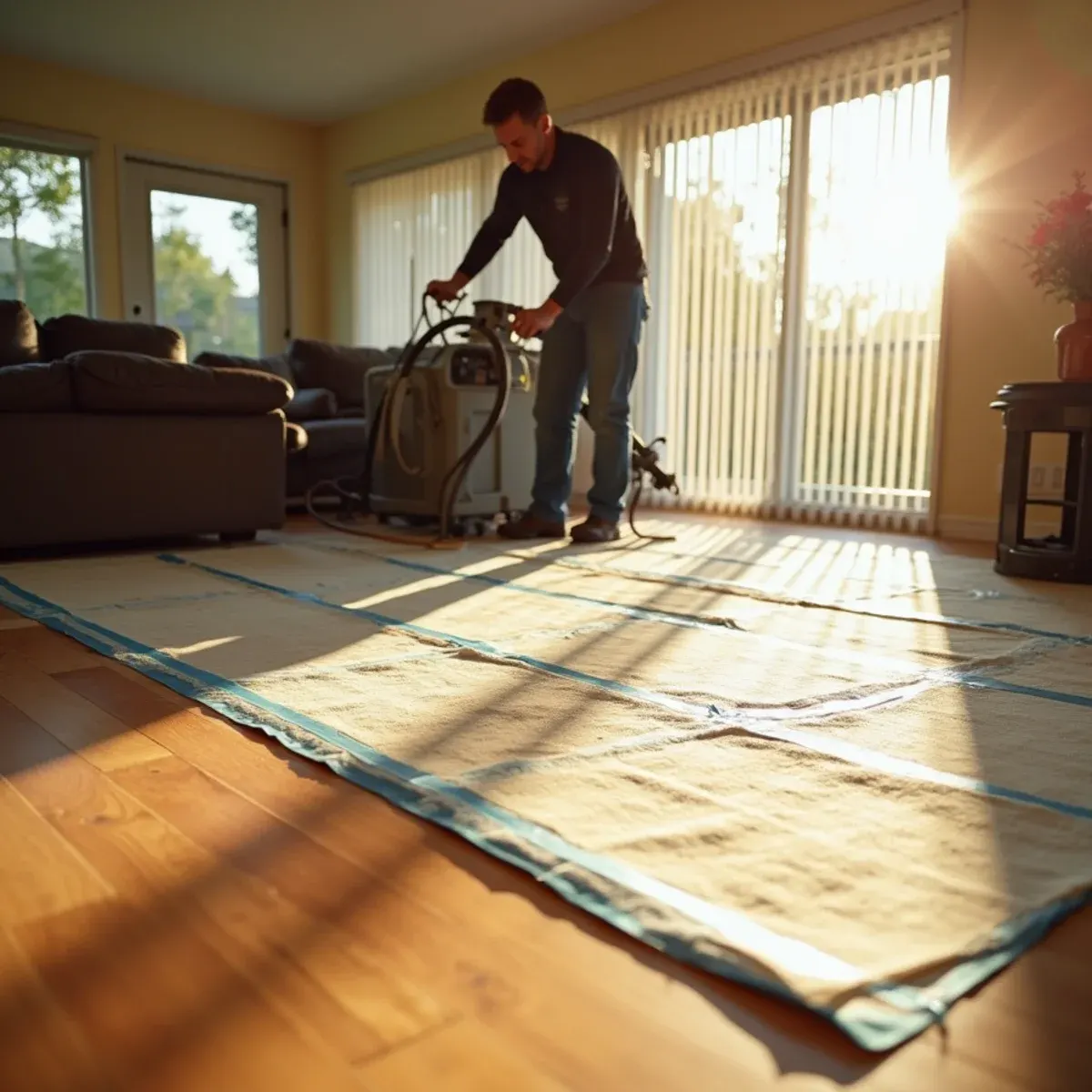
Before we quote a hardwood job in Tustin we ask what year the house went up, because the answer decides most of the outcome. Old Town's 1880s-to-1920s houses sit on raised foundations with solid wood over a plank subfloor, and solid wood is forgiving — it can cup hard and still come back flat. Tustin Legacy, built after 2005 on the old Marine Corps Air Station, is almost entirely engineered plank glued or floated over slab. Engineered doesn't cup and recover. It separates.
The 1960s to 1980s tract through the middle of the city is the mixed bag. Those slab houses started life with carpet and vinyl, so the wood floors in them now are retrofits — sometimes solid nailed to a plywood layer, sometimes floating engineered from a big-box store. We can't tell which from the doorway. We pull a vent register or a threshold, look at the edge of a board, and take a reading before anyone promises you that a floor gets saved.
What Tustin Changes About Hardwood Floor Drying
1Legacy plank fails at the glue line
Post-2005 Tustin Legacy homes are nearly all engineered plank. Engineered doesn't cup and recover the way solid wood does; it separates — the wear layer lifts off the core, edges swell, and the finish telegraphs every seam. Caught within hours, a thick glue-down wear layer sometimes holds. Caught the next morning, it usually doesn't. We'd rather tell you that on day one than on day five.
2Old Town gives us a second face
The 1880s-to-1920s houses off Main and El Camino Real sit on raised foundations. That crawl space is an asset: we dry the underside while mats pull through the top, which is the fastest and gentlest way to bring a cupped solid floor back flat. It also helps us find the actual source, since a leak under these houses drips into dirt instead of pooling where you'd see it.
3Retrofit floors over 1970s slab
The middle-era tract between Newport Avenue and Red Hill started life with carpet. Whatever wood is on those floors now went in later, often with no vapor retarder underneath it. That matters because the slab keeps giving up moisture during a dry-out, and the drying goal has to be set against an unaffected section of the same floor rather than a number off a chart.
How the Work Runs
The method is the same one we use on every hardwood floor drying job, documented to the IICRC S500:2025 standard. Here it is in short — the full hardwood floor water damage drying process explains each stage in detail.
- Measure before deciding anything
- Extract from below the surface
- Control the drying rate deliberately
- Dry the subfloor and any cavity below
- Let it acclimate before judging it
- Sand and refinish only if needed
The Tustin Background Worth Knowing
You can usually place your house without paperwork. Foundation vents around the perimeter and a floor that sits a step or two above grade means a raised foundation and a crawl space, which puts you in the Old Town generation. A slab sitting flush at grade with no vents puts you in the tract era. If you have a second-floor laundry, a tankless heater, or a manifold of colored plastic tubing in a closet, you are in the Legacy generation. Each of those buildings has an entirely different weak point, and knowing yours is most of the battle.
There is more on the housing stock, drainage and plumbing history of this city on our water damage restoration in Tustin page.
Tustin at a glance
- Dominant construction era
- 1880–2020
- Foundation type
- mixed on grade
- Supply piping found here
- original pre-war piping in Old Town, under-slab copper, modern PEX in Tustin Legacy
- Drain line materials
- cast iron, clay, ABS
- Terrain and water table
- flat, moderate water table
- Most common local failure
- wildly different failure modes street to street, because the era of the house decides everything
- Highest-value local prevention
- knowing which of the three Tustins your house belongs to before assuming any advice applies
What It Costs in Tustin
We do not quote a number over the phone before seeing the property — anyone who does is guessing. The variables that actually move the price on a hardwood floor drying job are square footage under the mat system, solid versus engineered wood, what is underneath, and they are broken down in full on the hardwood floor water damage drying page. The assessment and the written estimate are free anywhere in Tustin, day or night, with no obligation.
Hardwood Floor Drying Questions from Tustin Homeowners
There's a real chance if we get there the same day and it's a glue-down with a thick wear layer. What kills engineered plank is time: the core swells, the glue line lets go, and the wear layer starts lifting at the edges. Floating installations do worse than glue-down, because water tracks along the underside and reaches every board. We'll pull a threshold, read the core, and tell you before we commit you to a week of equipment.
Frequently, yes. Cupping is caused by uneven moisture between the top and bottom of each board, and when the moisture equalizes during controlled drying, much of the deformation reverses. Full flattening can take two to four weeks of acclimation after the equipment comes out, which is why we do not recommend sanding immediately.
Five to ten days under the mat system is typical, which is longer than drywall because wood gives up moisture slowly and has to be dried at a controlled rate. Rushing it causes splitting and permanent gapping, so the extra days are doing real work.
New plumbing removes corrosion from the list, not everything else. What fails in Legacy-era homes is connections and appliances: braided washer hoses, refrigerator ice-maker lines, angle stops, dishwasher fittings, and water heaters that are now well into their service life. Second-floor laundry rooms are the biggest single change from older Tustin housing, because a failure up there drains through two ceilings instead of across a garage slab. Age protects you from one category of failure and none of the others.