
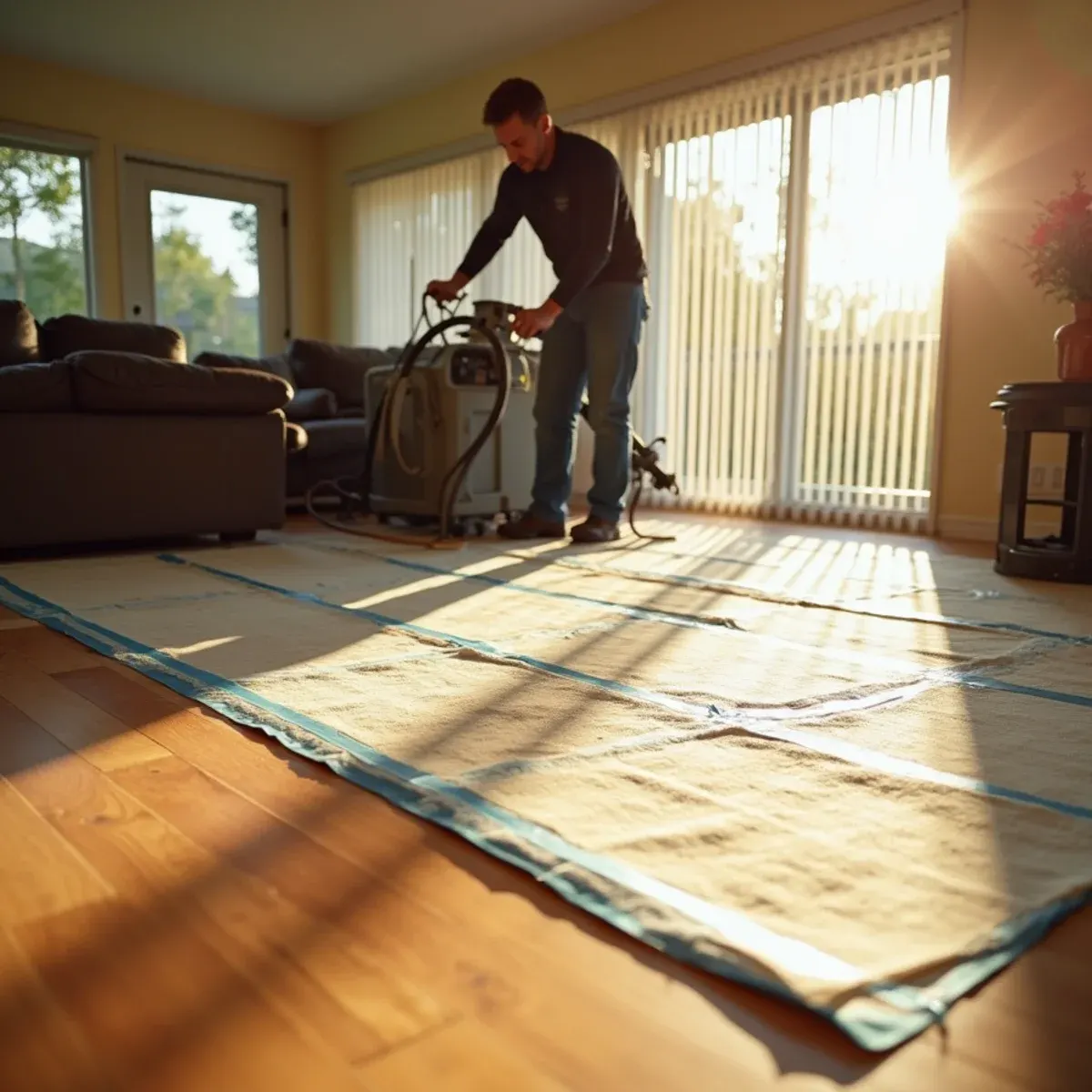
The oak strip floors in Old Towne were laid over a plank subfloor with a crawl space beneath, and that changes everything about how they dry. A supply leak under a Craftsman off Glassell can run for weeks — the water drips into the dirt instead of pooling somewhere you'd notice — and the first sign is a floor that starts to cup near an exterior wall. By then the boards have been taking on moisture from below the whole time, which is the direction wood swells fastest.
That same crawl space is the reason we can usually save the floor. We set mat systems on top to pull moisture up through the seams and dry the underside at the same time, so each board dries evenly instead of from one face. Homes east of the Plaza in Santiago Hills and Serrano Heights are slab, and there we're working one direction only, which takes longer and narrows what's salvageable. Orange Park Acres runs both ways depending on the decade the house went up.
What Orange Changes About Hardwood Floor Drying
1Crawl space access changes the odds
Under a raised-foundation home we work both faces of the board at once — mats on top pulling moisture through the seams, dehumidified air moving through the crawl space below. Wood dries more evenly that way, and severe cupping straightens out more reliably. On the slab tracts east of Tustin Street we only get one direction, so the same loss runs longer with less certainty.
2Original oak already sanded thin
A lot of Old Towne floors are on their third or fourth refinish. There may be only a sixteenth of an inch of wear layer left above the tongue, which means the floor gets one more sanding, ever. That's why we push for full drying and a long acclimation period before anyone touches a sander — sanding a floor that's still moving wastes the last pass you have.
3Chapman rentals and late reporting
A good share of Old Towne is student rental, and a crawl-space leak under a rented house tends to get reported when the floor visibly moves, not when the drip starts. If you own a rental near the Plaza, ask tenants to flag any musty smell coming out of a floor register. That single habit is often the difference between drying a floor and replacing it.
How the Work Runs
The method is the same one we use on every hardwood floor drying job, documented to the IICRC S500:2025 standard. Here it is in short — the full hardwood floor water damage drying process explains each stage in detail.
- Measure before deciding anything
- Extract from below the surface
- Control the drying rate deliberately
- Dry the subfloor and any cavity below
- Let it acclimate before judging it
- Sand and refinish only if needed
The Orange Background Worth Knowing
A slab leak announces itself eventually because concrete has nowhere to put the water. A crawl-space leak has somewhere to put it. Dirt absorbs a slow drip almost indefinitely, so the loss never produces the one thing homeowners watch for, which is water on a floor. Meanwhile the humidity under the house climbs, the fiberglass insulation between the joists soaks up moisture and sags, the subfloor picks up that moisture from below, and mold begins on the joists where it is invisible and undisturbed. Everything about this failure is built to stay quiet.
There is more on the housing stock, drainage and plumbing history of this city on our water damage restoration in Orange page.
Orange at a glance
- Dominant construction era
- 1888–1975
- Foundation type
- mixed on grade
- Supply piping found here
- original turn-of-century piping, galvanized steel, under-slab copper
- Drain line materials
- cast iron, clay
- Terrain and water table
- flat, moderate water table
- Most common local failure
- crawl-space leaks under raised-foundation historic homes, running for weeks because water drips into the dirt instead of pooling on a floor
- Highest-value local prevention
- an annual crawl-space inspection, which almost nobody does and which catches nearly everything early
What It Costs in Orange
We do not quote a number over the phone before seeing the property — anyone who does is guessing. The variables that actually move the price on a hardwood floor drying job are square footage under the mat system, solid versus engineered wood, what is underneath, and they are broken down in full on the hardwood floor water damage drying page. The assessment and the written estimate are free anywhere in Orange, day or night, with no obligation.
Hardwood Floor Drying Questions from Orange Homeowners
Usually not. Mat drying is built for exactly this: we seal panels to the surface and pull moisture up through the existing seams under negative pressure, so the boards stay nailed down. Sometimes we drill small relief holes in a closet or where the base will return. If a section has already delaminated or the subfloor beneath it has failed, we'll show you the readings and say so rather than run equipment on a floor that won't come back.
Frequently, yes. Cupping is caused by uneven moisture between the top and bottom of each board, and when the moisture equalizes during controlled drying, much of the deformation reverses. Full flattening can take two to four weeks of acclimation after the equipment comes out, which is why we do not recommend sanding immediately.
Five to ten days under the mat system is typical, which is longer than drywall because wood gives up moisture slowly and has to be dried at a controlled rate. Rushing it causes splitting and permanent gapping, so the extra days are doing real work.
Pick a dry day, open the hatch, and use a good flashlight. You are looking at the soil directly under the bathrooms, kitchen, and laundry for dark damp patches, at the insulation for sagging or fallen batts, and at the piers and foundation vents for rust or white staining. Trust your nose as much as your eyes. If the access is too tight or you would rather not go under, we will do the inspection and photograph what is down there.