
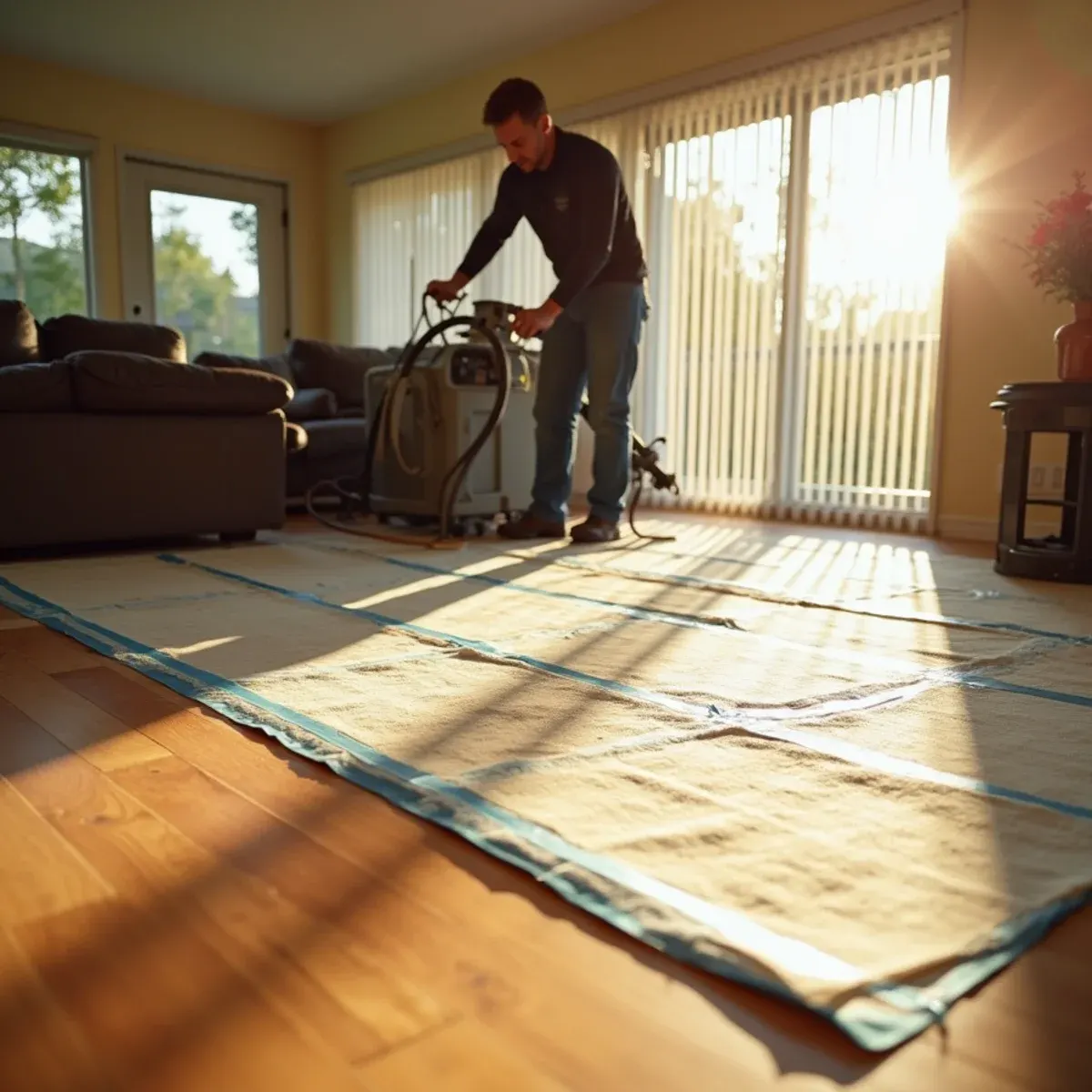
The floors in Floral Park and Washington Square are not replaceable. Old-growth oak and fir milled a century ago, tight-grained, often quartersawn, laid in patterns nobody runs anymore. You can buy new wood that looks similar and it will not match, not in grain and not in how it takes a finish. That is why we push so hard to dry these floors in place rather than pull them. A board that is cupped is a board that is still there. A board that has been torn out is gone for good.
The complication is everything around the floor. These homes are lath and plaster, and plaster holds several times the water drywall does while releasing it far more slowly, so the room stays humid and the floor readings stall unless we bring desiccant capacity alongside the mats. Wet plaster also has a clock on it, because the keys behind the lath soften and let go. On a Santa Ana historic loss we are moving within hours rather than the next morning, and where preservation review applies we work to it rather than around it.
What Santa Ana Changes About Hardwood Floor Drying
1Old-growth boards cannot be matched
The oak and fir in Floral Park, French Park and Washington Square came from timber that no longer exists commercially. New wood can be stained to approximate it and will never match the grain or the way it takes finish. That is the whole argument for drying in place. A cupped board is still an original board, and a removed one is gone permanently.
2Desiccant capacity alongside the floor mats
Lath and plaster holds several times the water drywall does and releases it slowly, so a plaster room keeps feeding humidity back at the floor and readings stall. Conventional refrigerant dehumidification often is not enough. Desiccant equipment pulls the room to a lower vapor pressure, which is what lets the mats actually move water out of the boards instead of circulating it.
3Crawl spaces under the historic blocks
Many pre-war homes here sit on raised foundations, and that access is a genuine advantage. Working the underside of the floor while mats run on top roughly halves the fight. It also lets us check the joists and subfloor, which in a century-old Santa Ana house are usually old-growth Douglas fir worth protecting in their own right.
How the Work Runs
The method is the same one we use on every hardwood floor drying job, documented to the IICRC S500:2025 standard. Here it is in short — the full hardwood floor water damage drying process explains each stage in detail.
- Measure before deciding anything
- Extract from below the surface
- Control the drying rate deliberately
- Dry the subfloor and any cavity below
- Let it acclimate before judging it
- Sand and refinish only if needed
The Santa Ana Background Worth Knowing
Lath and plaster is wood strips nailed across the studs with several coats of plaster troweled over them. The plaster that squeezes through the gaps between lath forms keys that hook over the wood and hold the whole wall in place. That construction is why plaster walls last a century — and why they behave so differently from drywall when wet.
There is more on the housing stock, drainage and plumbing history of this city on our water damage restoration in Santa Ana page.
Santa Ana at a glance
- Dominant construction era
- 1900–1970
- Foundation type
- mixed on grade
- Supply piping found here
- original early-century piping, galvanized steel, copper
- Drain line materials
- cast iron, clay
- Terrain and water table
- flat, moderate water table
- Most common local failure
- plaster key failure, where wet plaster softens and releases from the wood lath holding it to the wall
- Highest-value local prevention
- starting aggressive drying within hours on any plaster loss — waiting is the one thing that costs you the wall
What It Costs in Santa Ana
We do not quote a number over the phone before seeing the property — anyone who does is guessing. The variables that actually move the price on a hardwood floor drying job are square footage under the mat system, solid versus engineered wood, what is underneath, and they are broken down in full on the hardwood floor water damage drying page. The assessment and the written estimate are free anywhere in Santa Ana, day or night, with no obligation.
Hardwood Floor Drying Questions from Santa Ana Homeowners
Usually yes to both, in that order. Cupping is the reversible direction. The edges are swollen and they come down as moisture equalizes through the board. The mistake that ends these floors is sanding while they are still cupped, which cuts the high edges off and produces crowning once the wood finally dries. That is permanent. We wait for stable moisture readings, then a refinisher works on a flat floor.
Frequently, yes. Cupping is caused by uneven moisture between the top and bottom of each board, and when the moisture equalizes during controlled drying, much of the deformation reverses. Full flattening can take two to four weeks of acclimation after the equipment comes out, which is why we do not recommend sanding immediately.
Five to ten days under the mat system is typical, which is longer than drywall because wood gives up moisture slowly and has to be dried at a controlled rate. Rushing it causes splitting and permanent gapping, so the extra days are doing real work.
Usually, if drying starts quickly. Plaster holds much more water than drywall and dries far more slowly, so it needs more equipment and often desiccant dehumidification. The risk is the plaster keys softening and releasing from the lath, which is why waiting is the one thing that genuinely costs you the wall.