
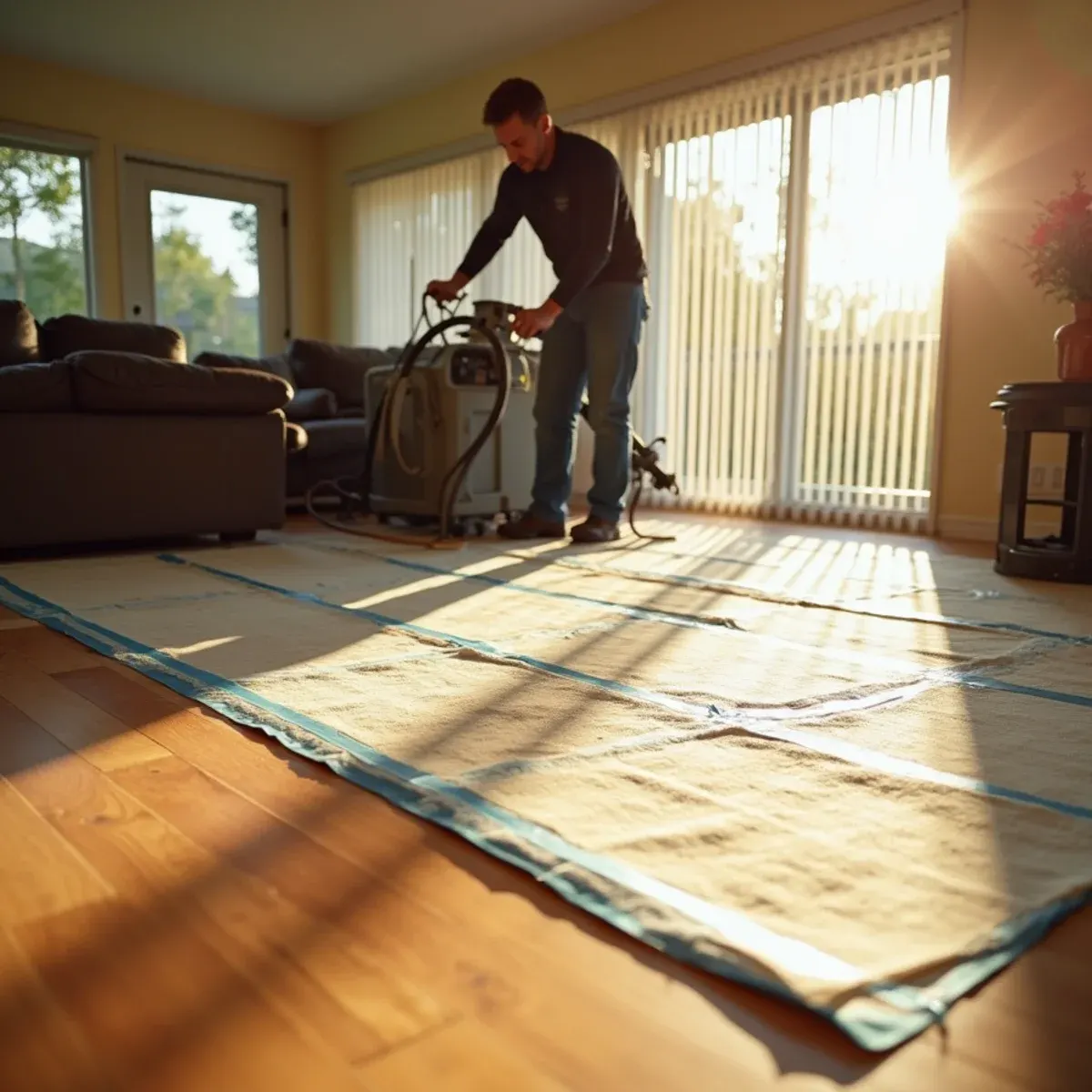
By the time most Villa Park homeowners call us about a wood floor, the leak has been running a while. That isn't neglect. On a half-acre lot with landscape irrigation on the domestic meter, the meter test that would catch a slab leak in a smaller house tells you nothing — the dial moves whether or not anything is wrong. Meanwhile the house has long plumbing runs under a large custom floor plan, and a failure twenty feet from the nearest fixture has plenty of room to sit unnoticed for months.
The floors themselves raise the stakes. These are 1960s and 1970s custom homes with big continuous expanses of site-finished solid oak through entries and formal rooms, often in widths and grades that no longer come off a shelf. Patching in a few boards means a visible seam for the life of the floor. That's the main reason we push mat drying hard here — pulling moisture up through the seams under negative pressure and keeping every original board in place is usually worth the extra days it takes.
What Villa Park Changes About Hardwood Floor Drying
1Irrigation on the meter hides everything
The standard slab-leak check — shut everything off, watch the meter — falls apart on a half-acre lot with irrigation on the domestic service. The dial moves regardless. If your house doesn't have a separate irrigation meter or a shutoff upstream of the valves, get one. Without it, a leak under your floor can run for months before anything at the surface tells you it's there.
2Long runs, late discovery, deep cupping
Large custom plans mean long under-slab piping, and a failure can sit thirty feet from the nearest fixture. By the time the floor moves, the boards have absorbed moisture slowly and uniformly, which produces the deepest cupping we see anywhere. It's also the most reversible kind, provided we dry evenly across the whole plane and nobody puts a sander on it early.
3Floors that cannot be matched
Much of the flooring in these 1960s and 1970s customs is site-finished solid oak in widths and grades that no longer come off a shelf. A patch reads as a patch forever. That's why we lean hard on drying in place here, even when it means more days of equipment in the house — keeping the original boards is worth more than a faster schedule.
How the Work Runs
The method is the same one we use on every hardwood floor drying job, documented to the IICRC S500:2025 standard. Here it is in short — the full hardwood floor water damage drying process explains each stage in detail.
- Measure before deciding anything
- Extract from below the surface
- Control the drying rate deliberately
- Dry the subfloor and any cavity below
- Let it acclimate before judging it
- Sand and refinish only if needed
The Villa Park Background Worth Knowing
In a tract, the plumbing sits where it sat in the last four houses we worked on. In Villa Park it is wherever the plan put it in 1974, and there is rarely a drawing left to consult. That is why locating a leak here can take longer than a homeowner expects. Water from a pinhole travels the path of least resistance under the slab and surfaces wherever the soil and the concrete let it, which on a plan this size can be an entire room away from the break. Guessing at the wet spot is how people end up cutting the wrong floor.
There is more on the housing stock, drainage and plumbing history of this city on our water damage restoration in Villa Park page.
Villa Park at a glance
- Dominant construction era
- 1962–1985
- Foundation type
- slab on grade
- Supply piping found here
- under-slab copper
- Drain line materials
- cast iron, ABS
- Terrain and water table
- rolling, moderate water table
- Most common local failure
- long under-slab runs in large custom floor plans, where a leak can sit far from any fixture and take longer to locate
- Highest-value local prevention
- separating irrigation from the domestic meter so a leak test actually means something
What It Costs in Villa Park
We do not quote a number over the phone before seeing the property — anyone who does is guessing. The variables that actually move the price on a hardwood floor drying job are square footage under the mat system, solid versus engineered wood, what is underneath, and they are broken down in full on the hardwood floor water damage drying page. The assessment and the written estimate are free anywhere in Villa Park, day or night, with no obligation.
Hardwood Floor Drying Questions from Villa Park Homeowners
No. We zone the drying instead of the floor. Mat panels go over the wet area and move as the readings change, with containment to keep conditioned air where it's doing work. The rest of the floor stays untouched and in place. On a continuous run like yours we take readings on a grid across all three rooms daily, because moisture under a single uninterrupted floor doesn't respect doorways.
Frequently, yes. Cupping is caused by uneven moisture between the top and bottom of each board, and when the moisture equalizes during controlled drying, much of the deformation reverses. Full flattening can take two to four weeks of acclimation after the equipment comes out, which is why we do not recommend sanding immediately.
Five to ten days under the mat system is typical, which is longer than drywall because wood gives up moisture slowly and has to be dried at a controlled rate. Rushing it causes splitting and permanent gapping, so the extra days are doing real work.
Start by taking irrigation out of the equation, because on a half-acre lot it is the largest variable you have. Shut the controller off for a full day, then read the meter twice with nothing running in the house. If the leak indicator is still moving, the loss is on the domestic side and worth locating. If it stops, you have a landscape valve or lateral line problem, which is a different and much cheaper trade.