
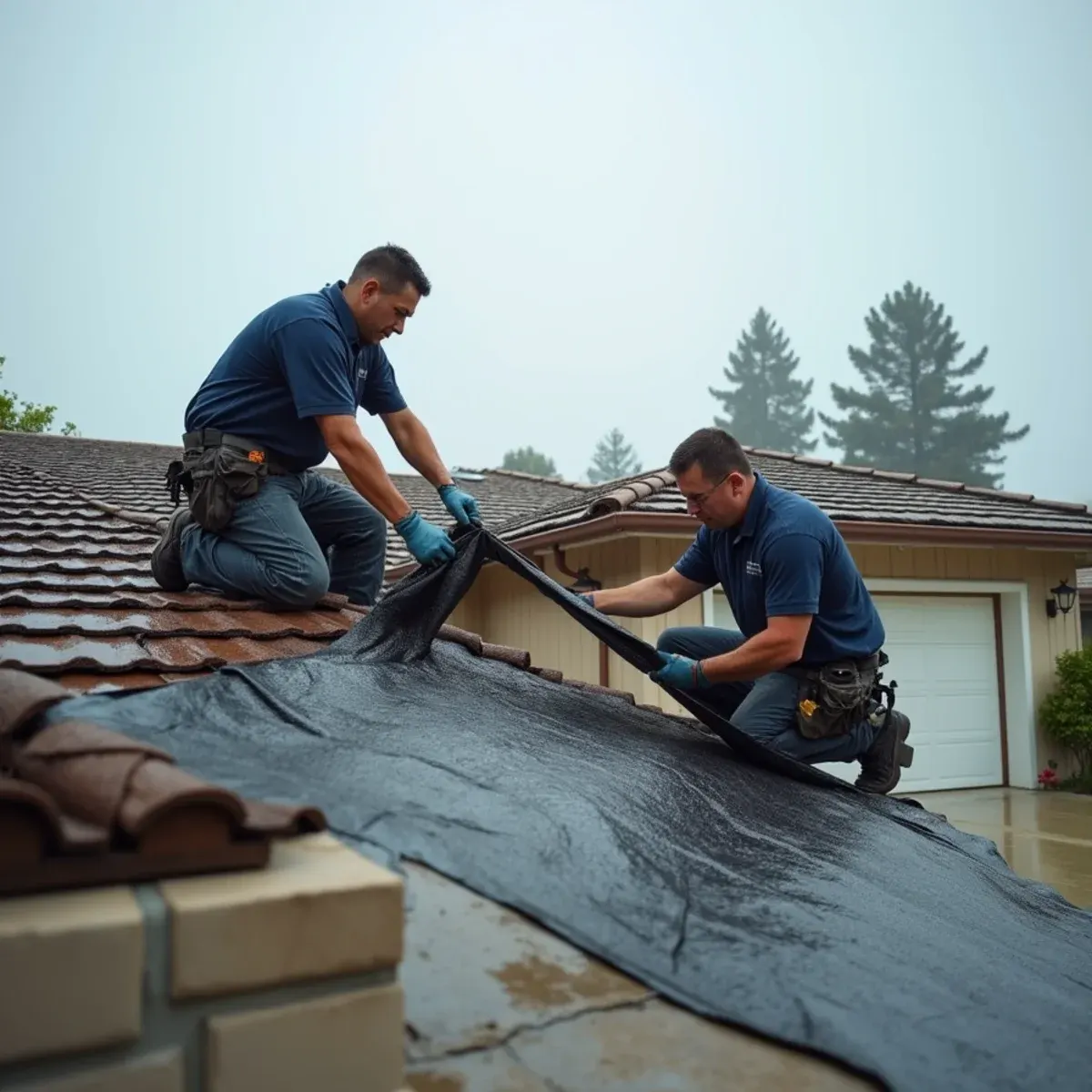
When you call us during a storm, the first thing we ask is what year your house was built. In Tustin that question does more work than anywhere else we serve. A bay window on a side street in Old Town, a 1970s tract roof off Red Hill, and a 2012 build in Columbus Square are three different jobs with three different failure points. Same rain, same night, three different sets of tools on the truck. Telling us the era gets the right crew and the right tarp to your door.
Old Town sits on raised foundations with original-era systems, so storm water gets under the house and stays there. The 1960s through 1980s tract through the middle of the city is slab with aging roof penetrations — jacks, vents and skylight curbs that have been baking in sun for forty years. Tustin Legacy and Columbus Grove are newer, with modern drainage that mostly works, though tight lot lines and shared walls mean one failed scupper can reach several homes. We're about eighteen minutes away and dispatch as conditions allow.
What Tustin Changes About Storm Damage
1Roof penetrations age faster than roofs
The tract housing between Old Town and Tustin Ranch is mostly on its second or third roof, but the flashings, vent boots and skylight curbs often are not. Cracked boots are the single most common storm leak we open up in these neighborhoods. Twenty minutes on a ladder in September, before the first atmospheric river, prevents most of what we get called for in January.
2Old Town crawl spaces take the water
Under a raised Victorian or Craftsman, storm runoff that gets past a gutter has somewhere to go that you never see. We meter the subfloor from below and check the perimeter grade, because on these lots decades of added planting beds have often raised the soil right up against the mudsill. That is a slow, expensive failure, and it starts with one storm.
3Newer Legacy homes, tighter tolerances
Post-2005 construction at Tustin Legacy and Columbus Square drains well until something blocks. Flat-roof scuppers, deck drains and narrow side yards between buildings carry a lot of water, and when they back up there's nowhere for the overflow to go but inside. If you own here, the pre-season job is simple: clear the deck drains and confirm the downspouts still terminate where the builder put them.
How the Work Runs
The method is the same one we use on every storm damage job, documented to the IICRC S500:2025 standard. Here it is in short — the full storm damage restoration process explains each stage in detail.
- Emergency tarping and board-up
- Water diversion and extraction
- Full damage documentation
- Interior mitigation
- Structural drying to standard
- Permanent repairs
The Tustin Background Worth Knowing
You can usually place your house without paperwork. Foundation vents around the perimeter and a floor that sits a step or two above grade means a raised foundation and a crawl space, which puts you in the Old Town generation. A slab sitting flush at grade with no vents puts you in the tract era. If you have a second-floor laundry, a tankless heater, or a manifold of colored plastic tubing in a closet, you are in the Legacy generation. Each of those buildings has an entirely different weak point, and knowing yours is most of the battle.
There is more on the housing stock, drainage and plumbing history of this city on our water damage restoration in Tustin page.
Tustin at a glance
- Dominant construction era
- 1880–2020
- Foundation type
- mixed on grade
- Supply piping found here
- original pre-war piping in Old Town, under-slab copper, modern PEX in Tustin Legacy
- Drain line materials
- cast iron, clay, ABS
- Terrain and water table
- flat, moderate water table
- Most common local failure
- wildly different failure modes street to street, because the era of the house decides everything
- Highest-value local prevention
- knowing which of the three Tustins your house belongs to before assuming any advice applies
What It Costs in Tustin
We do not quote a number over the phone before seeing the property — anyone who does is guessing. The variables that actually move the price on a storm damage job are size of the opening and duration of intrusion, emergency mitigation scope, how many rooms the water reached, and they are broken down in full on the storm damage restoration page. The assessment and the written estimate are free anywhere in Tustin, day or night, with no obligation.
Storm Damage Questions from Tustin Homeowners
Because the water found different paths. On a raised foundation, runoff that clears the gutter goes under the house through the vents and into the crawl space, where you won't see it for weeks. On a slab in Tustin Ranch, the same water has nowhere to hide, so it shows up on the floor the same night. Neither house is better protected. One just tells you sooner than the other.
During. Emergency tarping and board-up happen in the rain — that is the entire point of them. We triage by severity, so active intrusion into occupied living space goes to the front of the queue.
Sudden wind and rain damage is generally covered, including the resulting interior water damage. What gets excluded is damage from a roof that had already failed or from deferred maintenance, and flooding from water that came across the ground, which needs separate flood insurance.
New plumbing removes corrosion from the list, not everything else. What fails in Legacy-era homes is connections and appliances: braided washer hoses, refrigerator ice-maker lines, angle stops, dishwasher fittings, and water heaters that are now well into their service life. Second-floor laundry rooms are the biggest single change from older Tustin housing, because a failure up there drains through two ceilings instead of across a garage slab. Age protects you from one category of failure and none of the others.