
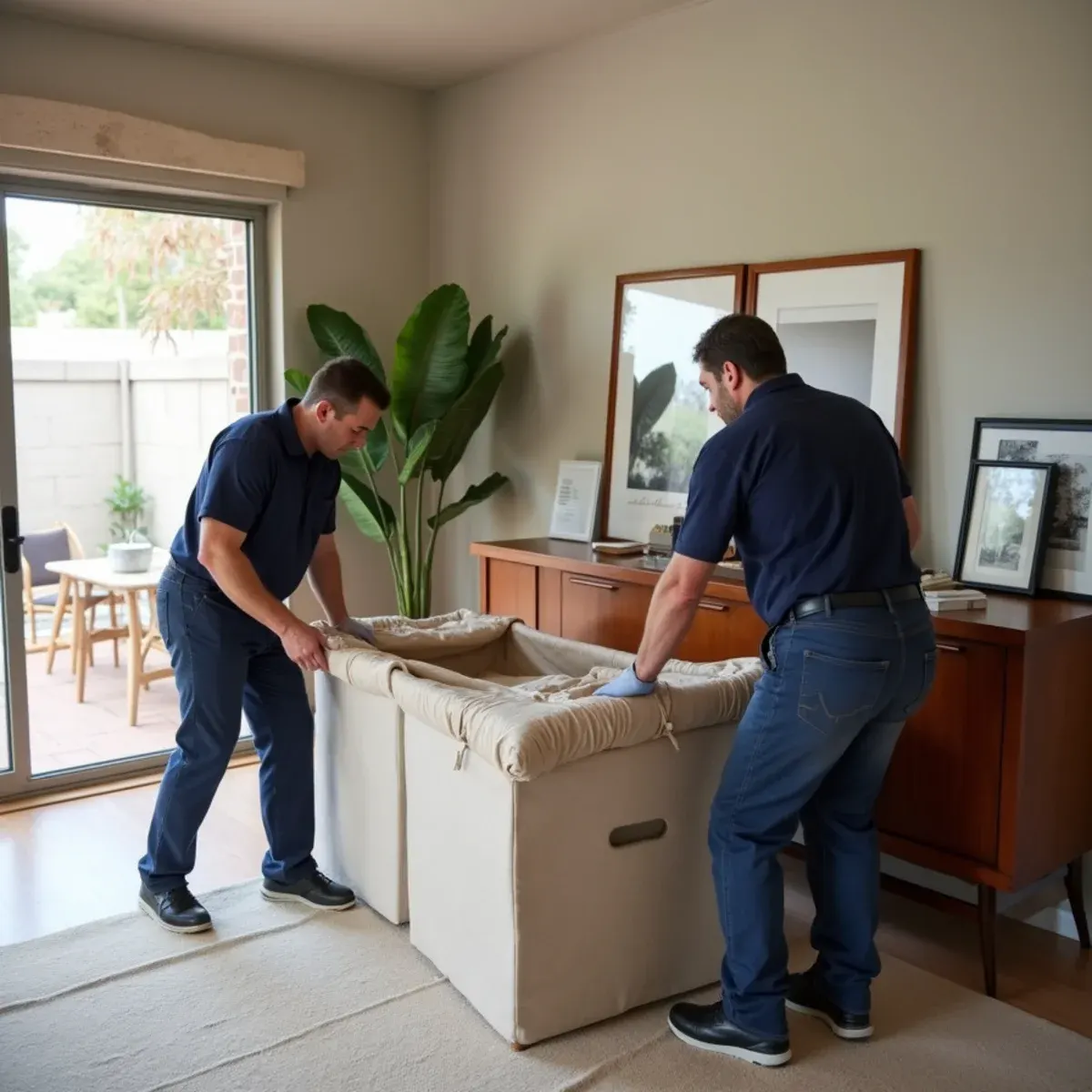
The first question we ask a Tustin caller is not what happened. It is what year the house was built. A pack-out on a 1900s Old Town place off Main Street, a 1970s tract home near Tustin Sports Park and a 2015 attached home in Columbus Square are three different jobs with three different problems, and the belongings inside them are not even stored the same way. Old Town has closets you could not fit a suitcase in. Legacy has garages, attics and walk-ins built to hold a lot more.
The plumbing follows the same split. Old Town runs original pre-war supply and clay drain lines, so losses there tend to be slow and dirty. The middle of the city is under-slab copper from the sixties through the eighties, which wets everything sitting on the floor from below. Tustin Legacy, built on the old Marine Corps Air Station after 2005, has PEX and modern drainage, and its failures are fast, clean and usually upstairs, which sounds better and is not, because a hundred gallons in an hour reaches more of your things than a slow drip ever does.
What Tustin Changes About Contents & Pack-Out
1Old Town doorways were not built for this
Original doorways, tight stair runs and deep porches in Old Town limit what can come out intact. Large case pieces sometimes have to be partly disassembled at the wall, photographed as they come apart, and reassembled at return. We pad jambs and thresholds because the original woodwork is part of what makes the house worth insuring, and a scuffed 1905 casing is its own small loss.
2Attached homes at Legacy mean shared walls
In Columbus Square, Columbus Grove and the newer Legacy blocks, a supply failure crosses into the neighboring unit and into common area. Contents from each household get inventoried and stored separately, tagged by address, so the association's carrier and each owner's personal property carrier work from their own list. Gate codes, elevators and delivery windows also set the pace, and we book those before packing starts.
3Tustin Ranch garages carry the overflow
The 1980s and 1990s tract homes east of Jamboree store the household's real archive in the garage: paperwork, holiday boxes, sports gear, cartons from the last move stacked directly on the slab. An under-slab leak or a water heater failure in that garage soaks cardboard from the bottom up, and nothing looks wrong until the box is lifted and the bottom stays behind.
How the Work Runs
The method is the same one we use on every contents & pack-out job, documented to the IICRC S500:2025 standard. Here it is in short — the full contents restoration & pack-out process explains each stage in detail.
- Room-by-room photographic inventory
- Triage into three categories
- Careful packing and transport
- Cleaning and restoration by material type
- Climate-controlled storage
- Delivery and placement back
The Tustin Background Worth Knowing
You can usually place your house without paperwork. Foundation vents around the perimeter and a floor that sits a step or two above grade means a raised foundation and a crawl space, which puts you in the Old Town generation. A slab sitting flush at grade with no vents puts you in the tract era. If you have a second-floor laundry, a tankless heater, or a manifold of colored plastic tubing in a closet, you are in the Legacy generation. Each of those buildings has an entirely different weak point, and knowing yours is most of the battle.
There is more on the housing stock, drainage and plumbing history of this city on our water damage restoration in Tustin page.
Tustin at a glance
- Dominant construction era
- 1880–2020
- Foundation type
- mixed on grade
- Supply piping found here
- original pre-war piping in Old Town, under-slab copper, modern PEX in Tustin Legacy
- Drain line materials
- cast iron, clay, ABS
- Terrain and water table
- flat, moderate water table
- Most common local failure
- wildly different failure modes street to street, because the era of the house decides everything
- Highest-value local prevention
- knowing which of the three Tustins your house belongs to before assuming any advice applies
What It Costs in Tustin
We do not quote a number over the phone before seeing the property — anyone who does is guessing. The variables that actually move the price on a contents & pack-out job are volume of contents, proportion of specialty items, storage duration, and they are broken down in full on the contents restoration & pack-out page. The assessment and the written estimate are free anywhere in Tustin, day or night, with no obligation.
Contents & Pack-Out Questions from Tustin Homeowners
Small rooms are the reason, not the objection. There is no dry corner in a 900-square-foot Old Town cottage to shuffle furniture into, and air movers cannot work around a full room without pushing moist air through your belongings. Raised-foundation houses also need floor access from above in places. We pack out what sits in the wet zone, leave what genuinely reads dry, and give you the written list either way.
It depends on the scope. For a contained single-room loss we often move contents to an unaffected part of the home and block furniture in place. When the drying chamber covers most of the living area or reconstruction is extensive, off-site pack-out is usually both safer and faster.
Every item is photographed and barcoded at your home and tracked through cleaning, storage, and delivery. You receive the inventory, and at delivery we reconcile it with you item by item before we leave.
New plumbing removes corrosion from the list, not everything else. What fails in Legacy-era homes is connections and appliances: braided washer hoses, refrigerator ice-maker lines, angle stops, dishwasher fittings, and water heaters that are now well into their service life. Second-floor laundry rooms are the biggest single change from older Tustin housing, because a failure up there drains through two ceilings instead of across a garage slab. Age protects you from one category of failure and none of the others.