
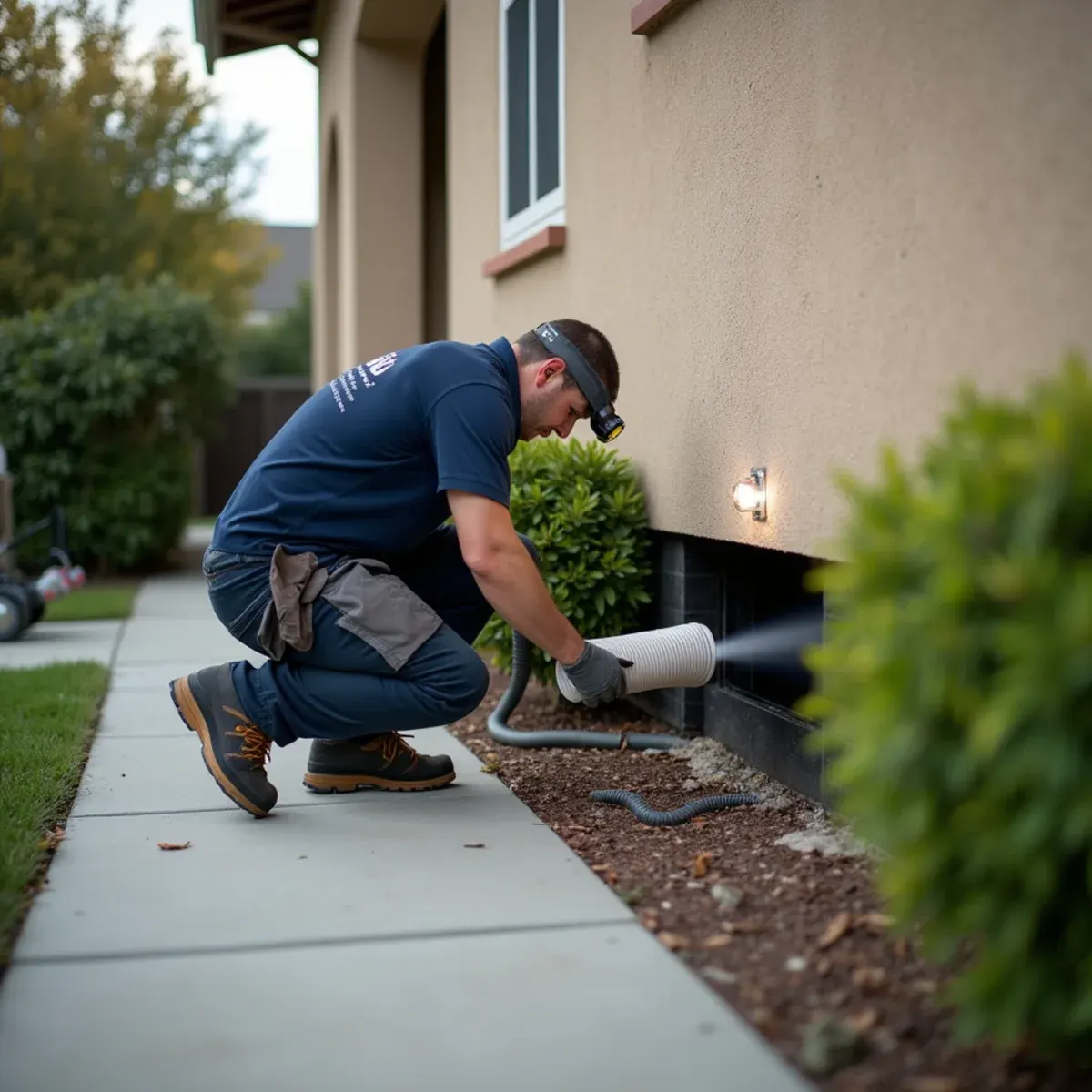
Two Tustin homeowners can call the same morning with the same wet floor and need two completely different jobs. One lives in Old Town in a house from the 1890s or the 1910s: raised foundation, cripple walls, dirt sub-area, original fir floor above. The other bought at Tustin Legacy on the old Marine Corps Air Station, where the floor is a modern slab with PEX in the walls and engineered site drainage outside. Same city, same storm, nothing in common below the finish floor.
In between is the 1960s through 1980s slab tract that fills the middle of the city, and it behaves like any uniform postwar subdivision — under-slab copper, repeated details, failures that cluster by tract. So the first thing we ask in Tustin is your street and your build year, not your symptoms. Old Town is where real crawl-space drying happens: wet fiberglass out of the joist bays, joists and subfloor metered from below, torn ground barrier replaced, and sometimes encapsulation once everything reads dry.
What Tustin Changes About Crawl Space Drying
1Old Town holds the real crawl spaces
The 1880s through 1920s Victorians and Craftsman bungalows around Old Town sit high enough to work under, which is a mercy. They also carry a century of add-ons: retrofit plumbing run through joist bays, ducting laid on the dirt, insulation stapled up in the 1970s that nobody has touched since. Any of it can hold water long after the leak is repaired, so it comes out rather than getting dried in place.
2Tustin Legacy has no sub-area at all
Post-2005 construction on the former air station is slab on grade with modern drainage and PEX supply. Water there comes from a supply fitting, an appliance line or an upstairs bath, and it travels across the slab and down through framing — a different chamber, different containment, different plan. If you're in Legacy and someone offers to dry your crawl space, ask what they think is under your floor.
3Your build year decides everything here
Tustin is three cities inside one boundary, and the era dictates piping generation, foundation type and how water moves. We ask for the address and the approximate build decade on the first call so the truck leaves with the right gear: sub-area equipment and respirators for Old Town, slab leak location for the mid-century tract, containment and cavity drying for Legacy.
How the Work Runs
The method is the same one we use on every crawl space drying job, documented to the IICRC S500:2025 standard. Here it is in short — the full crawl space water damage & drying process explains each stage in detail.
- Get in and map the whole space
- Extract, then remove what is finished
- Build the crawl space into a chamber
- Dry the framing to a measured standard
- Deal with growth on the joists
- New barrier, insulation, encapsulation if warranted
The Tustin Background Worth Knowing
You can usually place your house without paperwork. Foundation vents around the perimeter and a floor that sits a step or two above grade means a raised foundation and a crawl space, which puts you in the Old Town generation. A slab sitting flush at grade with no vents puts you in the tract era. If you have a second-floor laundry, a tankless heater, or a manifold of colored plastic tubing in a closet, you are in the Legacy generation. Each of those buildings has an entirely different weak point, and knowing yours is most of the battle.
There is more on the housing stock, drainage and plumbing history of this city on our water damage restoration in Tustin page.
Tustin at a glance
- Dominant construction era
- 1880–2020
- Foundation type
- mixed on grade
- Supply piping found here
- original pre-war piping in Old Town, under-slab copper, modern PEX in Tustin Legacy
- Drain line materials
- cast iron, clay, ABS
- Terrain and water table
- flat, moderate water table
- Most common local failure
- wildly different failure modes street to street, because the era of the house decides everything
- Highest-value local prevention
- knowing which of the three Tustins your house belongs to before assuming any advice applies
What It Costs in Tustin
We do not quote a number over the phone before seeing the property — anyone who does is guessing. The variables that actually move the price on a crawl space drying job are access and working height, how much of the footprint got wet, water category and soil contamination, and they are broken down in full on the crawl space water damage & drying page. The assessment and the written estimate are free anywhere in Tustin, day or night, with no obligation.
Crawl Space Drying Questions from Tustin Homeowners
That's the normal approach on those houses. The sub-area is treated as its own drying chamber, so we work from underneath: saturated fiberglass comes out, the joists and the underside of the subfloor get dried and metered, and the ground vapor barrier is replaced. Old fir floors will often flatten back out once the moisture below them is gone. We only recommend lifting boards when readings from below stop improving.
Often you cannot tell from inside, which is the whole problem. Sub-area odor rises through plumbing penetrations and the baseboard line and reads like a wall or flooring issue. The check takes about twenty minutes: a technician under the house with a light and a moisture meter. If the framing meters dry and the barrier is intact, we tell you it is not the crawl space and go look somewhere else.
Sometimes, over months, and usually not completely. The vents give you passive air exchange, which only helps when outdoor air is drier than the space. On a marine layer morning here that air is above 80% relative humidity, so the vents are bringing moisture in. Meanwhile the wet soil keeps evaporating and the subfloor above keeps taking it up. Left alone, the common outcome is growth on the joists.
New plumbing removes corrosion from the list, not everything else. What fails in Legacy-era homes is connections and appliances: braided washer hoses, refrigerator ice-maker lines, angle stops, dishwasher fittings, and water heaters that are now well into their service life. Second-floor laundry rooms are the biggest single change from older Tustin housing, because a failure up there drains through two ceilings instead of across a garage slab. Age protects you from one category of failure and none of the others.