
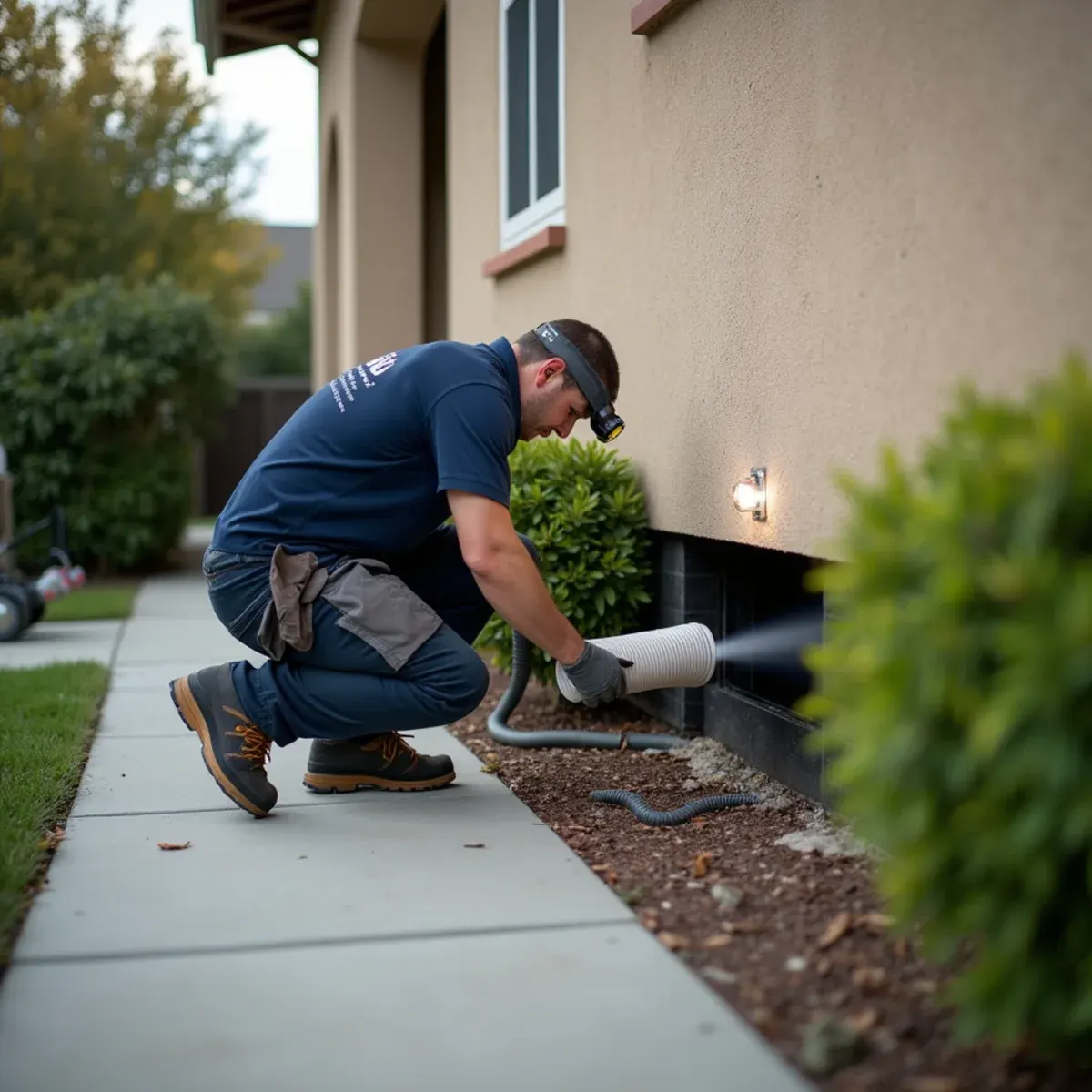
The dish area floor has felt soft for a while and the smell keeps getting blamed on the drain. Underneath is a build-up nobody thinks about: plywood over sleepers over the original 1950s slab, installed during a kitchen remodel to route drain lines the building was never designed to carry. Water and grease have been working under that plywood through cut edges at the sinks and the walk-in for months. It is a confined chamber, it has category three water in it, and it does not dry from the top no matter what you put on the floor.
That is the honest shape of this service in Artesia. The housing here is modest postwar slab from the 1950s through the 70s, so residential crawl space work is rare and mostly limited to a handful of older parcels and the occasional added room. The real underfloor work is commercial, because Pioneer Boulevard holds one of the densest concentrations of independent restaurants and retail anywhere in the region, almost all of it in buildings that predate commercial kitchens by decades, with grease-loaded cast iron laterals feeding the problem from below.
What Artesia Changes About Crawl Space Drying
1Raised kitchen decks over 1950s slabs
When a retail building becomes a restaurant, the floor usually comes up a few inches so drains can run somewhere. That void then collects everything that gets past a coved edge or a penetration at a sink. It has no ventilation, no drainage and no access, so the only way to assess it is to lift sections of decking, and the only way to dry it is as a sealed chamber.
2Category three from the first minute
Water that has been under a kitchen deck alongside grease-restricted cast iron is not clean water and never was. That sets the rules: containment, protection of adjacent prep areas, removal rather than drying of porous materials, and cleaning before drying. Treating it as a straightforward extraction because it looks like clear water on the surface is how a kitchen fails an inspection two weeks later.
3Drying a kitchen that cannot close
On Pioneer Boulevard a week dark is not a survivable option for most of these operators. We phase the work around service, contain the affected section so the rest of the line keeps running where the health department allows it, and do the loud and dirty stages overnight. It takes longer on paper. It costs the owner far less than closing.
How the Work Runs
The method is the same one we use on every crawl space drying job, documented to the IICRC S500:2025 standard. Here it is in short — the full crawl space water damage & drying process explains each stage in detail.
- Get in and map the whole space
- Extract, then remove what is finished
- Build the crawl space into a chamber
- Dry the framing to a measured standard
- Deal with growth on the joists
- New barrier, insulation, encapsulation if warranted
The Artesia Background Worth Knowing
A commercial kitchen is one of the hardest things you can ask a building to accommodate. High water use, continuous drainage, grease loading, floor drains, and equipment connections that get added and modified over the years. When that kitchen is in a building from the 1950s with original cast-iron waste lines, the failure is a matter of time.
There is more on the housing stock, drainage and plumbing history of this city on our water damage restoration in Artesia page.
Artesia at a glance
- Dominant construction era
- 1950–1970
- Foundation type
- slab on grade
- Supply piping found here
- galvanized steel, copper
- Drain line materials
- cast iron
- Terrain and water table
- flat, moderate water table
- Most common local failure
- grease-loaded cast-iron waste lines restricting until a commercial kitchen backs up
- Highest-value local prevention
- hydro-jetting the waste line rather than snaking it, so the pipe wall actually gets cleaned
What It Costs in Artesia
We do not quote a number over the phone before seeing the property — anyone who does is guessing. The variables that actually move the price on a crawl space drying job are access and working height, how much of the footprint got wet, water category and soil contamination, and they are broken down in full on the crawl space water damage & drying page. The assessment and the written estimate are free anywhere in Artesia, day or night, with no obligation.
Crawl Space Drying Questions from Artesia Homeowners
Usually in stages, not all at once. We contain and work one section at a time so the rest of the line can keep operating where your health inspector permits it, and we schedule demolition and deck removal overnight. What we will not do is leave contaminated material in place to keep you open, because water that has been sitting under a kitchen deck with grease in it has to come out before anything gets dried or closed back up.
Often you cannot tell from inside, which is the whole problem. Sub-area odor rises through plumbing penetrations and the baseboard line and reads like a wall or flooring issue. The check takes about twenty minutes: a technician under the house with a light and a moisture meter. If the framing meters dry and the barrier is intact, we tell you it is not the crawl space and go look somewhere else.
Sometimes, over months, and usually not completely. The vents give you passive air exchange, which only helps when outdoor air is drier than the space. On a marine layer morning here that air is above 80% relative humidity, so the vents are bringing moisture in. Meanwhile the wet soil keeps evaporating and the subfloor above keeps taking it up. Left alone, the common outcome is growth on the joists.
Yes, and on Pioneer Boulevard that is usually how we schedule it. Overnight crews cost somewhat more in labor and almost always cost dramatically less than lost revenue from closing during operating hours.