
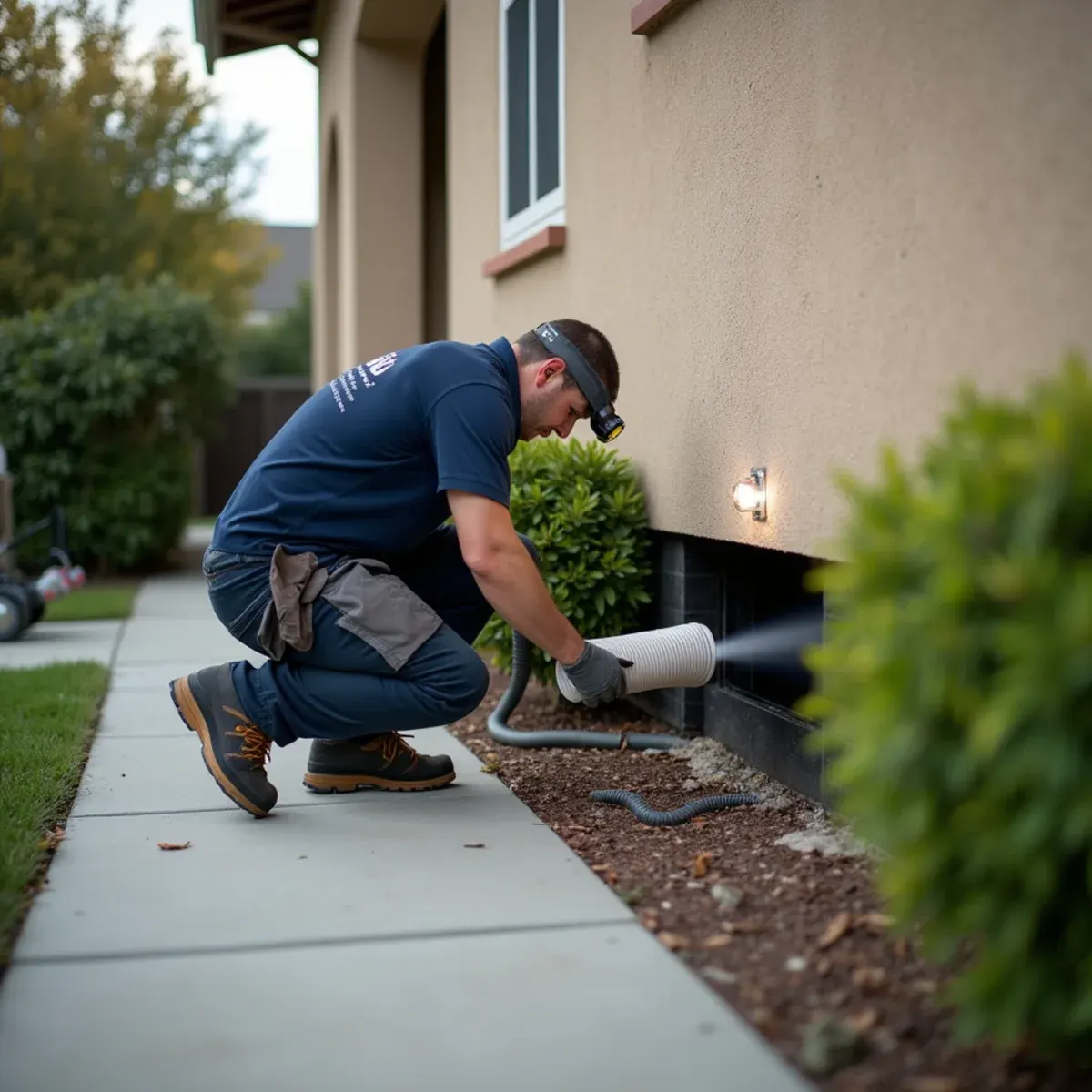
The call usually comes from a property manager rather than an owner-occupant. A ground-floor tenant says the unit smells like a wet basement, the floors look fine, nothing is dripping, and two people have already been out and found nothing. In a city with as much older multi-family stock as Buena Park, that combination points down. The sub-area under a pre-1960 walk-up or fourplex is the part of the building nobody has opened since it was built, and a supply leak down there drips into dirt for months without producing a single visible symptom.
Be clear about the fit, though. Most of Buena Park is slab-on-grade, the 1950s through 1970s tracts running out toward Ralph B. Clark Regional Park, and for those homes this service does not apply at all. Raised sub-areas here are concentrated in the older residential pockets and in some of the earlier income properties. Along the Beach Boulevard corridor near Knott's, what looks like a crawl space is more often a utility void or a floor build-up under a restaurant or hotel service area, which is a different job with different contamination rules.
What Buena Park Changes About Crawl Space Drying
1One sub-area serving four units
In an older fourplex, the space under the floor is shared, and so is the drying chamber. Water from one unit's supply line ends up under a neighbor's bedroom. That means containment and metering across the whole footprint, not just the unit that complained, and it means scheduling access to units whose tenants have no idea anything is wrong yet.
2Access hatches buried behind tenant storage
Sub-area hatches in these buildings end up under laundry room shelving, behind water heaters, or covered by a tenant's belongings in a closet. Finding and clearing the opening is routinely the slowest part of the first visit. If you manage the property, knowing where the access is before you call us saves an hour on a job where hours matter.
3Post the shutoff before you need it
A sub-area leak in a multi-unit building here runs unnoticed until it is a structural conversation. A labeled main shutoff and a laminated card in the laundry room does not prevent that, but it caps the sudden failures. It is the cheapest thing an owner in this city can do, and it is the thing we most often find missing.
How the Work Runs
The method is the same one we use on every crawl space drying job, documented to the IICRC S500:2025 standard. Here it is in short — the full crawl space water damage & drying process explains each stage in detail.
- Get in and map the whole space
- Extract, then remove what is finished
- Build the crawl space into a chamber
- Dry the framing to a measured standard
- Deal with growth on the joists
- New barrier, insulation, encapsulation if warranted
The Buena Park Background Worth Knowing
Buena Park has a large apartment and condominium stock, and multi-unit water losses are a meaningful share of our work here. A supply line failure in a second-floor unit reaches the unit below within minutes and frequently affects three or four units before anyone finds the shutoff.
There is more on the housing stock, drainage and plumbing history of this city on our water damage restoration in Buena Park page.
Buena Park at a glance
- Dominant construction era
- 1950–1975
- Foundation type
- slab on grade
- Supply piping found here
- galvanized steel, under-slab copper
- Drain line materials
- cast iron
- Terrain and water table
- flat, moderate water table
- Most common local failure
- multi-unit escalation, where one riser or supply failure reaches three or four units before anyone finds the shutoff
- Highest-value local prevention
- posting the main shutoff location and an emergency contact where tenants will actually see it
What It Costs in Buena Park
We do not quote a number over the phone before seeing the property — anyone who does is guessing. The variables that actually move the price on a crawl space drying job are access and working height, how much of the footprint got wet, water category and soil contamination, and they are broken down in full on the crawl space water damage & drying page. The assessment and the written estimate are free anywhere in Buena Park, day or night, with no obligation.
Crawl Space Drying Questions from Buena Park Homeowners
If the building predates about 1960 and sits on a raised perimeter foundation, look under it. A slow supply leak in a sub-area evaporates into the space rather than reaching finish materials, so the air smells wrong long before anything upstairs measures wet. We open the hatch, meter the joists and subfloor from below, and check the ground barrier. If the building is slab, we say so and move the search to the walls and the lines in them.
Often you cannot tell from inside, which is the whole problem. Sub-area odor rises through plumbing penetrations and the baseboard line and reads like a wall or flooring issue. The check takes about twenty minutes: a technician under the house with a light and a moisture meter. If the framing meters dry and the barrier is intact, we tell you it is not the crawl space and go look somewhere else.
Sometimes, over months, and usually not completely. The vents give you passive air exchange, which only helps when outdoor air is drier than the space. On a marine layer morning here that air is above 80% relative humidity, so the vents are bringing moisture in. Meanwhile the wet soil keeps evaporating and the subfloor above keeps taking it up. Left alone, the common outcome is growth on the joists.
Regularly. Multi-unit losses get documented unit by unit with separate photographs, moisture maps, and drying logs, which is what lets several owners, an HOA, and multiple carriers each resolve their portion without disputing a single blended invoice.