
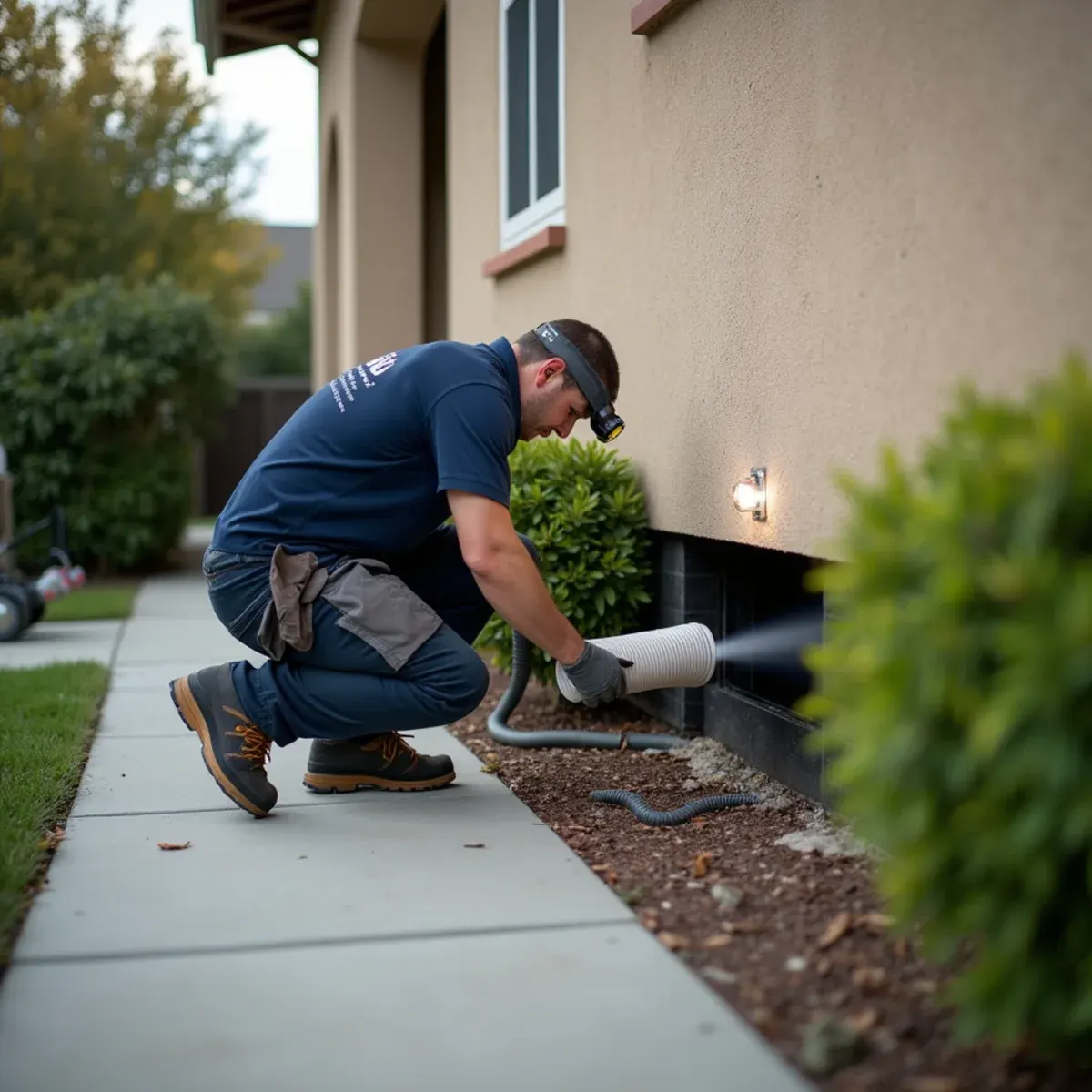
Brea puts two very different houses ten minutes apart. Near downtown there are small 1920s houses from the oil-town days, some still on raised foundations with post-and-pier framing and a dirt sub-area you can actually get into. Head north and east toward Carbon Canyon and it's 1990s and 2000s hillside tract — slab on grade, engineered pads, retaining walls, terrace drains. The crawl-space work in this city is concentrated in that older downtown band, and it is a genuinely small share of the housing stock.
The hills change how water arrives. The Brea Olinda oil field shaped the northern terrain, and Carbon Canyon funnels concentrated storm flow toward the developed slopes below it. When a canyon storm overwhelms slope drainage, water hits houses fast and with force rather than creeping up slowly. On the old downtown lots the effect is different: the ground under a 1920s cottage stays wet for weeks after the surface looks dry, and fiberglass someone stapled into those joist bays in the 1970s holds it there.
What Brea Changes About Crawl Space Drying
1Downtown-era cottages on post and pier
The small houses near old downtown Brea are the ones with real sub-areas. Clearance is low, the perimeter vents are often painted shut or blocked by decades of planting, and the ground barrier is usually torn or missing entirely. Wet fiberglass in those bays does not dry on its own — it comes out, the joists get metered, and new sheeting goes down on the dirt before we call it finished.
2Canyon storms deliver water all at once
Carbon Canyon runoff is not a steady soak. It arrives in a burst during a concentrated storm, overloads slope drains and area drains, and pushes into the low side of a pad within minutes. Houses that stayed dry for ten winters take water in one afternoon. If you're below the canyon, the drying plan has to account for silt and debris in that water, not just moisture.
3Hillside tracts are slab, not crawl space
The 1990s and 2000s development toward the hills is slab on grade with modern drainage. If your Brea house is from that era, water under the floor means a slab leak or an exterior entry point, and drying happens in flooring, wall cavities and the slab itself. We say that plainly rather than selling sub-area work on a house that doesn't have a sub-area.
How the Work Runs
The method is the same one we use on every crawl space drying job, documented to the IICRC S500:2025 standard. Here it is in short — the full crawl space water damage & drying process explains each stage in detail.
- Get in and map the whole space
- Extract, then remove what is finished
- Build the crawl space into a chamber
- Dry the framing to a measured standard
- Deal with growth on the joists
- New barrier, insulation, encapsulation if warranted
The Brea Background Worth Knowing
Brea's hillside tracts were designed to handle rain. Terrace drains catch runoff partway up a slope, v-ditches carry it around the toe, area drains take the flat yard, and everything ties into a system that moves water past the house rather than through it. The design works. What fails is maintenance. Over a dry summer those inlets fill with eucalyptus leaf litter, decomposed granite, and whatever the wind brought down the canyon, and nobody looks at them because they sit on a slope behind a fence. The first hard storm of the season finds every one that is blocked.
There is more on the housing stock, drainage and plumbing history of this city on our water damage restoration in Brea page.
Brea at a glance
- Dominant construction era
- 1920–2005
- Foundation type
- mixed on grade
- Supply piping found here
- galvanized steel, under-slab copper, PEX in newer hillside tracts
- Drain line materials
- cast iron, clay, ABS
- Terrain and water table
- hillside-mixed, deep water table
- Most common local failure
- canyon and hillside runoff overwhelming slope drainage during concentrated storms
- Highest-value local prevention
- keeping Carbon Canyon-side slope drains, v-ditches and downspout extensions genuinely clear
What It Costs in Brea
We do not quote a number over the phone before seeing the property — anyone who does is guessing. The variables that actually move the price on a crawl space drying job are access and working height, how much of the footprint got wet, water category and soil contamination, and they are broken down in full on the crawl space water damage & drying page. The assessment and the written estimate are free anywhere in Brea, day or night, with no obligation.
Crawl Space Drying Questions from Brea Homeowners
It's common, but it isn't fine. A recurring winter smell usually means the ground vapor barrier is torn or was never installed, so soil moisture evaporates straight up into the joists all season. Add old fiberglass that has been holding damp for years and you get fungal growth on the framing. Drying alone won't fix a seasonal pattern — new sheeting on the dirt, and on some of these houses encapsulation, is what stops it.
Often you cannot tell from inside, which is the whole problem. Sub-area odor rises through plumbing penetrations and the baseboard line and reads like a wall or flooring issue. The check takes about twenty minutes: a technician under the house with a light and a moisture meter. If the framing meters dry and the barrier is intact, we tell you it is not the crawl space and go look somewhere else.
Sometimes, over months, and usually not completely. The vents give you passive air exchange, which only helps when outdoor air is drier than the space. On a marine layer morning here that air is above 80% relative humidity, so the vents are bringing moisture in. Meanwhile the wet soil keeps evaporating and the subfloor above keeps taking it up. Left alone, the common outcome is growth on the joists.
Usually not under a standard homeowners policy. Water that runs across the ground and enters a building is surface water, and that is an excluded cause on nearly every form, whether it came off a Carbon Canyon slope or out of the street. Separate flood coverage handles it. Damage from a covered failure is a different story, so let us document the entry point and cause before anything gets cleaned up.