
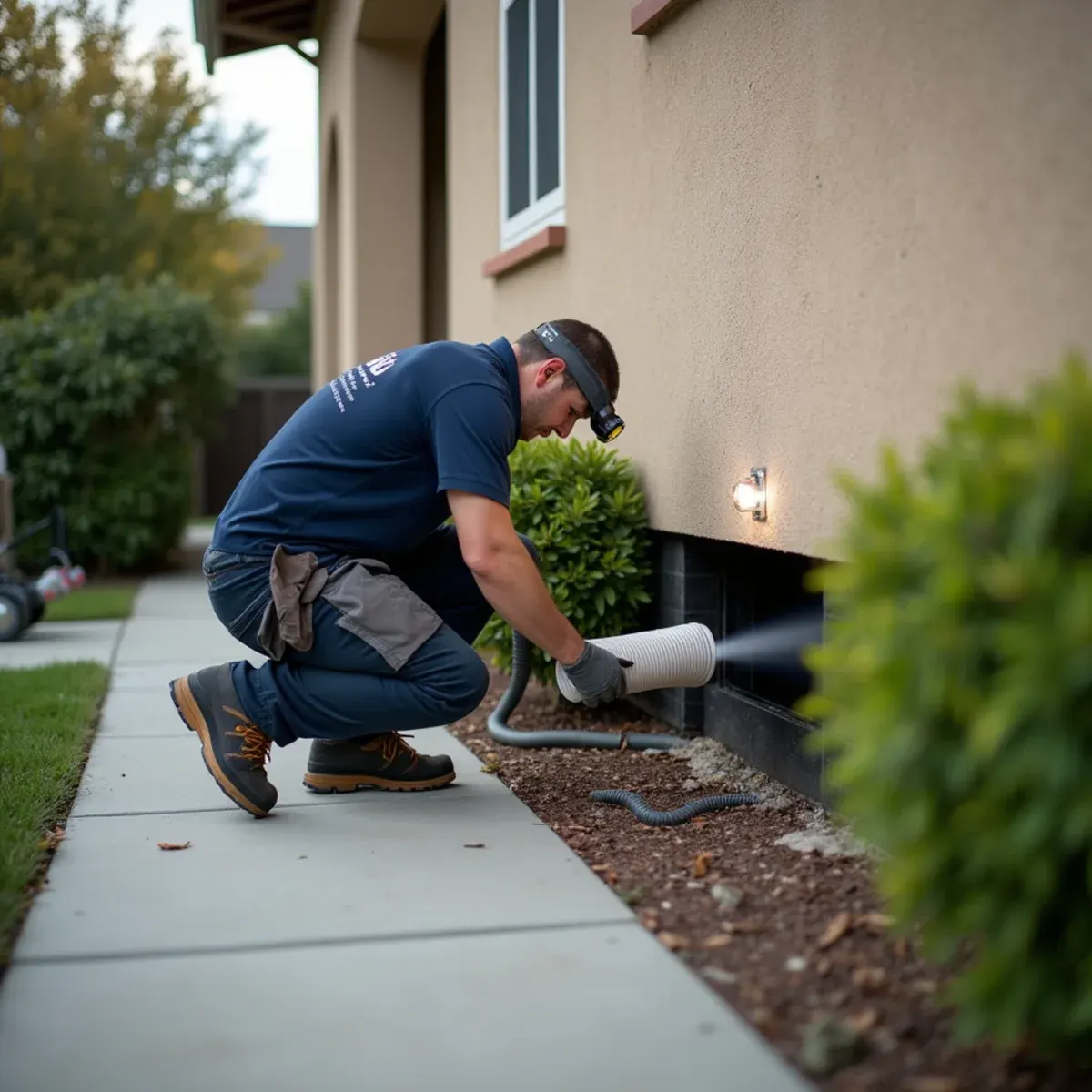
Crawl-space drying is not the common job in Placentia, and it would be dishonest to pretend otherwise. The city built out from the Valencia orange groves between roughly 1955 and 1980, and the tracts are uniform: slab on grade, under-slab copper, the same details street after street. That uniformity means failures cluster — when copper in one tract reaches the end of its life, neighbors start calling within a couple of years of each other. Concrete, not dirt, is what's under most of these floors.
Where sub-floor voids do turn up is the older pocket around Old Town Placentia, north of the tract wave, plus additions and converted garages elsewhere in the city. Those spaces are shallow, usually unlined, and often insulated late and badly. There's also a rental factor: the student housing near Cal State Fullerton turns over often enough that a slow leak under an added room can run for months. If you have a vented opening in an exterior wall, there is something under your floor worth looking at.
What Placentia Changes About Crawl Space Drying
1Old Town's older stock is the exception
The pre-tract houses near Old Town predate the slab era and some still sit on raised foundations with dirt below. They're low-clearance, tight to work in, and rarely have an intact ground vapor barrier. When one of those takes water, the fiberglass comes out and the ground gets sheeted before we talk about anything else. It's a small slice of Placentia, but it's real work when it comes up.
2Under-slab copper is the usual cause
In the tracts, a wet floor almost always traces to a pinhole in copper buried in or under the slab. It reads like ground moisture rising from below, which sends people hunting for a crawl space that isn't there. We locate it by pressure testing and thermal patterning, then dry the slab and the affected wall cavities rather than opening the whole floor to find out.
3Rental turnover hides slow leaks
Near Cal State Fullerton, houses and converted units change hands on the academic year. A tenant notices a smell in October, mentions it in June, and by then a sub-floor void under an addition has been damp long enough for growth on the framing. Landlords who call us for a look between tenancies usually catch it while it's still a drying job and not a rebuild.
How the Work Runs
The method is the same one we use on every crawl space drying job, documented to the IICRC S500:2025 standard. Here it is in short — the full crawl space water damage & drying process explains each stage in detail.
- Get in and map the whole space
- Extract, then remove what is finished
- Build the crawl space into a chamber
- Dry the framing to a measured standard
- Deal with growth on the joists
- New barrier, insulation, encapsulation if warranted
The Placentia Background Worth Knowing
Copper under a slab fails in two directions at once. From the inside, decades of water flow erode thin spots at bends and fittings, especially on the hot side where the metal runs warmer and the water moves faster. From the outside, soil chemistry and stray current attack the pipe wall. Either way the result is a pinhole rather than a burst, which is precisely why these losses are so expensive by the time we see them. A pinhole under concrete can run for months, soaking the sub-base, wicking up into the slab, and surfacing at the edge of the carpet as a stain nobody can explain.
There is more on the housing stock, drainage and plumbing history of this city on our water damage restoration in Placentia page.
Placentia at a glance
- Dominant construction era
- 1955–1980
- Foundation type
- slab on grade
- Supply piping found here
- under-slab copper, galvanized steel
- Drain line materials
- cast iron
- Terrain and water table
- flat, moderate water table
- Most common local failure
- under-slab copper reaching the end of its service life across whole tracts at once
- Highest-value local prevention
- the annual water-meter test, and treating a neighbor's slab leak as information
What It Costs in Placentia
We do not quote a number over the phone before seeing the property — anyone who does is guessing. The variables that actually move the price on a crawl space drying job are access and working height, how much of the footprint got wet, water category and soil contamination, and they are broken down in full on the crawl space water damage & drying page. The assessment and the written estimate are free anywhere in Placentia, day or night, with no obligation.
Crawl Space Drying Questions from Placentia Homeowners
Usually one of two things. Either your house predates the tract and has a genuine raised sub-area, or a later addition was framed over a shallow wood floor and given a vent. Both hold moisture, both can grow mold on joists, and neither shows a puddle. Open it and look for plastic sheeting on the dirt and for insulation hanging out of the bays — sagging fiberglass means water has been in there. Send us a photo if you're unsure.
Often you cannot tell from inside, which is the whole problem. Sub-area odor rises through plumbing penetrations and the baseboard line and reads like a wall or flooring issue. The check takes about twenty minutes: a technician under the house with a light and a moisture meter. If the framing meters dry and the barrier is intact, we tell you it is not the crawl space and go look somewhere else.
Sometimes, over months, and usually not completely. The vents give you passive air exchange, which only helps when outdoor air is drier than the space. On a marine layer morning here that air is above 80% relative humidity, so the vents are bringing moisture in. Meanwhile the wet soil keeps evaporating and the subfloor above keeps taking it up. Left alone, the common outcome is growth on the joists.
Worried is the wrong word, but you should start paying attention. These tracts were built in tight windows with the same copper at the same depth in the same soil, so failures cluster on a street rather than scattering randomly. Treat a neighbor's slab leak as a service bulletin for your own house. Run the meter test, listen for the water heater cycling at odd hours, and check the hallway and bedroom floors for warm or damp patches every so often.