
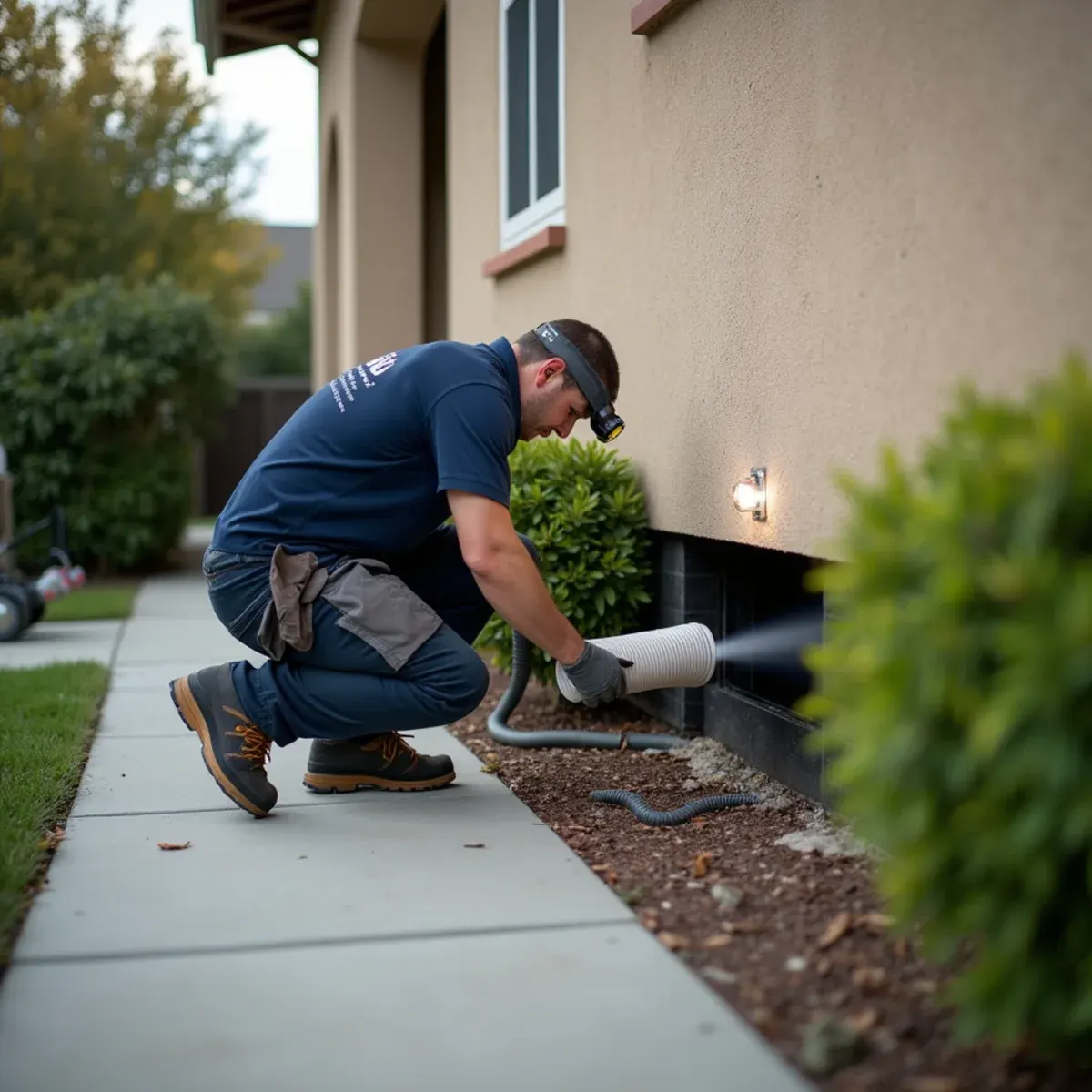
A terrace drain on the slope behind a Yorba Linda house plugs with leaf litter in November. The next real storm sheets water over the top of it, down the engineered slope, and into the low side of the pad. Nothing about that failure involves plumbing, and nothing about it involves a crawl space — the house is on a slab like nearly everything built here between 1970 and 2005. Water gets in at a door threshold or through the garage, not from underneath the floor.
That makes crawl-space drying uncommon in Yorba Linda, and pretending otherwise would waste your time. What does exist is sub-floor void: split-level pads where the lower run steps down, raised rooms built out over sloping ground, floors framed above a garage or a hillside deck. Those spaces trap water that arrives from above. Add heavy landscape irrigation on large lots, retaining walls everywhere, and the parts of the city inside the 2008 Freeway Complex Fire footprint where burn-scar runoff behaved differently for years.
What Yorba Linda Changes About Crawl Space Drying
1Slope drainage fails before plumbing does
Terrace drains, area drains and the swales behind retaining walls are what keep water off a Yorba Linda pad. They clog with slope litter and nobody looks until it rains hard. When we dry a house here we walk the slope first, because if the drain that let the water in is still blocked, the next storm undoes the work. We'll tell you what needs clearing even though we aren't the ones clearing it.
2Stepped pads create hidden sub-floor voids
Hillside lots produce split-level construction: a den or bedroom wing framed over ground that falls away, sometimes with a shallow crawl area beneath. Those voids are unvented as often as not, and they collect water that ran down the slope rather than water from a pipe. They also dry slowly because there's no airflow path. We open access, pull wet insulation, and force air through with ducting.
3Irrigation keeps the ground already loaded
Larger lots here run a lot of water — slope plantings, lawns, mature trees, each on separate valves. Soil that is already at capacity in October has nothing left to absorb in December, and it shows up as moisture readings that refuse to fall. We ask you to shut irrigation off entirely for the duration of drying, then re-read. It usually does more than adding another dehumidifier.
How the Work Runs
The method is the same one we use on every crawl space drying job, documented to the IICRC S500:2025 standard. Here it is in short — the full crawl space water damage & drying process explains each stage in detail.
- Get in and map the whole space
- Extract, then remove what is finished
- Build the crawl space into a chamber
- Dry the framing to a measured standard
- Deal with growth on the joists
- New barrier, insulation, encapsulation if warranted
The Yorba Linda Background Worth Knowing
A hillside lot in Yorba Linda is a drainage system with a house attached. Terrace drains cut across the face of the slope to intercept water before it gains speed. Brow ditches run along the top to keep runoff from ever reaching the slope face. Down-drains carry the collected water to the street or a storm connection. Retaining walls have weep holes and, behind them, a gravel subdrain that relieves pressure on the wall. Every one of those was engineered as part of the pad. Every one of them silts up, roots over, or gets buried by landscaping.
There is more on the housing stock, drainage and plumbing history of this city on our water damage restoration in Yorba Linda page.
Yorba Linda at a glance
- Dominant construction era
- 1970–2005
- Foundation type
- slab on grade
- Supply piping found here
- under-slab copper, later PEX and CPVC
- Drain line materials
- ABS, cast iron
- Terrain and water table
- hillside-mixed, deep water table
- Most common local failure
- exterior water from failed slope drainage, terrace drains and retaining-wall systems rather than from plumbing
- Highest-value local prevention
- clearing terrace and slope drains before the season, since a blocked one turns an engineered hillside into a funnel
What It Costs in Yorba Linda
We do not quote a number over the phone before seeing the property — anyone who does is guessing. The variables that actually move the price on a crawl space drying job are access and working height, how much of the footprint got wet, water category and soil contamination, and they are broken down in full on the crawl space water damage & drying page. The assessment and the written estimate are free anywhere in Yorba Linda, day or night, with no obligation.
Crawl Space Drying Questions from Yorba Linda Homeowners
Probably a sub-floor void rather than a full crawl space. On hillside lots the framing often steps down over the falling grade, leaving a shallow area under one wing. It's worth opening after a wet winter: look for standing water, insulation hanging out of the bays, and torn plastic on the dirt. If water is getting in there, the cause is usually a terrace drain or slope swale above the house, not a plumbing leak.
Often you cannot tell from inside, which is the whole problem. Sub-area odor rises through plumbing penetrations and the baseboard line and reads like a wall or flooring issue. The check takes about twenty minutes: a technician under the house with a light and a moisture meter. If the framing meters dry and the barrier is intact, we tell you it is not the crawl space and go look somewhere else.
Sometimes, over months, and usually not completely. The vents give you passive air exchange, which only helps when outdoor air is drier than the space. On a marine layer morning here that air is above 80% relative humidity, so the vents are bringing moisture in. Meanwhile the wet soil keeps evaporating and the subfloor above keeps taking it up. Left alone, the common outcome is growth on the joists.
Seeping from the weep holes is usually the wall doing its job, relieving water pressure from the soil behind it. The concerning version is the opposite: weep holes that stay dry through a storm while the ground above stays soggy, which suggests the subdrain behind the wall is plugged and pressure is building. Also watch for new cracking, bulging, or a wall that has tipped slightly. Those are engineering questions rather than restoration ones, and we will say so.