
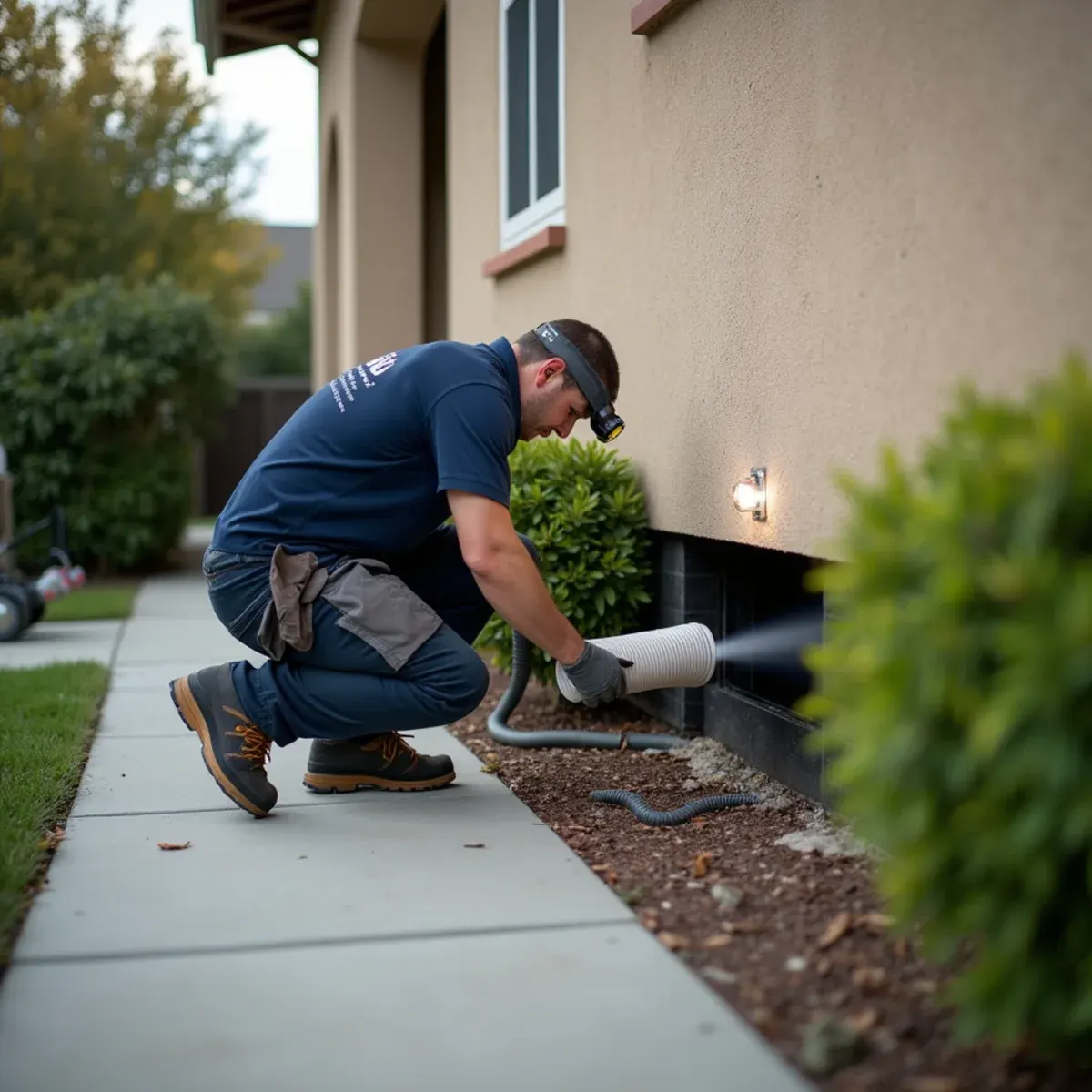
The closest thing to crawl-space work in Carson usually happens under a manufactured home. Carson has an unusually large mobile home park population, and those floors are built differently: a belly wrap — a sheet membrane slung under the joists holding batt insulation — runs the length of the home. When a supply line above it leaks, the wrap catches the water and holds it like a bag. Nothing drips onto the ground, nothing shows outside, and the subfloor above soaks from underneath for weeks.
The rest of the city is conventional postwar tract, built roughly 1950 to 1975 on slab, incorporated in 1968 on land that had been ranch, oil field and industry. The water table is shallow, refineries and logistics operations sit immediately adjacent to housing, and the flat ground drains slowly. So a Carson job is usually one of two things: a slab-era house with an under-slab supply failure, or a manufactured home where the whole underfloor assembly has to be opened and dried.
What Carson Changes About Crawl Space Drying
1Belly wrap holds water like a bag
That membrane is designed to keep rodents and cold air out, and it does the same job on water. Insulation inside it stays saturated, the subfloor above softens, and the smell arrives long before any visible damage. Drying a manufactured home means cutting and draining the wrap at controlled locations, removing the wet batt, drying the joists and decking, then patching the membrane properly rather than taping over it.
2Shallow water table under flat ground
Carson sits low and flat over groundwater that's close to the surface, so soil under a home's underfloor area stays damp regardless of what the plumbing did. That works against drying, and it means skirting condition and any ground moisture barrier matter. On park spaces where the pad drains poorly, we address ground moisture as part of the job or the readings simply won't hold.
3Slab tracts have no sub-area at all
The conventional housing here is slab on grade. If your Carson house is from the 1950s through the 1970s and sits on concrete, wet flooring means a slab leak, a supply failure inside a wall, or water entering at grade — and we dry flooring, cavities and the slab rather than anything underneath. We'll tell you which situation you're in on the first walk-through.
How the Work Runs
The method is the same one we use on every crawl space drying job, documented to the IICRC S500:2025 standard. Here it is in short — the full crawl space water damage & drying process explains each stage in detail.
- Get in and map the whole space
- Extract, then remove what is finished
- Build the crawl space into a chamber
- Dry the framing to a measured standard
- Deal with growth on the joists
- New barrier, insulation, encapsulation if warranted
The Carson Background Worth Knowing
Manufactured homes are built with the floor deck, usually particleboard or OSB, sitting on a steel frame, with batt insulation below it and a vapor barrier belly wrap stapled underneath to hold everything in place. Supply lines run through that cavity. When one leaks, the water does not run out onto the ground where you would see it. The belly wrap catches and holds it, the insulation soaks it up, and you now have a sealed reservoir under your floor with no path to evaporate. It can sit there for months before anything shows upstairs.
There is more on the housing stock, drainage and plumbing history of this city on our water damage restoration in Carson page.
Carson at a glance
- Dominant construction era
- 1950–1975
- Foundation type
- slab on grade
- Supply piping found here
- galvanized steel, under-slab copper, manufactured-home supply lines
- Drain line materials
- cast iron
- Terrain and water table
- flat, shallow water table
- Most common local failure
- manufactured-home underfloor leaks trapped in the belly wrap, alongside conventional 1960s slab failures
- Highest-value local prevention
- treating any soft spot in a manufactured-home floor as moisture until a meter proves otherwise
What It Costs in Carson
We do not quote a number over the phone before seeing the property — anyone who does is guessing. The variables that actually move the price on a crawl space drying job are access and working height, how much of the footprint got wet, water category and soil contamination, and they are broken down in full on the crawl space water damage & drying page. The assessment and the written estimate are free anywhere in Carson, day or night, with no obligation.
Crawl Space Drying Questions from Carson Homeowners
Very likely. The membrane under the floor traps water against the insulation and the underside of the decking, so the surface can look fine while the assembly stays wet. It won't drain or dry on its own. We open the wrap at controlled points to release the water, remove the saturated batt, dry and meter the joists and decking, then reseal the membrane. Patching the wrap without drying first is why soft floors come back.
Often you cannot tell from inside, which is the whole problem. Sub-area odor rises through plumbing penetrations and the baseboard line and reads like a wall or flooring issue. The check takes about twenty minutes: a technician under the house with a light and a moisture meter. If the framing meters dry and the barrier is intact, we tell you it is not the crawl space and go look somewhere else.
Sometimes, over months, and usually not completely. The vents give you passive air exchange, which only helps when outdoor air is drier than the space. On a marine layer morning here that air is above 80% relative humidity, so the vents are bringing moisture in. Meanwhile the wet soil keeps evaporating and the subfloor above keeps taking it up. Left alone, the common outcome is growth on the joists.
By locating it rather than arguing about it. The dividing line is the connection point where the park's service meets your home. Upstream of that is the park's responsibility, downstream is yours. We open the belly wrap where water is pooling, trace the wet path back to its source, and photograph what we find with the connection in frame. That documentation settles the question. Guessing from where the wet spot showed up inside is unreliable, because water travels along the frame first.