
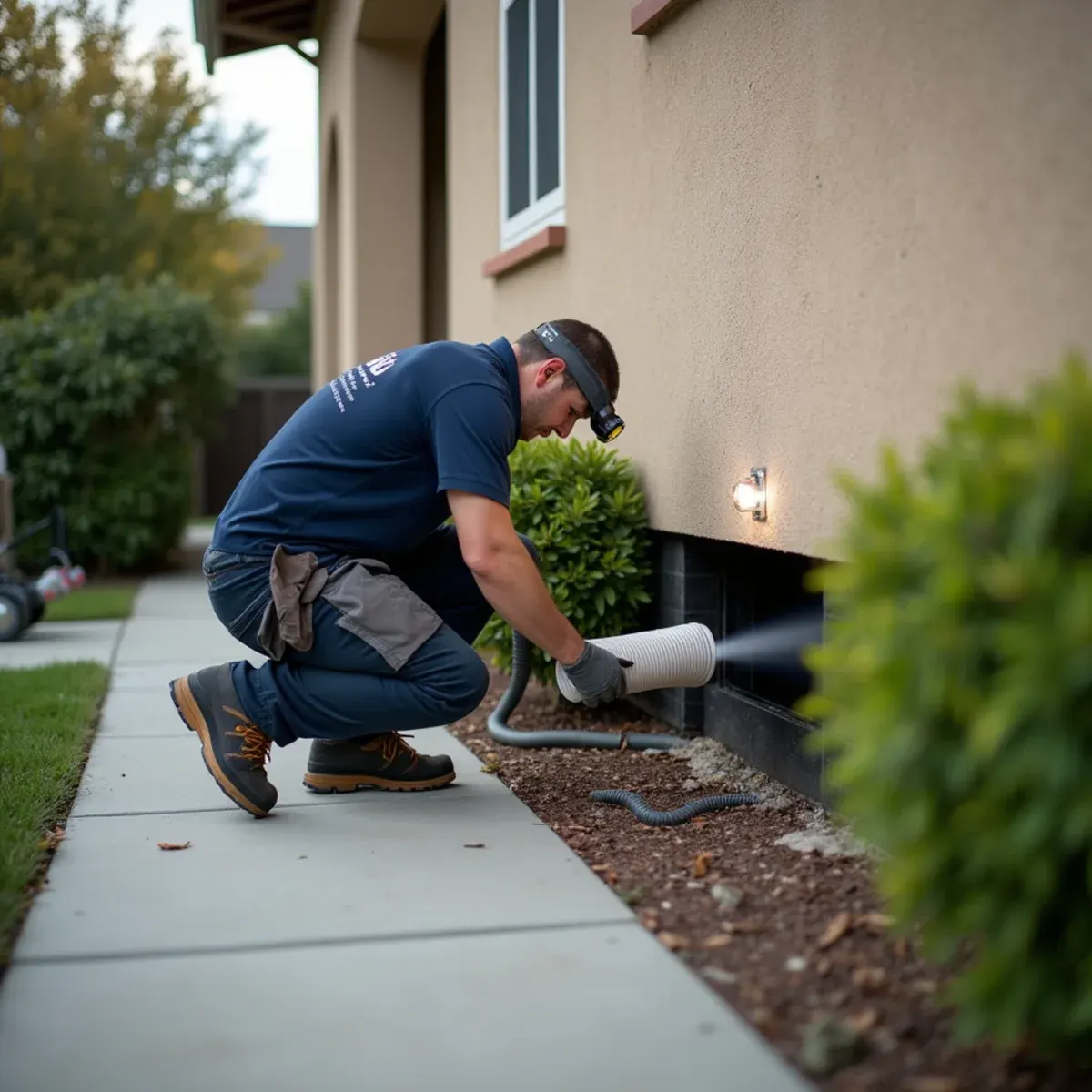
Ask three Long Beach homeowners whether they have a crawl space and you will get three honest, contradictory answers, because they live in three different building eras. The 1920s houses in Bluff Park and California Heights sit on raised perimeter foundations over bare soil, lath and plaster above. Naples sits on filled land at canal level with a water table a few feet down. Belmont Shore is narrow lots packed tight with no driveways. East Long Beach, El Dorado Park Estates and Los Altos, is postwar slab that behaves exactly like the Cypress tracts we work in daily.
That spread decides the work before anything else does. In Bluff Park it is a classic sub-area job: sagging saturated fiberglass out of the joist bays, a torn ground barrier replaced, old-growth framing cleaned and dried on its own slow schedule. In Naples the groundwater and the barrier are the story, and opening vents to help just pulls canal air into the chamber. In Belmont Shore the constraint is logistics before it is moisture. In East Long Beach there is usually no crawl space at all, and we will say so.
What Long Beach Changes About Crawl Space Drying
1Bluff Park and California Heights sub-areas
These are the real thing: raised perimeter walls, interior piers, bare dirt, and framing old enough that the fir under the floor is denser than anything sold today. Wet fiberglass comes out and does not go back until the framing hits target, and the ground barrier usually needs replacing outright because whatever is down there predates the current standard by decades.
2Naples sits on fill at canal level
Sub-floor voids in Naples are close to the water table, on ground that was made rather than found. Damp soil under a house here is a background condition, not automatically a leak, and ventilating with canal air on a humid morning adds moisture rather than removing it. We seal, dehumidify as a closed chamber, and read the soil separately from the framing before assigning a cause.
3Belmont Shore logistics before moisture
Narrow lots, no driveway, cars on both sides and a neighbor eight feet away. Hose, cord and duct runs stretch the length of the property to a truck on a busy street, which costs airflow and has to be designed rather than improvised. We matt anything crossing a public walk and plan equipment placement so a week of drying does not make the block unusable.
How the Work Runs
The method is the same one we use on every crawl space drying job, documented to the IICRC S500:2025 standard. Here it is in short — the full crawl space water damage & drying process explains each stage in detail.
- Get in and map the whole space
- Extract, then remove what is finished
- Build the crawl space into a chamber
- Dry the framing to a measured standard
- Deal with growth on the joists
- New barrier, insulation, encapsulation if warranted
The Long Beach Background Worth Knowing
The postwar tracts around El Dorado Park, Los Altos, and the neighborhoods near the Cypress border were built in the same era and largely the same way as the housing in our home city. Single-story slab construction, plumbing routed under the concrete, and a fifty-to-seventy-year age on the supply lines.
There is more on the housing stock, drainage and plumbing history of this city on our water damage restoration in Long Beach page.
Long Beach at a glance
- Dominant construction era
- 1920–1980
- Foundation type
- mixed on grade
- Supply piping found here
- original 1920s piping, galvanized steel, under-slab copper
- Drain line materials
- cast iron, clay
- Terrain and water table
- coastal-flat, shallow water table
- Most common local failure
- the approach changing entirely by neighborhood — a 1926 plaster wall and a 1955 drywall wall are different restoration problems
- Highest-value local prevention
- identifying the construction type before anyone starts cutting
What It Costs in Long Beach
We do not quote a number over the phone before seeing the property — anyone who does is guessing. The variables that actually move the price on a crawl space drying job are access and working height, how much of the footprint got wet, water category and soil contamination, and they are broken down in full on the crawl space water damage & drying page. The assessment and the written estimate are free anywhere in Long Beach, day or night, with no obligation.
Crawl Space Drying Questions from Long Beach Homeowners
Ask whether anyone actually went under it, and how far. Plenty of inspections stop at the hatch. You want to know the condition of the ground barrier, whether the fiberglass in the joist bays is sagging or stained, whether there is fungal growth on the underside of the subfloor, and whether the soil is damp evenly or in one place. Uneven damp near plumbing is a leak. Even damp usually means the barrier is the problem.
Often you cannot tell from inside, which is the whole problem. Sub-area odor rises through plumbing penetrations and the baseboard line and reads like a wall or flooring issue. The check takes about twenty minutes: a technician under the house with a light and a moisture meter. If the framing meters dry and the barrier is intact, we tell you it is not the crawl space and go look somewhere else.
Sometimes, over months, and usually not completely. The vents give you passive air exchange, which only helps when outdoor air is drier than the space. On a marine layer morning here that air is above 80% relative humidity, so the vents are bringing moisture in. Meanwhile the wet soil keeps evaporating and the subfloor above keeps taking it up. Left alone, the common outcome is growth on the joists.
All of it, with the fastest response to East Long Beach — El Dorado Park Estates, Los Altos, and the neighborhoods near the Cypress border, which are typically twenty to twenty-five minutes. Coastal and downtown areas run a little longer, and we will give you a realistic ETA when you call.