
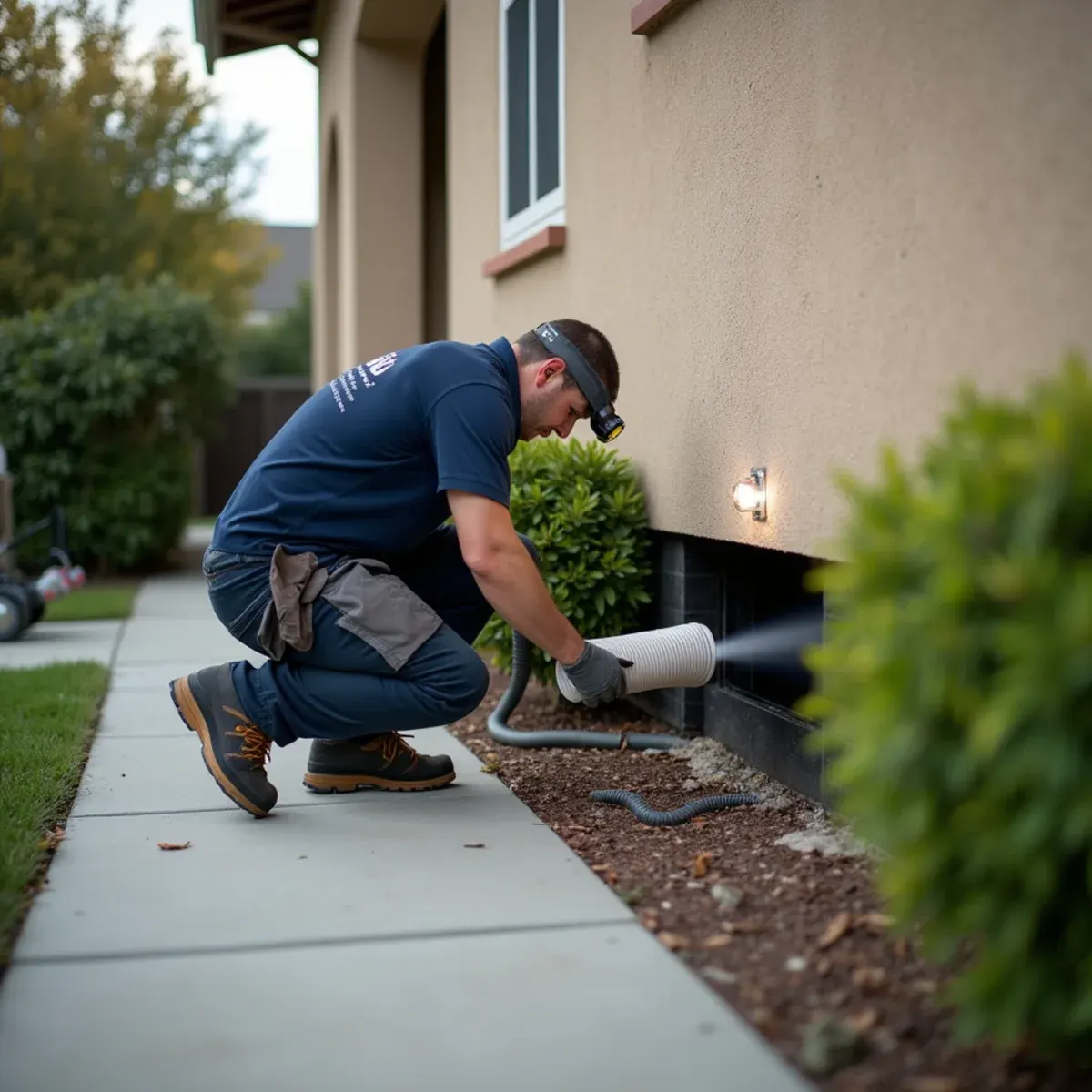
A supply line under an Old Town cottage on one of the numbered streets starts weeping about a cup an hour. Sand takes it instantly. No puddle, no stain, no sound, and the only symptom for a season is a closet on the ocean side that smells like a boat. Sand hides a leak far better than the clay soils inland do, which is why the losses we open up in this part of Seal Beach are frequently older and deeper into fungal growth on the joists than the homeowner's description suggested.
There are really three Seal Beaches and only one of them is crawl space country. Old Town's 1920s through 1940s cottages sit raised on cripple walls and piers with a shallow water table under them. Leisure World is roughly 9,000 attached units from the early sixties, where the sub-floor question rarely comes up and the real complication is a loss crossing a shared wall into a second unit, a mutual and a management company at the same time. Inland College Park is postwar and largely slab. The marine layer, though, applies to all of it.
What Seal Beach Changes About Crawl Space Drying
1Marine air makes ventilating the wrong move
The instinct is to open every vent and let the sub-area breathe. Within a few blocks of the water that often adds moisture instead of removing it, because outdoor air on a marine morning is wetter than the air we are trying to dry. We close the chamber, seal the vents temporarily and dehumidify it as a controlled space. Expect the job to run longer here than the same job inland.
2Sand sub-areas swallow the evidence
Water that would pool on inland soil vanishes into sand, so leaks in Old Town run long before anyone notices. It also means damp sand is not by itself proof of a leak this close to the tide. We probe at depth, meter the joists and the subfloor above, and read the pattern rather than the surface, because the surface here tells you almost nothing.
3Attached units and more than one policy
When a loss in Leisure World or another attached building crosses a shared wall, several parties acquire an interest at once: two homeowners, the mutual, and the management company, sometimes with different carriers. We document the boundary of the wet area precisely and coordinate access rather than assuming permission. It slows the first day and prevents a month of argument later.
How the Work Runs
The method is the same one we use on every crawl space drying job, documented to the IICRC S500:2025 standard. Here it is in short — the full crawl space water damage & drying process explains each stage in detail.
- Get in and map the whole space
- Extract, then remove what is finished
- Build the crawl space into a chamber
- Dry the framing to a measured standard
- Deal with growth on the joists
- New barrier, insulation, encapsulation if warranted
The Seal Beach Background Worth Knowing
Structural drying works by creating a vapor pressure differential — dry air pulls moisture out of wet materials. When the surrounding air is already carrying a heavy moisture load, that differential shrinks and everything slows down.
There is more on the housing stock, drainage and plumbing history of this city on our water damage restoration in Seal Beach page.
Seal Beach at a glance
- Dominant construction era
- 1920–1965
- Foundation type
- mixed on grade
- Supply piping found here
- galvanized steel, copper, shared community mains
- Drain line materials
- cast iron, clay
- Terrain and water table
- coastal-flat, shallow water table
- Most common local failure
- losses that cross shared walls between attached units, involving several policies and a mutual at once
- Highest-value local prevention
- documenting each affected unit separately from the first hour
What It Costs in Seal Beach
We do not quote a number over the phone before seeing the property — anyone who does is guessing. The variables that actually move the price on a crawl space drying job are access and working height, how much of the footprint got wet, water category and soil contamination, and they are broken down in full on the crawl space water damage & drying page. The assessment and the written estimate are free anywhere in Seal Beach, day or night, with no obligation.
Crawl Space Drying Questions from Seal Beach Homeowners
Usually noticeably longer, and it is the marine layer rather than the damage. Ambient humidity near the water stays high enough that ventilation works against us, so we seal the sub-area and pull moisture with closed-system dehumidification, which is slower than air exchange. We will not put a number of days on it before we have readings, because the honest answer depends on how long the leak ran and how much the sand around it is still holding.
Often you cannot tell from inside, which is the whole problem. Sub-area odor rises through plumbing penetrations and the baseboard line and reads like a wall or flooring issue. The check takes about twenty minutes: a technician under the house with a light and a moisture meter. If the framing meters dry and the barrier is intact, we tell you it is not the crawl space and go look somewhere else.
Sometimes, over months, and usually not completely. The vents give you passive air exchange, which only helps when outdoor air is drier than the space. On a marine layer morning here that air is above 80% relative humidity, so the vents are bringing moisture in. Meanwhile the wet soil keeps evaporating and the subfloor above keeps taking it up. Left alone, the common outcome is growth on the joists.
Coastal marine layer conditions keep ambient humidity high for extended periods, which reduces the vapor pressure differential that drives drying. Jobs near the water need sealed chambers and more dehumidification capacity than an equivalent loss inland, and the equipment stays on longer.