
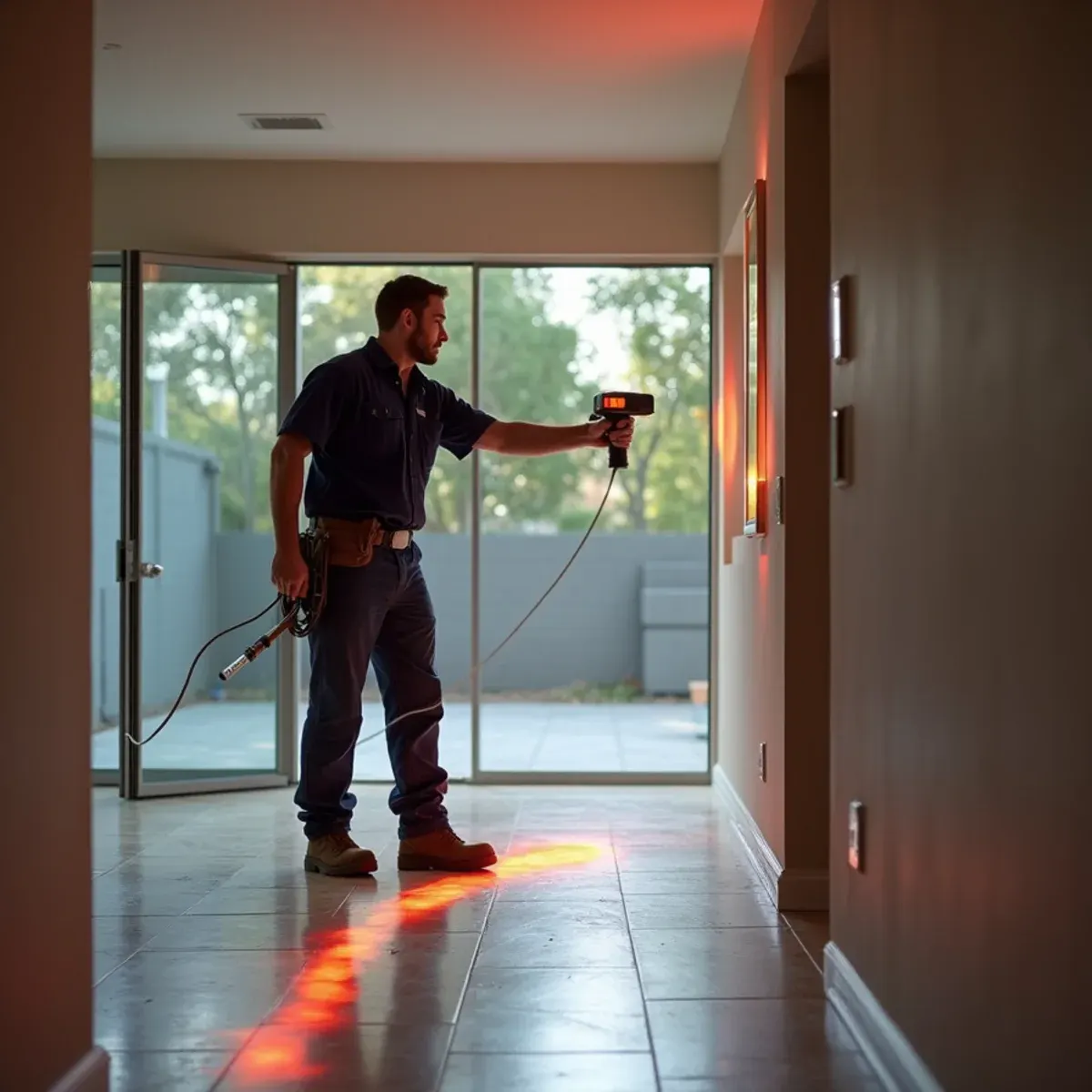
In Leisure World, the first question after a slab leak isn't how to fix it. It's whose pipe it is. Nine thousand attached units built in the early sixties, shared community mains running beneath whole buildings, and a mutual plus a management company standing between you and the concrete. We've watched residents lose days because nobody was certain who could authorize opening a floor. Our answer is to document from the first hour, unit by unit, so the mutual, the management company and every insurer involved are working from one record instead of three different accounts.
Seal Beach also dries slower than nearly anywhere inland. The marine layer parks over Old Town and the Hill for days at a stretch, and ambient humidity that high means a concrete slab gives up moisture grudgingly. We bring more dehumidification here than the same job would need in La Palma, and we say plainly that a slab reading dry at the surface after a week can still be releasing vapor a month later. Salt handles the rest, corroding exterior flashings and fasteners within about a mile of the pier.
What Seal Beach Changes About Slab Leak Damage
1Shared mains mean shared responsibility
In Leisure World the line under your unit may serve neighbors and belong to the mutual rather than to you. Until that's established, nobody can authorize opening concrete. We identify the run early, put the finding in writing, and give the mutual and the management company the same documentation on the same day, so the decision isn't stalled by three conflicting stories.
2Attached units mean several policies at once
Water crossing a shared wall creates a separate claim for each unit plus a possible association claim, and adjusters will not accept a single blended report. We document each affected unit independently from the first hour, with its own moisture readings, its own photographs and its own drying log. Assembling that later from memory is exactly where these claims fall apart.
3Marine air stretches concrete drying
When the marine layer sits over Old Town for days, ambient humidity stays high and a slab surrenders moisture slowly. We bring more dehumidification here than an equivalent inland job and set expectations to match. A slab that reads dry at the surface after a week can still be emitting vapor a month later, and in-situ probes are what settle that argument.
How the Work Runs
The method is the same one we use on every slab leak damage job, documented to the IICRC S500:2025 standard. Here it is in short — the full slab leak water damage repair process explains each stage in detail.
- Confirm it is actually a slab leak
- Electronic leak location
- Choose the repair approach with you
- Dry the slab and the affected assemblies
- Address the flooring and wall base
- Restore the floor and finish
The Seal Beach Background Worth Knowing
Structural drying works by creating a vapor pressure differential — dry air pulls moisture out of wet materials. When the surrounding air is already carrying a heavy moisture load, that differential shrinks and everything slows down.
There is more on the housing stock, drainage and plumbing history of this city on our water damage restoration in Seal Beach page.
Seal Beach at a glance
- Dominant construction era
- 1920–1965
- Foundation type
- mixed on grade
- Supply piping found here
- galvanized steel, copper, shared community mains
- Drain line materials
- cast iron, clay
- Terrain and water table
- coastal-flat, shallow water table
- Most common local failure
- losses that cross shared walls between attached units, involving several policies and a mutual at once
- Highest-value local prevention
- documenting each affected unit separately from the first hour
What It Costs in Seal Beach
We do not quote a number over the phone before seeing the property — anyone who does is guessing. The variables that actually move the price on a slab leak damage job are how long the leak ran undetected, flooring type over the leak, repair method chosen, and they are broken down in full on the slab leak water damage repair page. The assessment and the written estimate are free anywhere in Seal Beach, day or night, with no obligation.
Slab Leak Damage Questions from Seal Beach Homeowners
Call us to stop the water and start documenting, and notify the mutual within the same hour. Because the supply line under your slab may be a shared main, the mutual has to be part of any decision to open concrete, and the earlier they're in the conversation the less time you lose. Written notice with dated photographs protects you regardless of where responsibility eventually lands.
The meter test is the first step: shut off every fixture and watch the low-flow indicator. If it moves and nothing is wet above the floor, suspect the slab. Warm spots on the floor, running-water sounds from below, and flooring that lifts or cups without an obvious cause all point the same direction. We confirm it with thermal imaging and moisture mapping at no charge.
Not always. Depending on where the leak is and the condition of the system, rerouting the line overhead through the attic and walls avoids opening the concrete entirely. When a spot repair is the better option, precise electronic location keeps the opening small — typically a couple of feet, not a trench across the room.
Coastal marine layer conditions keep ambient humidity high for extended periods, which reduces the vapor pressure differential that drives drying. Jobs near the water need sealed chambers and more dehumidification capacity than an equivalent loss inland, and the equipment stays on longer.