
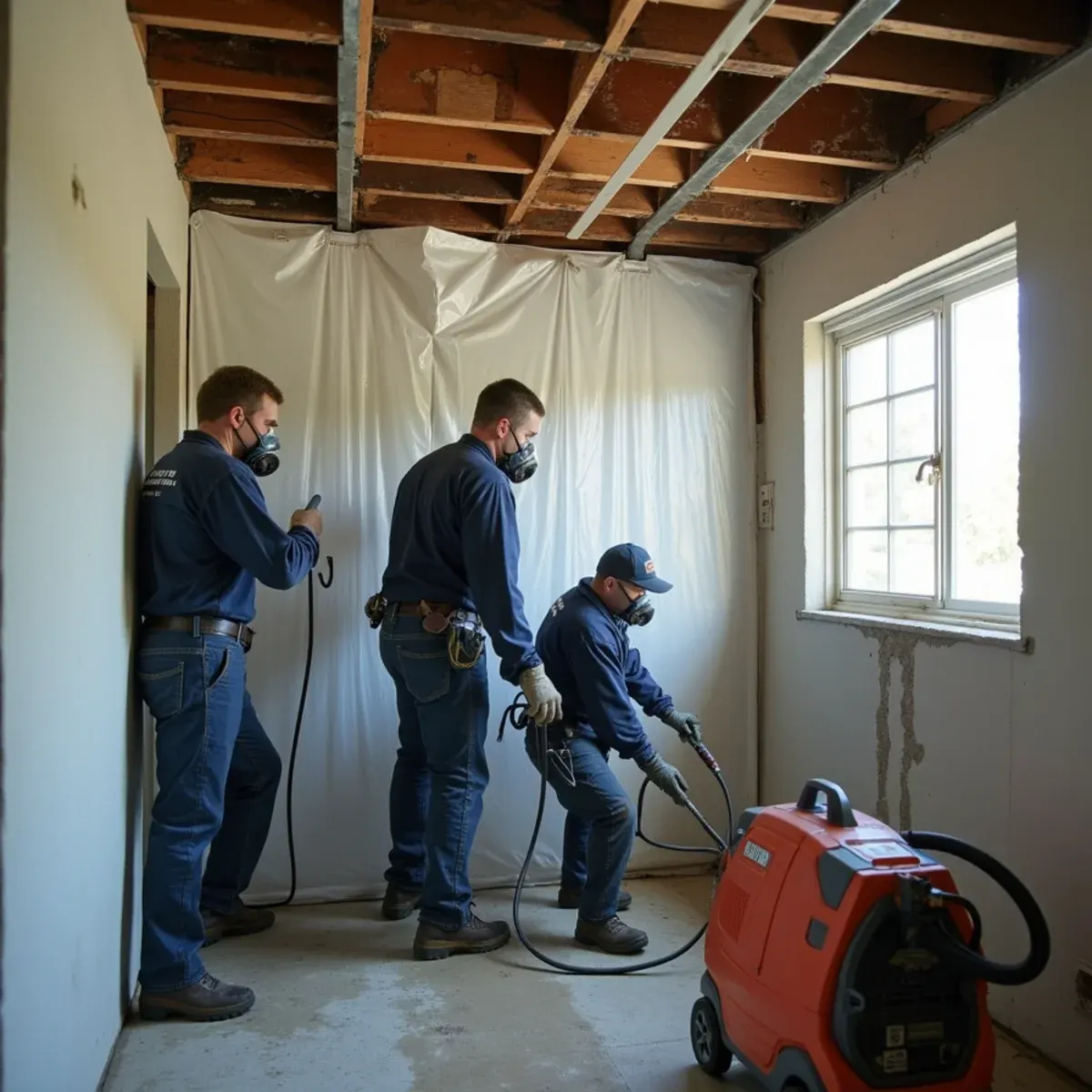
A ground-floor unit in Leisure World floods and it is immediately not one household's problem. Nearly 9,000 attached units share walls, and water crossing into a neighbor's unit brings in a second resident, the mutual, the management company and more than one policy before the day is out. Add that many residents are older and often living alone, and that in a single-story attached unit there is nowhere inside to move to while containment goes up. The logistics here matter as much as the equipment does.
The rest of the city is nothing like that. Old Town's dense lots near Main Street and the pier sit low behind the sand, Surfside Colony sits closer to the water than anything else we work on, and College Park is ordinary inland tract. What ties them together is the marine layer. Ambient humidity stays high for long stretches, so opening windows dries nothing and every job needs real dehumidification capacity and more days than the same loss would take a few miles inland.
What Seal Beach Changes About Flood Cleanup
1Shared walls, separate documentation
When water crosses a party wall in Leisure World, each affected unit needs its own moisture map, its own photographs and its own scope from the first hour. The mutual and the management company are looking at the building; each resident is looking at their own interior and belongings. Mixing those records together is what turns a two-week job into a two-month argument, so we keep them apart from the start.
2Marine humidity extends every drying plan
Within a mile of the pier, outdoor air is frequently wetter than the air we are trying to create inside. Ventilation is not a drying strategy here. We run a closed system with dehumidification sized for the load, monitor daily, and say plainly that a Seal Beach job often takes longer than the same loss inland. That is the environment, not the equipment.
3Salt water is its own contaminant
Storm surge and tidal water near Surfside and Old Town leaves chloride behind in framing, fasteners and wall cavities after the moisture is gone. Salt is hygroscopic, so it keeps pulling humidity back into materials, and it corrodes connectors and metal over the following years. Where we find it, we rinse and neutralize the affected assemblies rather than drying over the residue and calling it finished.
How the Work Runs
The method is the same one we use on every flood cleanup job, documented to the IICRC S500:2025 standard. Here it is in short — the full flood damage cleanup process explains each stage in detail.
- Safety assessment and utility check
- Containment and negative air
- Documentation and contents triage
- Extraction and controlled demolition
- Cleaning and disinfection
- Structural drying and clearance
The Seal Beach Background Worth Knowing
Structural drying works by creating a vapor pressure differential — dry air pulls moisture out of wet materials. When the surrounding air is already carrying a heavy moisture load, that differential shrinks and everything slows down.
There is more on the housing stock, drainage and plumbing history of this city on our water damage restoration in Seal Beach page.
Seal Beach at a glance
- Dominant construction era
- 1920–1965
- Foundation type
- mixed on grade
- Supply piping found here
- galvanized steel, copper, shared community mains
- Drain line materials
- cast iron, clay
- Terrain and water table
- coastal-flat, shallow water table
- Most common local failure
- losses that cross shared walls between attached units, involving several policies and a mutual at once
- Highest-value local prevention
- documenting each affected unit separately from the first hour
What It Costs in Seal Beach
We do not quote a number over the phone before seeing the property — anyone who does is guessing. The variables that actually move the price on a flood cleanup job are how high the water reached, how long it sat before extraction, contents volume in the flooded area, and they are broken down in full on the flood damage cleanup page. The assessment and the written estimate are free anywhere in Seal Beach, day or night, with no obligation.
Flood Cleanup Questions from Seal Beach Homeowners
No — file separately, and document separately. Each unit is its own claim, and the mutual's coverage of the building is separate again from what covers your interior and belongings. Notify management in writing immediately, photograph your unit before anything is moved, and keep a copy of every reading and scope. We provide per-unit documentation rather than one combined report, because combined reports tend to help nobody when the claims diverge.
Yes. Water that crossed soil, pavement, or a storm drain is Category 3 by IICRC classification regardless of appearance — it carries bacteria, fuel and oil residue, lawn chemicals, and whatever else was on the ground. Do not walk through it in open shoes, and keep children and pets out of the area entirely.
If the water came from outside across the ground, almost certainly not — that requires separate flood insurance. If it came from a failed water heater, a burst pipe, or a supply line inside the garage, it is usually covered. We document the source carefully because that distinction determines everything.
Coastal marine layer conditions keep ambient humidity high for extended periods, which reduces the vapor pressure differential that drives drying. Jobs near the water need sealed chambers and more dehumidification capacity than an equivalent loss inland, and the equipment stays on longer.