
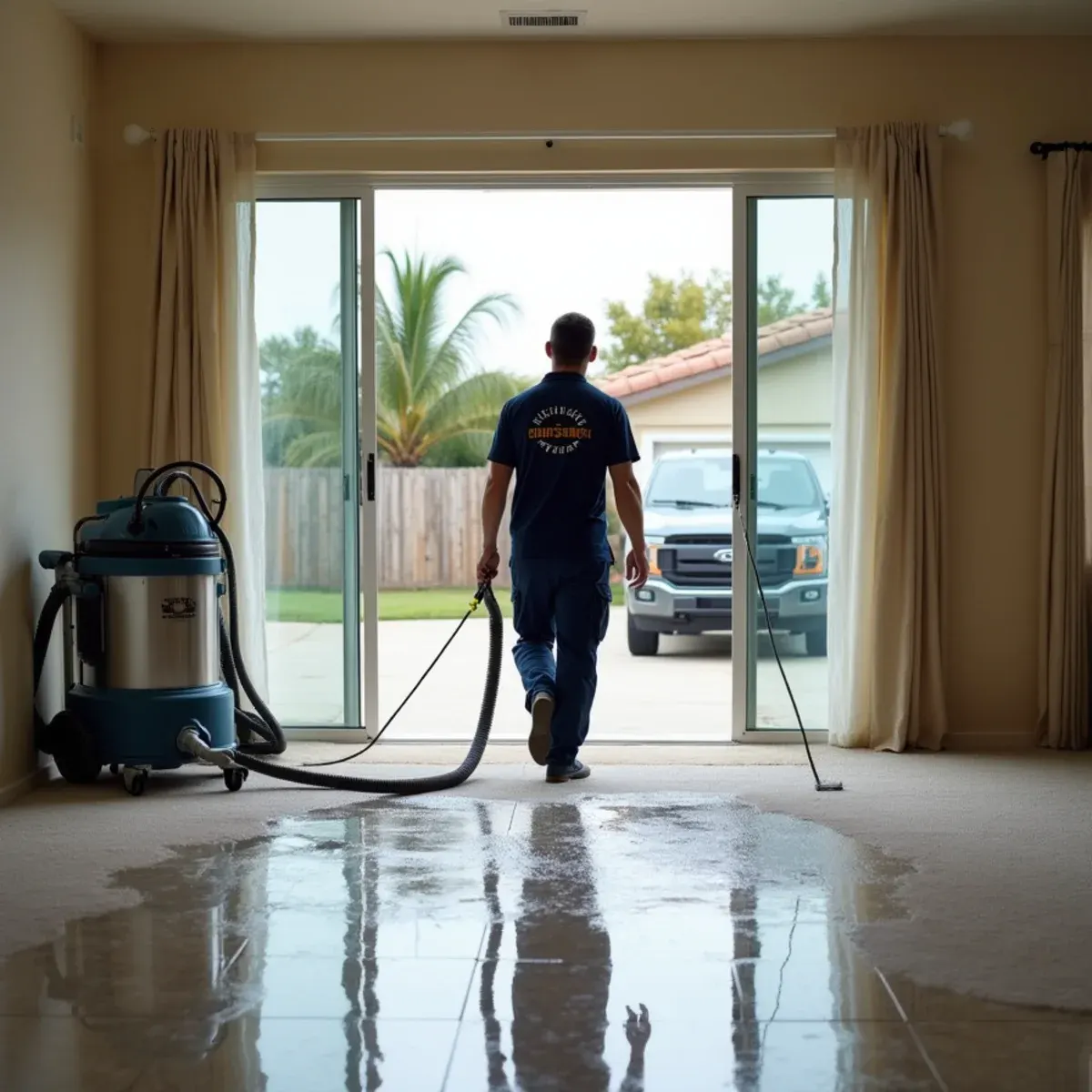
In Leisure World a water loss is rarely one household's problem. Nine thousand units built in the early 1960s, attached, sharing walls and in many cases sharing plumbing — when a line fails in one unit the water is under the neighbor's flooring before anybody has made a phone call. Extraction there means working two or three units at once, with a mutual and a management company involved and often more than one insurance policy on the table. We document each unit separately from the first hour, because untangling that later never goes well for the residents.
Then there's the rest of Seal Beach. Old Town lots off Main Street are dense and tight, with limited room to stage a truck anywhere near the pier. And the marine layer here isn't a footnote — ambient humidity stays high for long stretches, so water left in a carpet pad or a wall cavity evaporates slowly, and the drying that follows takes longer and needs more dehumidification capacity than the same loss would inland. That's precisely why we pull out as much water mechanically as we possibly can.
What Seal Beach Changes About Water Extraction
1Shared walls mean shared losses
In an attached Leisure World unit, extraction stops at a wall that water doesn't respect. We ask for access to the adjoining unit early, meter the shared partition from both sides, and extract wherever readings say water went. Handling only the reporting unit leaves wet framing and pad next door, and puts that resident in the position of discovering damage weeks later with no documentation of their own.
2Marine humidity punishes incomplete extraction
Within a mile of the water, ambient conditions work against you. A pad left holding even a modest amount of water dries slowly here, and slow drying is where secondary damage and odor come from. So we run more weighted extraction passes than we would inland, until the pad genuinely stops giving water up rather than until it stops looking wet. Extra passes are cheap. A second mobilization is not.
3Old Town streets limit truck staging
Main Street and the surrounding Old Town lots are narrow, parking is scarce, and many homes have no driveway to speak of. Truck-mounted extraction still works, but on a long hose lay planned before we arrive. Tell us the cross street and whether there's alley access when you call, and we'll bring the right hose configuration and spend the time extracting instead of circling the block.
How the Work Runs
The method is the same one we use on every water extraction job, documented to the IICRC S500:2025 standard. Here it is in short — the full water extraction & removal process explains each stage in detail.
- Bulk removal with submersible pumps
- Truck-mounted extraction on carpet and pad
- Hard-surface and specialty extraction
- Cavity and void extraction
- Removing what cannot be saved
- Post-extraction moisture reading
The Seal Beach Background Worth Knowing
Structural drying works by creating a vapor pressure differential — dry air pulls moisture out of wet materials. When the surrounding air is already carrying a heavy moisture load, that differential shrinks and everything slows down.
There is more on the housing stock, drainage and plumbing history of this city on our water damage restoration in Seal Beach page.
Seal Beach at a glance
- Dominant construction era
- 1920–1965
- Foundation type
- mixed on grade
- Supply piping found here
- galvanized steel, copper, shared community mains
- Drain line materials
- cast iron, clay
- Terrain and water table
- coastal-flat, shallow water table
- Most common local failure
- losses that cross shared walls between attached units, involving several policies and a mutual at once
- Highest-value local prevention
- documenting each affected unit separately from the first hour
What It Costs in Seal Beach
We do not quote a number over the phone before seeing the property — anyone who does is guessing. The variables that actually move the price on a water extraction job are volume and depth of water, flooring type, contamination level, and they are broken down in full on the water extraction & removal page. The assessment and the written estimate are free anywhere in Seal Beach, day or night, with no obligation.
Water Extraction Questions from Seal Beach Homeowners
Practically speaking, one crew should handle both sides even though the claims stay separate. Water doesn't stop at the partition, and splitting the work between two companies creates gaps at exactly the place damage concentrates. We extract and document your unit under its own file, with your own photos, readings and scope, while coordinating with the mutual and management. Ask that your unit be documented independently from day one, whoever ends up doing the work.
For a typical single-room residential loss, extraction runs one to three hours. Multi-room losses or Category 3 water can take most of a day because of containment setup and material removal. We will give you a realistic timeframe after the walkthrough, before we start.
Often we can save the carpet and only replace the pad, which is the cheaper and less disruptive path. The deciding factors are water category, how long it sat, and whether the pad is a moisture barrier type. Clean water caught quickly usually means the carpet stays.
Coastal marine layer conditions keep ambient humidity high for extended periods, which reduces the vapor pressure differential that drives drying. Jobs near the water need sealed chambers and more dehumidification capacity than an equivalent loss inland, and the equipment stays on longer.