
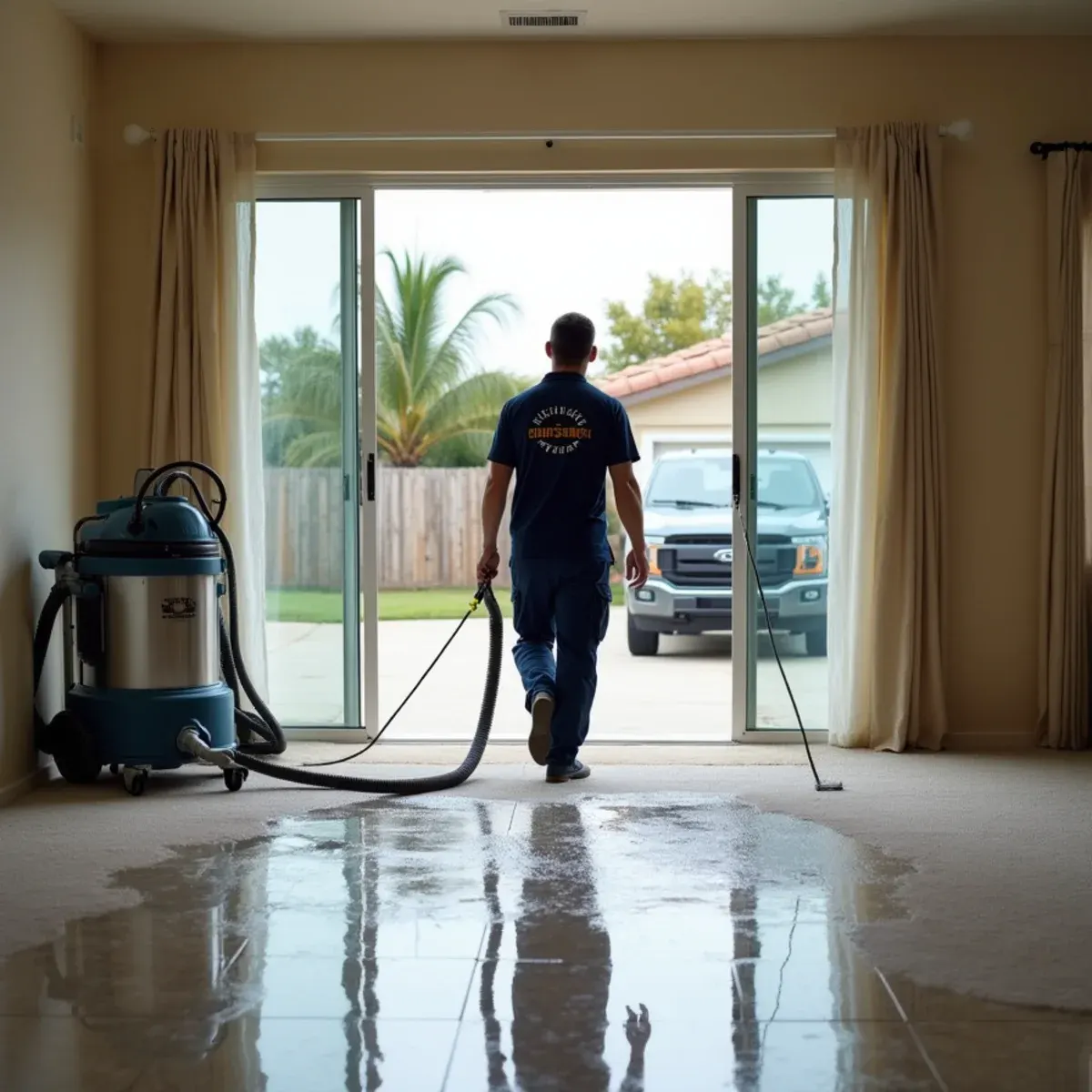
Los Alamitos doesn't have one answer to the question we ask first on every extraction call: where is the water sitting right now? A good share of the housing here predates 1965, and the foundations run mixed — some slab, some raised with a crawl space underneath. On a slab, water spreads out and stays put where you can see it. Over a crawl space, it drains through the subfloor and out of sight, so the floor above looks nearly dry while several inches stand on the dirt below.
The other thing that shapes this work locally is how much of it isn't residential. Los Alamitos Medical Center and the offices along Katella mean we're often extracting from glue-down carpet tile and VCT in a suite that has to open for patients in the morning, not from a living room. Commercial flooring hides water differently than household carpet — it releases slowly through seams and under the tile rather than soaking a pad. That changes the tooling, and it changes how long we stay.
What Los Alamitos Changes About Water Extraction
1Crawl spaces need pumps, not wands
When a raised-foundation home here loses a supply line, the standing water ends up on soil under the house. No amount of surface extraction touches it. We pump it out, pull the saturated vapor barrier, and take down soaked batt insulation from between the joists. Left alone, that water evaporates upward into your subfloor for months and the first sign you get is a smell.
2Sixty years of mixed-metal repairs
Piecemeal plumbing repairs across this city have left a lot of galvanized-to-copper joints quietly corroding. When one of those finally opens up, it does so at full supply pressure inside a wall, which is why Los Alamitos losses tend to involve real volume rather than a slow stain. That volume is the reason we bring extraction capacity before we bring drying equipment.
3Medical and office suites off Katella
Commercial extraction along the Katella corridor has constraints a house doesn't. Patient areas and records need containment. Ceiling grid and cavity spaces above suites carry water sideways into rooms nobody reported. And the work often has to happen overnight so the suite opens on schedule. We plan hose routing and equipment noise around that rather than showing up mid-morning with a truck.
How the Work Runs
The method is the same one we use on every water extraction job, documented to the IICRC S500:2025 standard. Here it is in short — the full water extraction & removal process explains each stage in detail.
- Bulk removal with submersible pumps
- Truck-mounted extraction on carpet and pad
- Hard-surface and specialty extraction
- Cavity and void extraction
- Removing what cannot be saved
- Post-extraction moisture reading
The Los Alamitos Background Worth Knowing
When a home has been standing since 1958, the plumbing question is not whether something will fail but which thing already has. We routinely find three generations of repair inside a single Los Alamitos wall: original galvanized, a copper section from a 1980s repair, and a PEX patch from last decade, all joined with whatever transition fitting was on the truck that day.
There is more on the housing stock, drainage and plumbing history of this city on our water damage restoration in Los Alamitos page.
Los Alamitos at a glance
- Dominant construction era
- 1950–1965
- Foundation type
- mixed on grade
- Supply piping found here
- galvanized steel, early copper, mixed-metal repair joints
- Drain line materials
- cast iron, clay
- Terrain and water table
- flat, moderate water table
- Most common local failure
- galvanic corrosion at mixed-metal joints where sixty years of piecemeal repairs meet
- Highest-value local prevention
- a camera inspection of the sewer lateral, which has never been scoped on most homes here
What It Costs in Los Alamitos
We do not quote a number over the phone before seeing the property — anyone who does is guessing. The variables that actually move the price on a water extraction job are volume and depth of water, flooring type, contamination level, and they are broken down in full on the water extraction & removal page. The assessment and the written estimate are free anywhere in Los Alamitos, day or night, with no obligation.
Water Extraction Questions from Los Alamitos Homeowners
Very likely, yes. On a raised foundation the water doesn't pool on your floor, it drips through and collects underneath. We open the crawl access and check with a light and a meter before we quote anything. If there's standing water on the soil, we pump it, remove the wet vapor barrier, and pull any insulation that's holding water. Skipping that step is how homes here develop a persistent musty smell months later.
For a typical single-room residential loss, extraction runs one to three hours. Multi-room losses or Category 3 water can take most of a day because of containment setup and material removal. We will give you a realistic timeframe after the walkthrough, before we start.
Often we can save the carpet and only replace the pad, which is the cheaper and less disruptive path. The deciding factors are water category, how long it sat, and whether the pad is a moisture barrier type. Clean water caught quickly usually means the carpet stays.
Usually fifteen to twenty-five minutes — Los Alamitos is our closest neighbor, straight east on Katella from where our trucks stage. The 60-minute response commitment applies here the same as in Cypress.