
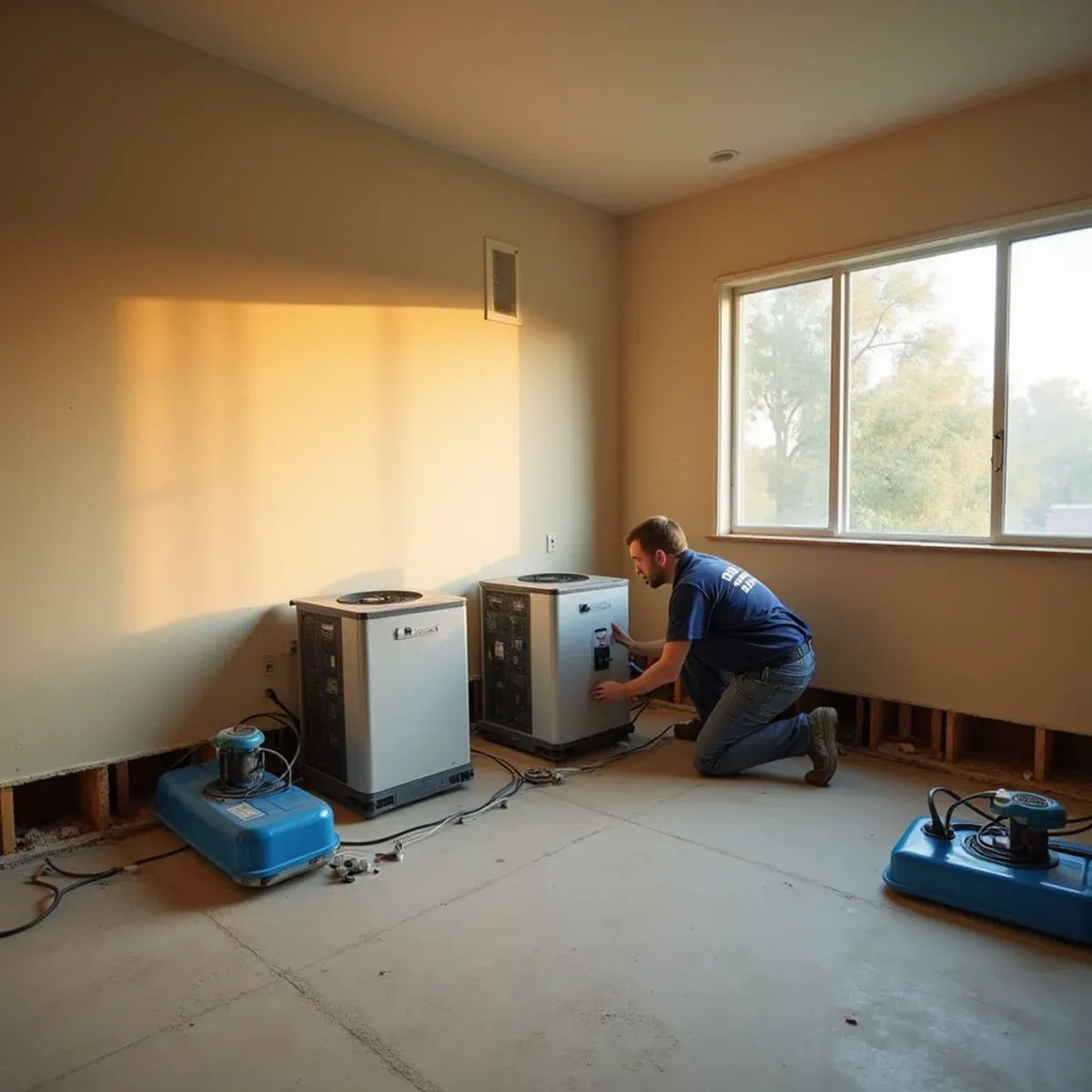
A dental suite off Katella calls on a Sunday. The line under the break room sink let go Friday night, and Monday's schedule is already full. That job doesn't start with fans. It starts with a containment wall, because we're drying one suite while the offices on either side stay open. Los Alamitos hands us more of this work than most cities its size. The medical center anchors a corridor of clinics, small commercial buildings and light industrial space, and every one of them runs on a calendar a three-day dry-out has to fit inside.
Residential work here splits two ways on the same block. Some homes near Laurel Park sit on slab. Others from the same years sit on a raised floor over a crawl space, and the drying plan is not the same for either. On a slab we're pulling water out of concrete, bottom plates and the wall cavity above them. Over a crawl space we're drying the underside of the subfloor and the joists in a space that already carries its own moisture. Either way, the dry standard comes from unaffected material in your own house first.
What Los Alamitos Changes About Structural Drying
1Two foundation types, two drying plans
Because this city mixes slab and raised construction, we confirm what you're standing on before equipment comes off the truck. A slab job means cavity drying and slab-edge readings. A raised floor means sealing and dehumidifying the crawl and monitoring the subfloor from both faces. Running the wrong plan wastes days and leaves framing wet under a floor that feels fine underfoot.
2Drying around a working medical office
Clinic and office work near the medical center needs the loss isolated from the rest of the suite. We build sealed containment, run the affected zone under negative pressure so air moves toward the equipment rather than into occupied rooms, and schedule the noisy work outside patient hours. Daily readings still happen. They just happen at seven in the morning instead of midday.
3Sixty years of mixed-metal repairs
Homes here have been repaired piecemeal since the late fifties, and where galvanized meets copper the joint corrodes and seeps rather than bursting. Slow leaks wet material far beyond the visible stain, and they wet it deeply. That shows up as a longer drying schedule and a moisture map reaching into rooms nobody suspected. We map first, then size equipment to what the meter found.
How the Work Runs
The method is the same one we use on every structural drying job, documented to the IICRC S500:2025 standard. Here it is in short — the full structural drying & dehumidification process explains each stage in detail.
- Establish the dry standard
- Calculate the load and build the chamber
- Place air movers for surface evaporation
- Run LGR dehumidification to capture the moisture
- Monitor and adjust daily
- Verify, document, and demobilize
The Los Alamitos Background Worth Knowing
When a home has been standing since 1958, the plumbing question is not whether something will fail but which thing already has. We routinely find three generations of repair inside a single Los Alamitos wall: original galvanized, a copper section from a 1980s repair, and a PEX patch from last decade, all joined with whatever transition fitting was on the truck that day.
There is more on the housing stock, drainage and plumbing history of this city on our water damage restoration in Los Alamitos page.
Los Alamitos at a glance
- Dominant construction era
- 1950–1965
- Foundation type
- mixed on grade
- Supply piping found here
- galvanized steel, early copper, mixed-metal repair joints
- Drain line materials
- cast iron, clay
- Terrain and water table
- flat, moderate water table
- Most common local failure
- galvanic corrosion at mixed-metal joints where sixty years of piecemeal repairs meet
- Highest-value local prevention
- a camera inspection of the sewer lateral, which has never been scoped on most homes here
What It Costs in Los Alamitos
We do not quote a number over the phone before seeing the property — anyone who does is guessing. The variables that actually move the price on a structural drying job are size of the drying chamber, class of water intrusion, material types involved, and they are broken down in full on the structural drying & dehumidification page. The assessment and the written estimate are free anywhere in Los Alamitos, day or night, with no obligation.
Structural Drying Questions from Los Alamitos Homeowners
Usually, yes. On a raised floor we work from below, which is the easier of the two foundations in this city. Soaked insulation comes out, the crawl gets sealed so it becomes a controlled space, and we dehumidify it instead of blowing damp outside air under your house. Readings come from the crawl and through the finished floor above, so both faces are proven. If the flooring itself is saturated, we'll say plainly what can and can't be saved.
Three to five days covers most residential losses. Saturated hardwood, plaster, or a concrete slab can run seven or more. We will give you an estimated window after the first readings and update you daily — and equipment comes out when the numbers say so, not on a fixed schedule.
We would rather you did not. Drying is a continuous process, and every hour off extends the total run — which usually costs more than the sleep is worth. If noise is genuinely unmanageable we can often reconfigure the chamber or reposition units to reduce it. Talk to us instead of unplugging them.
Usually fifteen to twenty-five minutes — Los Alamitos is our closest neighbor, straight east on Katella from where our trucks stage. The 60-minute response commitment applies here the same as in Cypress.