
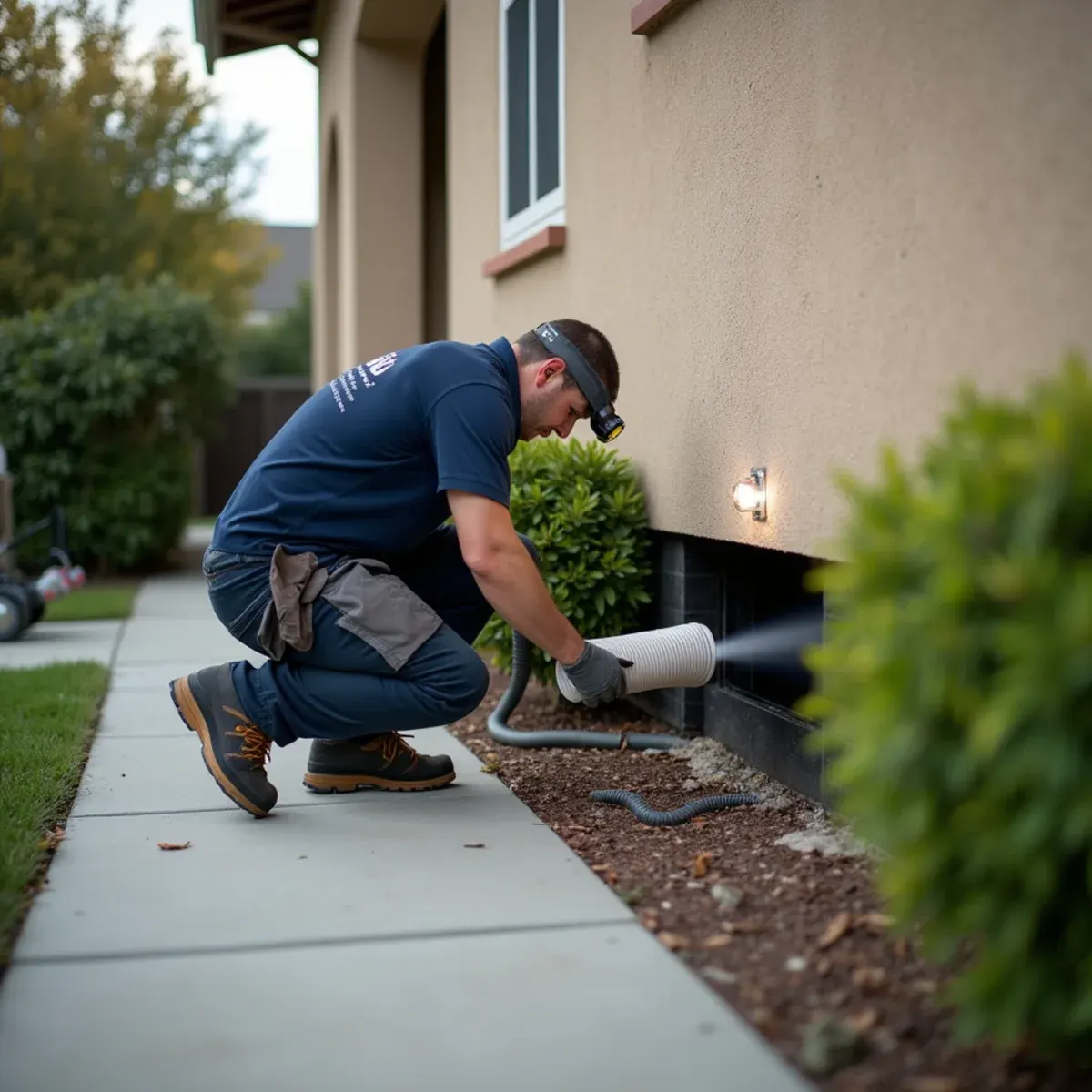
Before you call anybody, walk the outside of your house and look along the base of the wall for screened rectangular vents near grade. If they are there, you have a raised foundation and a sub-area underneath your floor. If the stucco runs straight into concrete, you are on a slab. Los Alamitos built through the changeover years, roughly 1950 to 1965, when raised foundations and slab-on-grade overlapped inside the same tracts, so one house on a block can have three feet of dirt under it while its neighbor has none.
Under the raised ones we mostly find the accumulated record of sixty years of repairs: a galvanized branch tied into copper, a copper stub joined to steel with whatever fitting was on the truck that day. Those dissimilar-metal joints corrode from the inside and weep, and because the drip lands on soil instead of a floor, nothing shows upstairs for months. Add the cast iron and clay laterals running under the mature parkway trees on the older residential streets, and a root-cracked lateral can put waste into that sub-area before anyone smells it.
What Los Alamitos Changes About Crawl Space Drying
1Settling the foundation question first
This is the one nearby city where we genuinely cannot guess from the address. Two houses built two years apart here can sit on completely different foundations. Our first ten minutes go to vents, the step height at the front door, and the sound of the floor underfoot, because a sub-area drying plan and a slab drying plan share almost nothing beyond the meters we carry.
2Corroded joints drip onto dirt, not floors
A mixed-metal joint under a raised Los Alamitos house does not fail dramatically. It weeps. The water falls eighteen inches onto soil and soaks in, so there is no stain, no puddle and no obvious change in the bill. What you get instead is a musty closet on one side of the house and joists that have been quietly feeding fungal growth since spring.
3Clay laterals under the parkway trees
The older streets here have big mature parkway trees, and the sewer laterals under them are cast iron and clay from the original build. Roots find the joints. When a lateral cracks under a raised house, waste goes into the sub-area rather than backing up into a tub, which turns a straightforward drying job into contaminated soil removal and full barrier replacement.
How the Work Runs
The method is the same one we use on every crawl space drying job, documented to the IICRC S500:2025 standard. Here it is in short — the full crawl space water damage & drying process explains each stage in detail.
- Get in and map the whole space
- Extract, then remove what is finished
- Build the crawl space into a chamber
- Dry the framing to a measured standard
- Deal with growth on the joists
- New barrier, insulation, encapsulation if warranted
The Los Alamitos Background Worth Knowing
When a home has been standing since 1958, the plumbing question is not whether something will fail but which thing already has. We routinely find three generations of repair inside a single Los Alamitos wall: original galvanized, a copper section from a 1980s repair, and a PEX patch from last decade, all joined with whatever transition fitting was on the truck that day.
There is more on the housing stock, drainage and plumbing history of this city on our water damage restoration in Los Alamitos page.
Los Alamitos at a glance
- Dominant construction era
- 1950–1965
- Foundation type
- mixed on grade
- Supply piping found here
- galvanized steel, early copper, mixed-metal repair joints
- Drain line materials
- cast iron, clay
- Terrain and water table
- flat, moderate water table
- Most common local failure
- galvanic corrosion at mixed-metal joints where sixty years of piecemeal repairs meet
- Highest-value local prevention
- a camera inspection of the sewer lateral, which has never been scoped on most homes here
What It Costs in Los Alamitos
We do not quote a number over the phone before seeing the property — anyone who does is guessing. The variables that actually move the price on a crawl space drying job are access and working height, how much of the footprint got wet, water category and soil contamination, and they are broken down in full on the crawl space water damage & drying page. The assessment and the written estimate are free anywhere in Los Alamitos, day or night, with no obligation.
Crawl Space Drying Questions from Los Alamitos Homeowners
Look for screened foundation vents near grade on the exterior walls, a noticeable step up at the front threshold, and a floor that sounds hollow rather than dead when you walk it. Most raised Los Alamitos homes also have an access hatch in a hall closet floor or an exterior door in the perimeter wall. If you are still unsure, we will confirm it during a free assessment before anyone quotes you work.
Often you cannot tell from inside, which is the whole problem. Sub-area odor rises through plumbing penetrations and the baseboard line and reads like a wall or flooring issue. The check takes about twenty minutes: a technician under the house with a light and a moisture meter. If the framing meters dry and the barrier is intact, we tell you it is not the crawl space and go look somewhere else.
Sometimes, over months, and usually not completely. The vents give you passive air exchange, which only helps when outdoor air is drier than the space. On a marine layer morning here that air is above 80% relative humidity, so the vents are bringing moisture in. Meanwhile the wet soil keeps evaporating and the subfloor above keeps taking it up. Left alone, the common outcome is growth on the joists.
Usually fifteen to twenty-five minutes — Los Alamitos is our closest neighbor, straight east on Katella from where our trucks stage. The 60-minute response commitment applies here the same as in Cypress.