
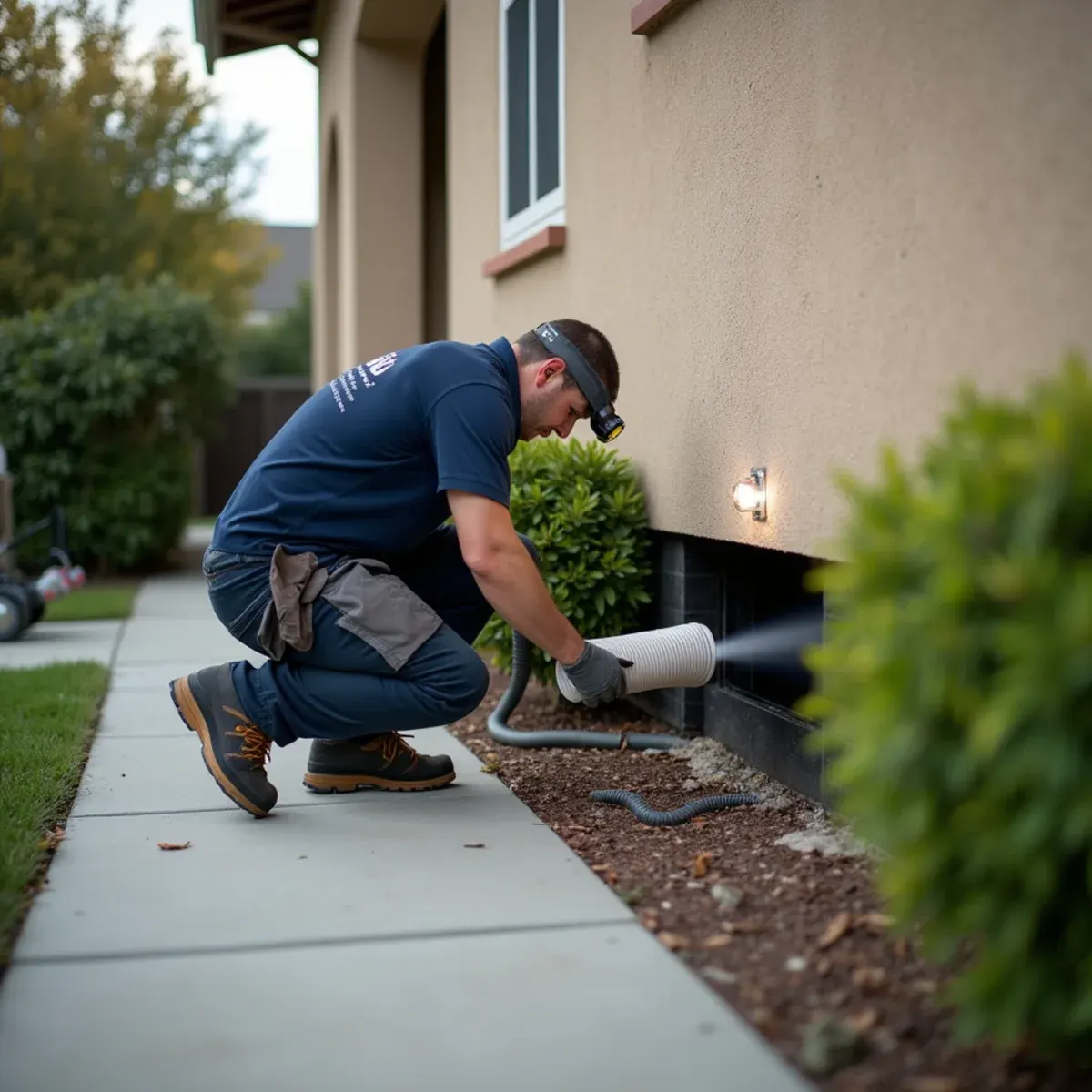
Ross Cortese put up roughly 3,500 houses in Rossmoor between 1957 and 1961, to a short list of plans, all of them slab-on-grade. That uniformity is the defining fact about this neighborhood and it settles the crawl space question before we get there: the original single-story ranch you bought does not have a sub-area under it. Crawl space drying is not a Rossmoor service the way it is in Fullerton or Santa Ana, and we will say so rather than sell an inspection of a space that was never built.
What we do dry under floors here came later. Somewhere between the seventies and now, most of these houses grew: an enclosed patio off the back, a den, a fourth bedroom, a laundry room bumped out past the original footprint. A fair number of those additions were framed over a wood deck rather than poured, sitting a few inches to a couple of feet above grade, skirted rather than vented, with fiberglass batts underneath nobody has looked at since. Off Montecito Road we open those and find insulation that has been hanging wet for a long time.
What Rossmoor Changes About Crawl Space Drying
1Additions and patio rooms, not original floors
The wet sub-floor call in Rossmoor is almost always about an added room. Water from a relocated washer, a hose bib or a failed line at the addition wall gets under that raised deck and stays. The main house dries out normally because it is concrete, everyone relaxes, and the added room keeps feeding a smell that gets worse through summer.
2Skirted voids with no ventilation
Purpose-built crawl spaces have vents and an access hatch. These additions usually have neither. The perimeter is closed in with stucco or wood skirting, there is no ground barrier over bare dirt, and the only way to see inside is to cut an opening. We do that deliberately and in a spot that closes cleanly, not wherever is fastest.
3Unpermitted work and the County counter
Rossmoor is unincorporated, so permits and inspections run through Orange County rather than a city building department. Plenty of these additions were never permitted at all. That does not stop us drying anything, but it shapes the rebuild conversation and it is better raised on day one than discovered when the repair scope reaches the adjuster.
How the Work Runs
The method is the same one we use on every crawl space drying job, documented to the IICRC S500:2025 standard. Here it is in short — the full crawl space water damage & drying process explains each stage in detail.
- Get in and map the whole space
- Extract, then remove what is finished
- Build the crawl space into a chamber
- Dry the framing to a measured standard
- Deal with growth on the joists
- New barrier, insulation, encapsulation if warranted
The Rossmoor Background Worth Knowing
Plumbing failure is largely a function of time, water chemistry, and installation method — and in Rossmoor all three are effectively identical from house to house. That is why leak calls here tend to arrive in clusters, and why a neighbor's slab leak is genuinely relevant information about your own home.
There is more on the housing stock, drainage and plumbing history of this city on our water damage restoration in Rossmoor page.
Rossmoor at a glance
- Dominant construction era
- 1957–1961
- Foundation type
- slab on grade
- Supply piping found here
- under-slab copper, some galvanized
- Drain line materials
- cast iron
- Terrain and water table
- flat, moderate water table
- Most common local failure
- clustered slab leaks, where one failure on a street reliably predicts the neighbors
- Highest-value local prevention
- treating a neighbor's slab leak as information about your own house and running the meter test
What It Costs in Rossmoor
We do not quote a number over the phone before seeing the property — anyone who does is guessing. The variables that actually move the price on a crawl space drying job are access and working height, how much of the footprint got wet, water category and soil contamination, and they are broken down in full on the crawl space water damage & drying page. The assessment and the written estimate are free anywhere in Rossmoor, day or night, with no obligation.
Crawl Space Drying Questions from Rossmoor Homeowners
Usually a wet void under a raised deck that has been holding water long enough to soften the subfloor. We cut an access opening, pull the wet insulation, check the joists and the underside of the sheathing for fungal growth, and dry the space as its own chamber with the perimeter sealed. Subfloor that has swollen and lost bond does not come back with drying, and we will tell you that before you are billed for trying.
Often you cannot tell from inside, which is the whole problem. Sub-area odor rises through plumbing penetrations and the baseboard line and reads like a wall or flooring issue. The check takes about twenty minutes: a technician under the house with a light and a moisture meter. If the framing meters dry and the barrier is intact, we tell you it is not the crawl space and go look somewhere else.
Sometimes, over months, and usually not completely. The vents give you passive air exchange, which only helps when outdoor air is drier than the space. On a marine layer morning here that air is above 80% relative humidity, so the vents are bringing moisture in. Meanwhile the wet soil keeps evaporating and the subfloor above keeps taking it up. Left alone, the common outcome is growth on the joists.
Because they were all built between 1957 and 1961 with the same materials and methods. Copper routed through a slab fails from internal erosion and external soil corrosion on a fairly predictable timeline, and when an entire community shares one construction date, it shares one failure window too.