
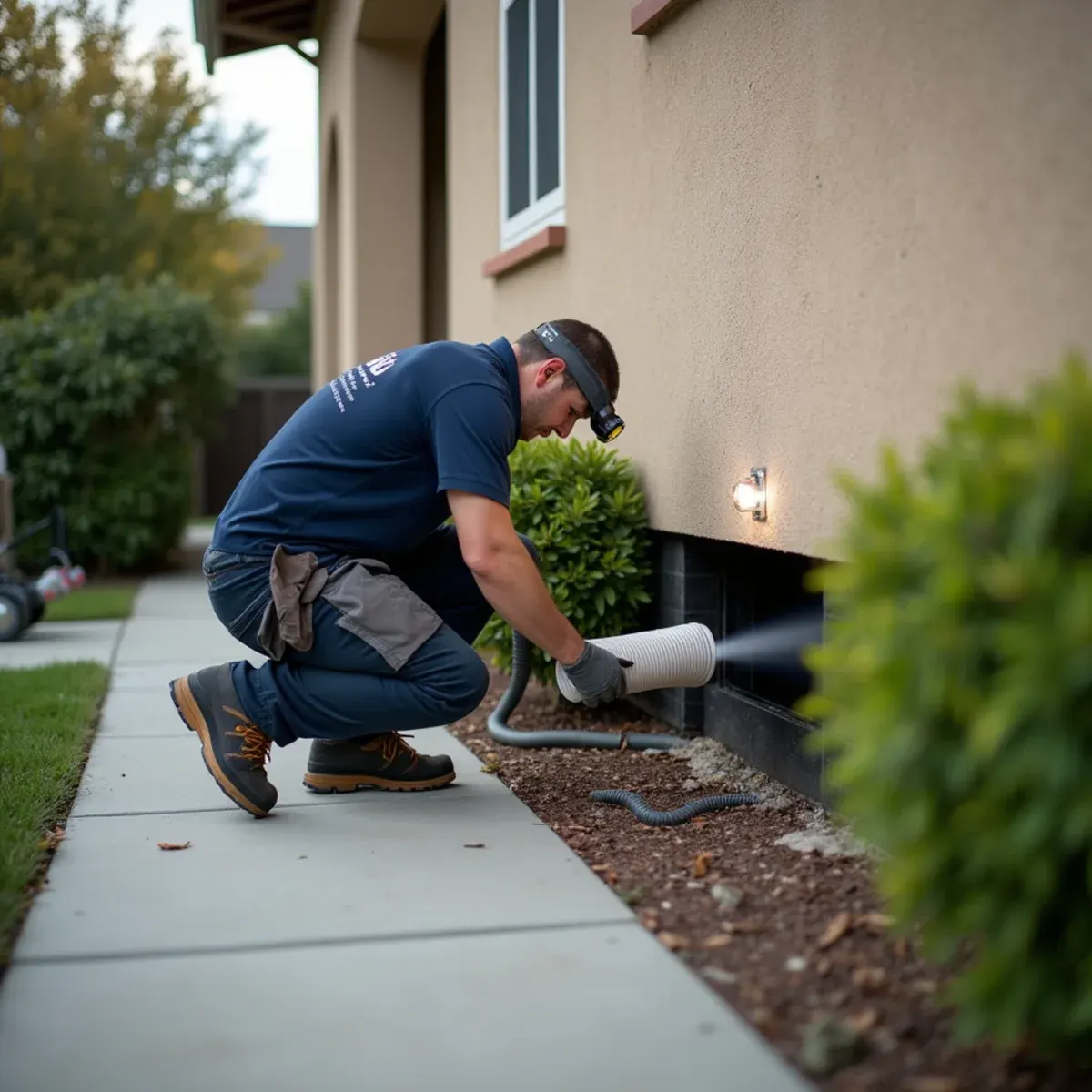
Paramount is packed tight. The city grew out of the old Hynes and Clearwater dairy communities and turned into one of the more industrially dense places around, with housing wedged between commercial corridors and very little permeable ground anywhere. It's also almost entirely slab. Under-floor drying in the sense of a raised crawl space is uncommon here, and saying that up front is more useful than sending a crew to hunt for one. What we mostly handle is water moving across concrete, residential and commercial, sometimes on the same block.
Where under-floor work does apply is on the commercial side. Warehouses, shops and older mixed-use buildings along the corridors have utility trenches, pipe chases and slab-recessed voids that hold water long after the visible floor looks dry. On the residential side, a handful of prewar Hynes and Clearwater era cottages still sit raised over dirt, and additions built onto small postwar houses sometimes have shallow voids underneath. With the Los Angeles River channel on the western edge and almost no open soil, water that gets in has nowhere to go on its own.
What Paramount Changes About Crawl Space Drying
1Trenches and chases hold water underground
In commercial buildings here the water often ends up in a utility trench, a pipe chase or a recessed floor void rather than on the surface. Those spaces trap it against insulation and conduit, and a dry-looking floor tells you nothing. We open covers, meter inside, and dry them as their own chambers with directed air, because otherwise moisture keeps coming back up through the slab for months.
2Residential and commercial on one block
Paramount blocks routinely put houses next to shops and light industry, and a single storm or main break can involve both. They need different handling: occupancy and contents on the residential side, production downtime, racked stock and different water categories on the commercial side. We scope them separately even when it's one address list, and we bill them separately so the insurance side doesn't tangle.
3No permeable ground to absorb runoff
Between paving, buildings and the channelized river on the west edge, there is little open soil left in Paramount. Storm water runs on hard surfaces until it finds a low door, a dock well or a garage slope. That means the entry point is usually at grade rather than from below, and the fastest first move is often sandbagging and a pump before drying even starts.
How the Work Runs
The method is the same one we use on every crawl space drying job, documented to the IICRC S500:2025 standard. Here it is in short — the full crawl space water damage & drying process explains each stage in detail.
- Get in and map the whole space
- Extract, then remove what is finished
- Build the crawl space into a chamber
- Dry the framing to a measured standard
- Deal with growth on the joists
- New barrier, insulation, encapsulation if warranted
The Paramount Background Worth Knowing
On a typical Paramount lot, the house, the driveway, the walkways and the rear slab cover most of the parcel. What is left is a narrow side yard, and everything that lands on the roof and the paving is supposed to leave through a couple of small area drains. That system has no margin. When a grate silts up, when a downspout dumps straight onto paving, or when the outlet at the curb has been crushed by a parked truck, the water has no soil to soak into and nowhere else to be. It ponds against the slab edge and comes in at the lowest threshold, which is usually a garage or a side door.
There is more on the housing stock, drainage and plumbing history of this city on our water damage restoration in Paramount page.
Paramount at a glance
- Dominant construction era
- 1945–1965
- Foundation type
- slab on grade
- Supply piping found here
- original galvanized steel, copper
- Drain line materials
- cast iron
- Terrain and water table
- flat, moderate water table
- Most common local failure
- residential and commercial losses on the same block, needing very different handling
- Highest-value local prevention
- clearing area drains before the season on lots with very little permeable ground
What It Costs in Paramount
We do not quote a number over the phone before seeing the property — anyone who does is guessing. The variables that actually move the price on a crawl space drying job are access and working height, how much of the footprint got wet, water category and soil contamination, and they are broken down in full on the crawl space water damage & drying page. The assessment and the written estimate are free anywhere in Paramount, day or night, with no obligation.
Crawl Space Drying Questions from Paramount Homeowners
Almost certainly a trench or chase under the slab still holding water. Commercial floors here are laced with utility runs, and once water gets into one it sits against conduit and insulation with no airflow. The surface dries because the surface is exposed; the void isn't. We pull covers, meter inside, and run directed air and dehumidification into the void until it reads dry. Skipping that step is why the smell keeps returning.
Often you cannot tell from inside, which is the whole problem. Sub-area odor rises through plumbing penetrations and the baseboard line and reads like a wall or flooring issue. The check takes about twenty minutes: a technician under the house with a light and a moisture meter. If the framing meters dry and the barrier is intact, we tell you it is not the crawl space and go look somewhere else.
Sometimes, over months, and usually not completely. The vents give you passive air exchange, which only helps when outdoor air is drier than the space. On a marine layer morning here that air is above 80% relative humidity, so the vents are bringing moisture in. Meanwhile the wet soil keeps evaporating and the subfloor above keeps taking it up. Left alone, the common outcome is growth on the joists.
Almost certainly your area drains. Paramount lots have very little permeable ground, so everything that falls on the roof and the paving has to leave through a couple of small drains. If a grate silts up or the outlet is crushed, the water ponds against the slab and enters at the lowest threshold, which is usually the garage. Rodding the drains and checking the outlet before the season costs far less than drying the garage wall afterward.