
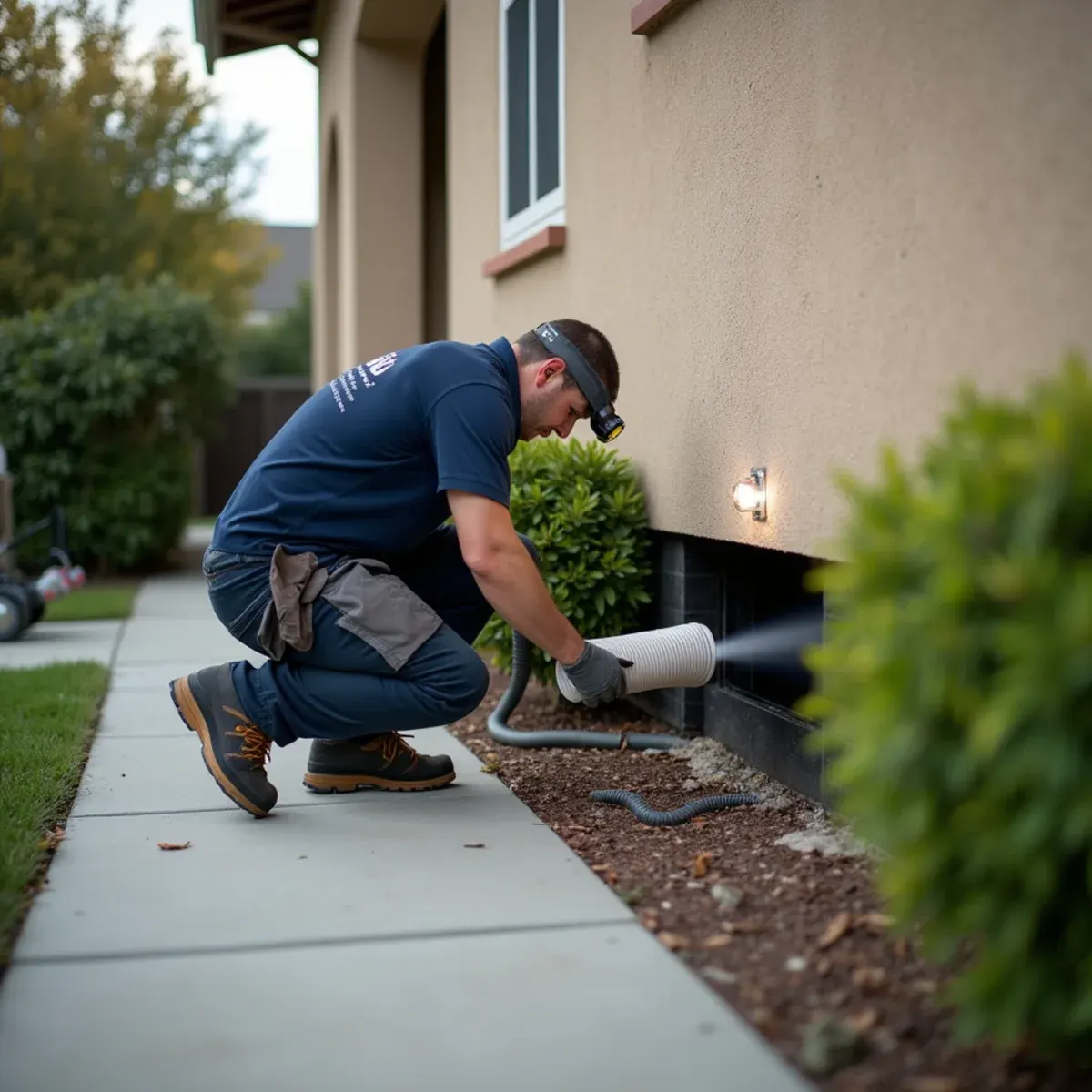
The most useful advice we can give a Downey homeowner is about what not to cut. Jean Vandruff's Cinderella Homes carry turrets, pointed rooflines, scalloped trim and interior millwork that no lumberyard sells anymore. When water gets into one, the instinct — and the instinct of a lot of crews — is to open baseboard, casing and cabinet toe kicks to speed the drying up. On these houses that trim is the expensive part of the building, and low-demolition drying is worth the extra days it takes.
Underneath the detailing, Downey is standard 1950s and early 1960s construction: slab on grade with galvanized supply, built through the same optimistic decade that gave the city the oldest surviving McDonald's and the aerospace campus now marked by the Columbia Memorial Space Center. True crawl spaces are scarce. Where sub-floor void exists, it's under prewar houses in the older pockets and under additions built after the original pour. That's a small slice of a city otherwise sitting on concrete.
What Downey Changes About Crawl Space Drying
1Cinderella millwork sets the drying method
Scalloped fascia, diamond-pane detail and original interior casing can't be replaced in kind. We dry cavities through small hidden access points, using directed airflow and dehumidification rather than demolition, and we take the extra days that requires. Documentation matters too — insurers pay for what's proven, so we photograph and meter throughout, and nobody has to argue later that saving the trim was reasonable.
2Galvanized under slab, not under a floor
Original galvanized supply in these houses has been scaling shut from the inside since the Eisenhower administration. When it splits under concrete, moisture wicks up through the slab and out along the bottom plate, which mimics ground moisture from a crawl space. Downey homeowners often go hunting for a sub-area that was never built. We test the line first and save you the search.
3Older pockets do have sub-floor voids
A number of pre-1940 houses survive in the older parts of Downey, and some are raised with dirt beneath. Additions built onto 1950s tract homes can be framed the same way. Those spaces are small, poorly ventilated and rarely sheeted, and after a wet winter they hold moisture that works its way into the subfloor above. If you have foundation vents anywhere on the exterior, it's worth a look.
How the Work Runs
The method is the same one we use on every crawl space drying job, documented to the IICRC S500:2025 standard. Here it is in short — the full crawl space water damage & drying process explains each stage in detail.
- Get in and map the whole space
- Extract, then remove what is finished
- Build the crawl space into a chamber
- Dry the framing to a measured standard
- Deal with growth on the joists
- New barrier, insulation, encapsulation if warranted
The Downey Background Worth Knowing
The instinct on a wet wall is to open it, and sometimes that is correct. But IICRC S500:2025 is built around restoring rather than replacing wherever the drying goals can genuinely be met, and on a house with original arched casings and applied gingerbread, meeting those goals is worth some patience. We would rather spend three extra days with equipment running than pull a run of trim that would have to be milled from scratch to come back. The standard supports that choice and so does the arithmetic on the estimate, because custom millwork is not cheap and matching a fifties profile is not quick.
There is more on the housing stock, drainage and plumbing history of this city on our water damage restoration in Downey page.
Downey at a glance
- Dominant construction era
- 1950–1965
- Foundation type
- slab on grade
- Supply piping found here
- galvanized steel, under-slab copper
- Drain line materials
- cast iron
- Terrain and water table
- flat, moderate water table
- Most common local failure
- 1950s slab and galvanized failures in houses whose decorative woodwork makes careful, low-demolition drying worth paying for
- Highest-value local prevention
- drying in place wherever readings allow, because the trim and detailing on these houses cannot be bought
What It Costs in Downey
We do not quote a number over the phone before seeing the property — anyone who does is guessing. The variables that actually move the price on a crawl space drying job are access and working height, how much of the footprint got wet, water category and soil contamination, and they are broken down in full on the crawl space water damage & drying page. The assessment and the written estimate are free anywhere in Downey, day or night, with no obligation.
Crawl Space Drying Questions from Downey Homeowners
Slowly and deliberately. We create small access points where they don't show — inside cabinet bases, behind removable shoe molding, at closet floors — and move dry air into the wall and floor cavities through them, with dehumidification holding the room low enough that moisture keeps leaving the wood. We meter daily and adjust rather than opening more. Where material is genuinely unsalvageable we say so, but we never open finish carpentry just because it's faster.
Often you cannot tell from inside, which is the whole problem. Sub-area odor rises through plumbing penetrations and the baseboard line and reads like a wall or flooring issue. The check takes about twenty minutes: a technician under the house with a light and a moisture meter. If the framing meters dry and the barrier is intact, we tell you it is not the crawl space and go look somewhere else.
Sometimes, over months, and usually not completely. The vents give you passive air exchange, which only helps when outdoor air is drier than the space. On a marine layer morning here that air is above 80% relative humidity, so the vents are bringing moisture in. Meanwhile the wet soil keeps evaporating and the subfloor above keeps taking it up. Left alone, the common outcome is growth on the joists.
Usually, yes. We go into the wall cavity through small ports low on the wall, hidden behind shoe molding or inside a closet, and dry from the inside out rather than taking the finished face off. That takes longer and needs more equipment than gutting the wall would, which is exactly the trade we think is worth making on a house with millwork that cannot be bought. Where it will not work, we tell you early.