
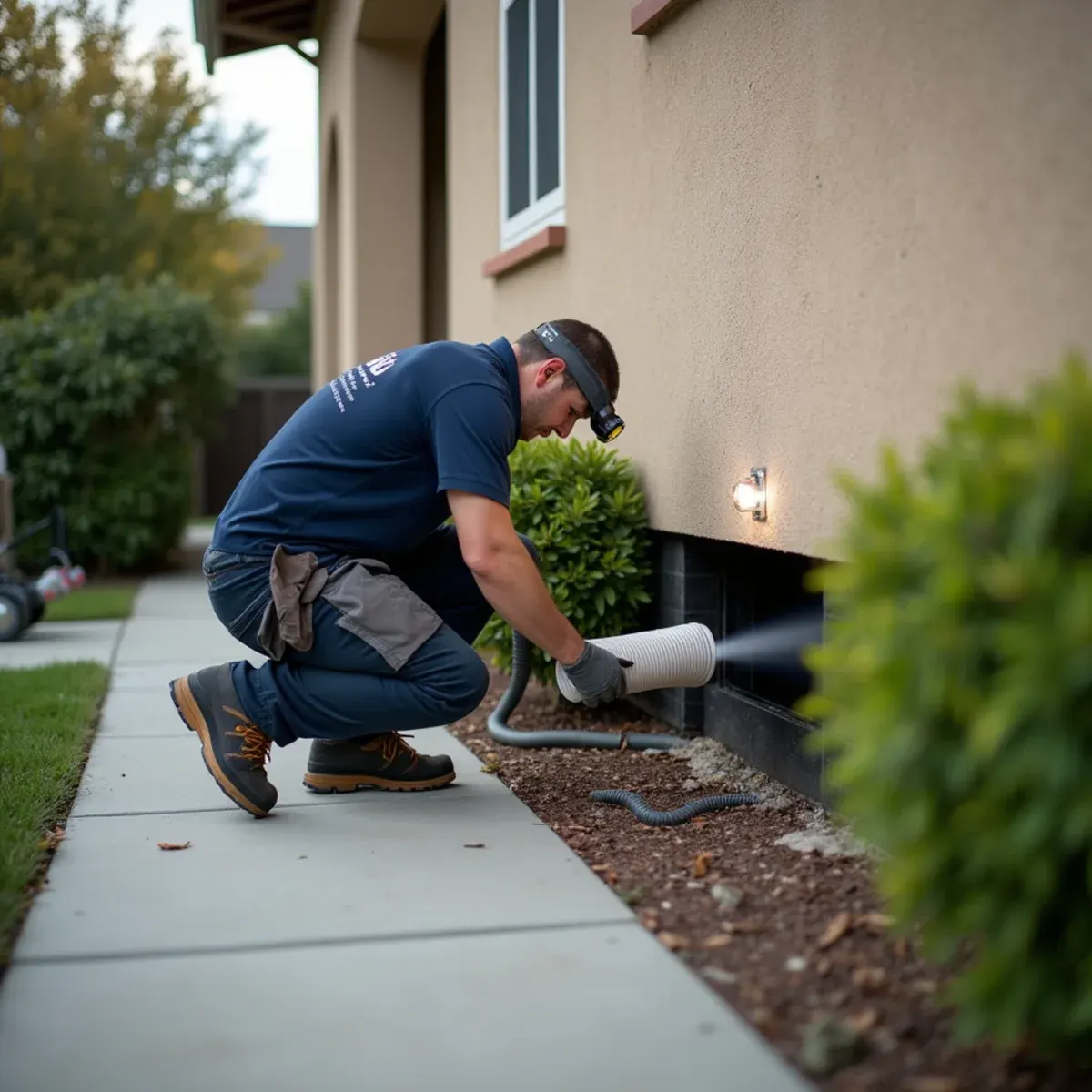
Signal Hill is a 365-foot hill completely surrounded by Long Beach, and everything about water here follows from the grade. Water doesn't pond on this hill — it moves, and it moves with speed. A retaining wall that has held fine for fifteen years fails at one weep hole and sends storm flow across a pad in minutes. On the newer hillside lots, terrace drains and area drains are the whole defense, and when they plug the water arrives at the house rather than going around it.
The housing is split by era and by oil. The 1921 Alamitos No. 1 discovery set off one of the most productive booms in American history, and the field is still working — active wells and oilfield infrastructure sit intermixed with housing. Small 1920s boom-era cottages on cripple walls and raised foundations survive alongside much newer development built on former oil land, on steep engineered lots. Marine influence off Long Beach keeps humidity up, so a wet sub-area under one of those old cottages doesn't clear on its own.
What Signal Hill Changes About Crawl Space Drying
1Water arrives with velocity, not slowly
On grades this steep, storm flow hits a foundation wall moving. It carries silt, it finds the weakest point in a retaining wall or a terrace drain, and it can push into a sub-area in the time it takes to notice the rain got heavy. Drying the wood is the second job here. The first is working out how it got in, because there will be another storm.
2Boom-era cottages sit on cripple walls
The 1920s houses that survived the oil years typically sit on short cripple walls over dirt, with sub-areas that were never sheeted and insulation added decades later. Those are true crawl spaces and they dry slowly — low clearance, poor cross-flow, and coastal humidity working against you. We seal the space, pull the wet fiberglass, and run controlled dehumidification rather than trusting the vents to do it.
3Oil-field ground needs an honest answer
Houses on former oil land occasionally have soil conditions we are not the right people to judge. We dry water damage; we don't assess hydrocarbon contamination. If what's under your floor smells like petroleum rather than mildew, or the soil is visibly stained, we stop, document it, and tell you to bring in an environmental consultant before we set equipment. That's a limit worth naming up front.
How the Work Runs
The method is the same one we use on every crawl space drying job, documented to the IICRC S500:2025 standard. Here it is in short — the full crawl space water damage & drying process explains each stage in detail.
- Get in and map the whole space
- Extract, then remove what is finished
- Build the crawl space into a chamber
- Dry the framing to a measured standard
- Deal with growth on the joists
- New barrier, insulation, encapsulation if warranted
The Signal Hill Background Worth Knowing
On these lots the drainage is engineered rather than natural. Terrace drains catch water partway down a slope, v-ditches carry it around a pad instead of across it, and retaining walls have weep holes with a gravel drain behind them so pressure never builds in the soil. All of that works until something clogs. Then a retaining wall stops being a wall and starts being a dam, and saturated soil pushes water through the joints and into whatever sits on the other side, which is usually a garage, a storage room, or the back of a lower level.
There is more on the housing stock, drainage and plumbing history of this city on our water damage restoration in Signal Hill page.
Signal Hill at a glance
- Dominant construction era
- 1920–2005
- Foundation type
- mixed on grade
- Supply piping found here
- original 1920s piping, galvanized steel, modern PEX in newer hillside builds
- Drain line materials
- cast iron, ABS
- Terrain and water table
- hillside-mixed, deep water table
- Most common local failure
- slope drainage and retaining-wall failures on steep lots, where water arrives with velocity rather than ponding
- Highest-value local prevention
- keeping terrace drains, v-ditches and retaining-wall weeps clear before the first storm
What It Costs in Signal Hill
We do not quote a number over the phone before seeing the property — anyone who does is guessing. The variables that actually move the price on a crawl space drying job are access and working height, how much of the footprint got wet, water category and soil contamination, and they are broken down in full on the crawl space water damage & drying page. The assessment and the written estimate are free anywhere in Signal Hill, day or night, with no obligation.
Crawl Space Drying Questions from Signal Hill Homeowners
With the exterior. On this grade the entry point matters more than the puddle, so we find where water crossed the pad, check the terrace drains and weep holes above it, and get the immediate path controlled. Then the sub-area gets treated as its own chamber — standing water out, saturated insulation out, dirt sheeted, controlled drying on the joists. We'll flag what needs a drainage contractor, though that part isn't work we do.
Often you cannot tell from inside, which is the whole problem. Sub-area odor rises through plumbing penetrations and the baseboard line and reads like a wall or flooring issue. The check takes about twenty minutes: a technician under the house with a light and a moisture meter. If the framing meters dry and the barrier is intact, we tell you it is not the crawl space and go look somewhere else.
Sometimes, over months, and usually not completely. The vents give you passive air exchange, which only helps when outdoor air is drier than the space. On a marine layer morning here that air is above 80% relative humidity, so the vents are bringing moisture in. Meanwhile the wet soil keeps evaporating and the subfloor above keeps taking it up. Left alone, the common outcome is growth on the joists.
Start uphill. On this hill the cause is almost never at the place the water got in. Walk the slope above your pad and check the terrace drains, the v-ditch and the retaining wall weep holes. A weep that has been painted or stuccoed over is common and completely disables the drain behind the wall. Then look at where the uphill property discharges. Fixing the entry point without finding the redirect just moves the problem a few feet.