
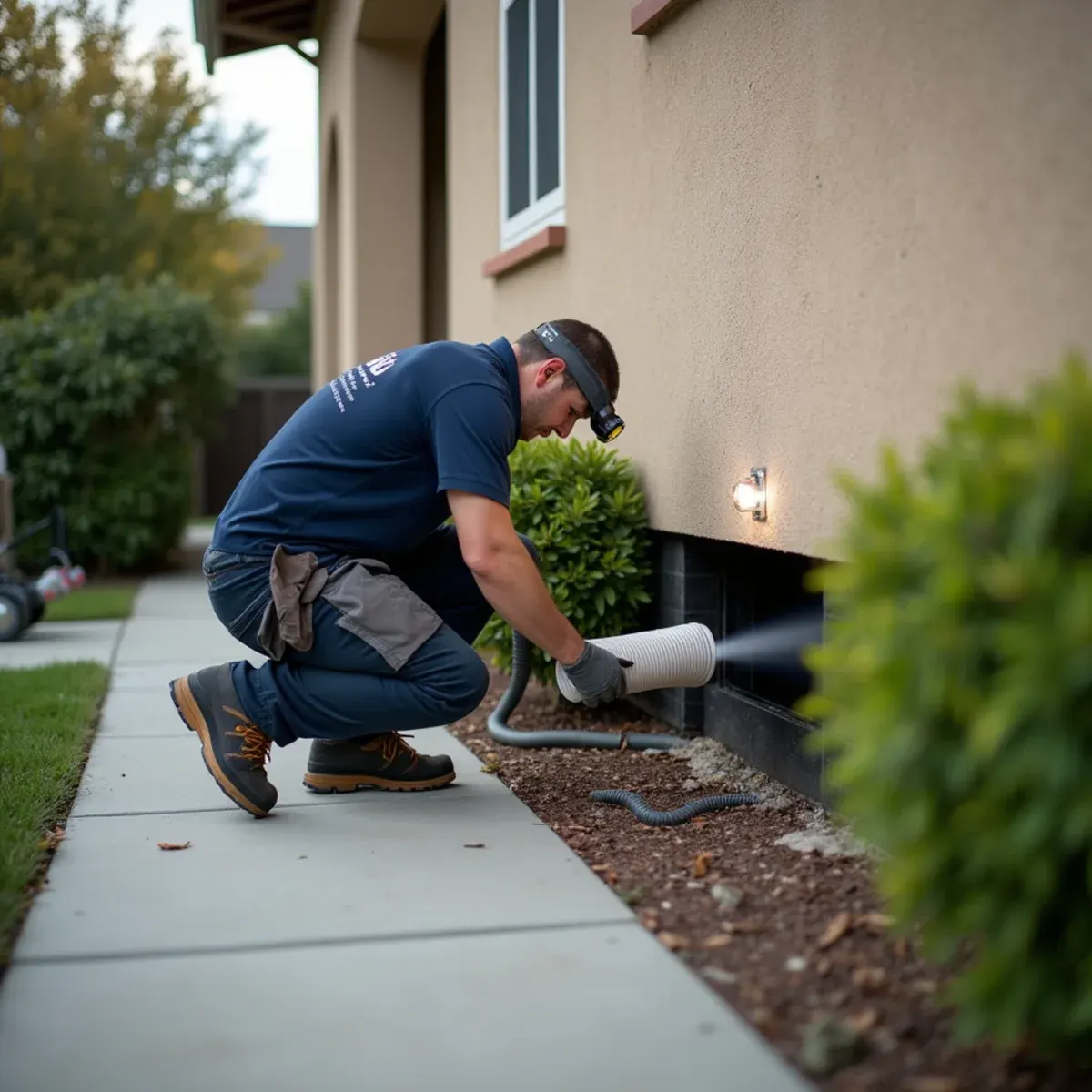
A quarter-inch drip from a supply line under a 1924 Craftsman does not announce itself. The water falls eighteen inches, lands on dirt and soaks in. No stain on a ceiling, no puddle on a floor, nothing dramatic on the bill. What you get instead, usually in late summer, is a hallway that smells like somebody else's basement and a floor that squeaks in a place it never used to. By then the fiberglass in the joist bays is hanging out of its supports and there is growth on the underside of the subfloor.
Fullerton is genuinely mixed in a way most of its neighbors are not. The pre-war Craftsman and Spanish Revival neighborhoods sit on raised perimeter foundations over old-growth Douglas fir framing. Raymond Hills and Sunny Hills add slope, so sub-areas step down with the lot and everything that gets loose collects in the low corner. And the blocks around Cal State Fullerton and Fullerton College are dense student rentals, where nobody reports anything for weeks because the tenants do not own the house and the owner is not local.
What Fullerton Changes About Crawl Space Drying
1Sloped sub-areas collect at the low corner
On a Raymond Hills or Sunny Hills lot, the sub-area is not level. Water from a failure at the uphill end travels along the grade and pools at the downhill corner, often two rooms away from the leak. Metering only where the plumbing is misses it entirely. We map the low points first, then work backward to the source, which is the opposite order from a flat-lot job.
2Student rentals and weeks of delay
Around the two campuses, the gap between when a sub-floor leak starts and when someone reports it is the longest we see anywhere. Renters do not go under the house, and a musty smell gets attributed to the age of the building. By the time we are called it is usually a mold conversation as much as a drying one, and the scope is set by that delay rather than by the leak itself.
3Old-growth fir dries on its own clock
The Douglas fir in these pre-war floors is far denser than modern framing. It takes on water reluctantly and surrenders it just as reluctantly, so meter readings lag behind what the air in the chamber is doing. That is a reason to keep equipment running past the point where the space feels dry, and a reason to distrust anyone who calls a Fullerton crawl space finished in two days.
How the Work Runs
The method is the same one we use on every crawl space drying job, documented to the IICRC S500:2025 standard. Here it is in short — the full crawl space water damage & drying process explains each stage in detail.
- Get in and map the whole space
- Extract, then remove what is finished
- Build the crawl space into a chamber
- Dry the framing to a measured standard
- Deal with growth on the joists
- New barrier, insulation, encapsulation if warranted
The Fullerton Background Worth Knowing
The pre-war homes around downtown Fullerton were built with materials that behave completely differently from modern construction. Lath and plaster walls hold several times the water drywall does. Old-growth Douglas fir framing is dense and dries slowly. Original oak and fir flooring is thick, high-quality material that is well worth saving.
There is more on the housing stock, drainage and plumbing history of this city on our water damage restoration in Fullerton page.
Fullerton at a glance
- Dominant construction era
- 1910–1980
- Foundation type
- mixed on grade
- Supply piping found here
- galvanized steel, copper, original pre-war piping
- Drain line materials
- cast iron, clay
- Terrain and water table
- rolling, moderate water table
- Most common local failure
- crawl-space leaks that run undetected for weeks because the water drips away instead of pooling on a floor
- Highest-value local prevention
- posting a shutoff location and emergency contact in every rental, since delayed reporting is the local failure mode
What It Costs in Fullerton
We do not quote a number over the phone before seeing the property — anyone who does is guessing. The variables that actually move the price on a crawl space drying job are access and working height, how much of the footprint got wet, water category and soil contamination, and they are broken down in full on the crawl space water damage & drying page. The assessment and the written estimate are free anywhere in Fullerton, day or night, with no obligation.
Crawl Space Drying Questions from Fullerton Homeowners
Three things, and none of them involve going under the house. A persistent musty smell that is worse in one part of the house, floors that develop a new squeak or feel softer near a bathroom or laundry wall, and a water bill that steps up without a change in habits. Ask them to report any of those the week they notice it. On a raised foundation the difference between week one and week eight is the entire difference in scope.
Often you cannot tell from inside, which is the whole problem. Sub-area odor rises through plumbing penetrations and the baseboard line and reads like a wall or flooring issue. The check takes about twenty minutes: a technician under the house with a light and a moisture meter. If the framing meters dry and the barrier is intact, we tell you it is not the crawl space and go look somewhere else.
Sometimes, over months, and usually not completely. The vents give you passive air exchange, which only helps when outdoor air is drier than the space. On a marine layer morning here that air is above 80% relative humidity, so the vents are bringing moisture in. Meanwhile the wet soil keeps evaporating and the subfloor above keeps taking it up. Left alone, the common outcome is growth on the joists.
Yes, and they need a different approach. Lath and plaster and old-growth framing hold far more water than modern materials and dry much more slowly, so we plan for seven to fourteen days with higher-capacity equipment. The original material is worth that effort — nothing sold today replaces it.