
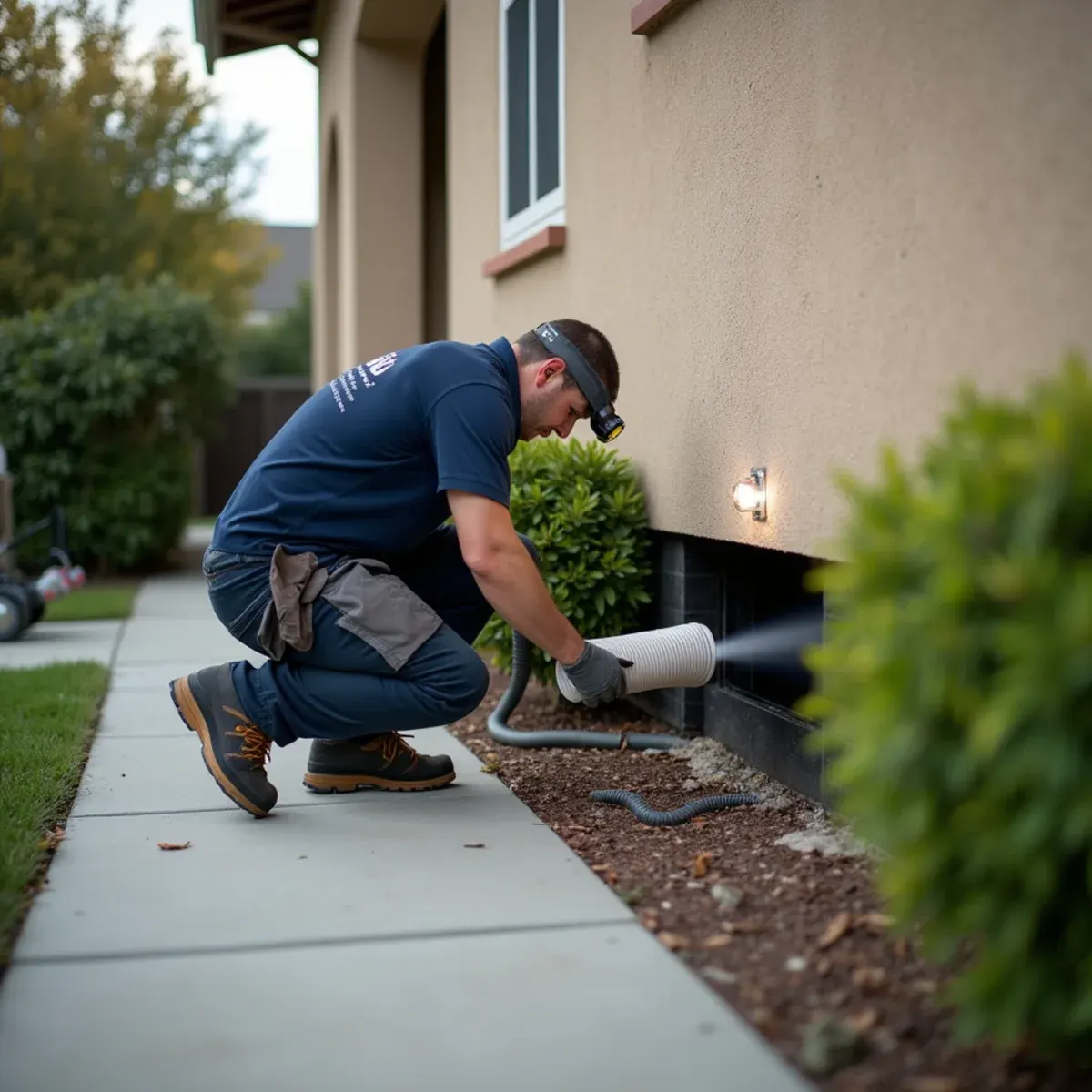
Here's the honest part first. If your La Mirada house went up between 1953 and 1965 with the rest of the planned community, it's on a slab and there is no crawl space to dry. That's most of the city. What we do find is sub-floor void under later work — a family room added over a raised wood floor, a garage converted to a bedroom with the framing furred up off the old slab, a bonus room built out where the lot stepped down.
The rolling ground is what gets those voids wet. La Mirada was laid across low hills rather than a flat sheet, so storm water moves instead of ponding, and fifty years of added patios, planters and retaining walls have quietly aimed that movement back at the house. Water gets under a raised addition on the downhill side and has nowhere to go. Around Biola, the student rentals add a delay — nobody living there checks a vented opening until the floor starts to feel soft.
What La Mirada Changes About Crawl Space Drying
1Additions and conversions, not original tracts
The original 1950s and 1960s tract floors here are poured concrete. The wood-framed voids belong to what came after: room additions, converted garages, raised laundry rooms, enclosed patios. Those spaces are shallow, often unvented, and were rarely built with a ground vapor barrier. When water gets in, they behave like a crawl space — wet fiberglass, damp joists, no drainage — and they need the same treatment on a smaller footprint.
2The downhill wall takes water first
On a rolling lot the house has an uphill side and a downhill side, and water shows up at the low corner. We look at where the grade sits against the addition, whether a planter or patio pour raised it above the sill line, and whether a retaining wall added later dammed a path that used to drain. Drying without addressing that means doing the job twice.
3Rentals near Biola delay discovery
Student housing and institutional buildings near the campus turn over on a school calendar, not a maintenance calendar. A slow leak under an added room can run through a whole semester before anyone reports it, and by then fungal growth on the joists matters more than the water. We'd rather look early and tell you nothing's wrong than open a floor in June that started weeping in January.
How the Work Runs
The method is the same one we use on every crawl space drying job, documented to the IICRC S500:2025 standard. Here it is in short — the full crawl space water damage & drying process explains each stage in detail.
- Get in and map the whole space
- Extract, then remove what is finished
- Build the crawl space into a chamber
- Dry the framing to a measured standard
- Deal with growth on the joists
- New barrier, insulation, encapsulation if warranted
The La Mirada Background Worth Knowing
La Mirada's gentle slopes mean storm water moves across properties instead of sitting on them, which is generally an advantage — except where fifty years of added patios, raised planters, retaining walls, and settled hardscape have redirected it.
There is more on the housing stock, drainage and plumbing history of this city on our water damage restoration in La Mirada page.
La Mirada at a glance
- Dominant construction era
- 1953–1965
- Foundation type
- slab on grade
- Supply piping found here
- under-slab copper, galvanized steel
- Drain line materials
- cast iron
- Terrain and water table
- rolling, moderate water table
- Most common local failure
- exterior water entering where fifty years of added patios, planters and retaining walls redirected the original drainage back toward the house
- Highest-value local prevention
- walking the property during the first real rain and watching where water actually goes
What It Costs in La Mirada
We do not quote a number over the phone before seeing the property — anyone who does is guessing. The variables that actually move the price on a crawl space drying job are access and working height, how much of the footprint got wet, water category and soil contamination, and they are broken down in full on the crawl space water damage & drying page. The assessment and the written estimate are free anywhere in La Mirada, day or night, with no obligation.
Crawl Space Drying Questions from La Mirada Homeowners
Almost always because that room isn't on the slab. Additions and garage conversions here were commonly framed over a shallow wood floor with dirt underneath and no vapor barrier. Ground moisture rises into the joists, the fiberglass holds it, and the smell reaches the room before any stain does. We open the access, meter the subfloor from below, and check the exterior grade on the downhill side — that's usually where the answer is.
Often you cannot tell from inside, which is the whole problem. Sub-area odor rises through plumbing penetrations and the baseboard line and reads like a wall or flooring issue. The check takes about twenty minutes: a technician under the house with a light and a moisture meter. If the framing meters dry and the barrier is intact, we tell you it is not the crawl space and go look somewhere else.
Sometimes, over months, and usually not completely. The vents give you passive air exchange, which only helps when outdoor air is drier than the space. On a marine layer morning here that air is above 80% relative humidity, so the vents are bringing moisture in. Meanwhile the wet soil keeps evaporating and the subfloor above keeps taking it up. Left alone, the common outcome is growth on the joists.
Almost always exterior drainage rather than a plumbing leak — a plugged area drain, a patio that has settled toward the house, or a planter holding moisture against the wall. We identify the actual path rather than just drying the wall, because drying without fixing the cause means doing it again next storm.