
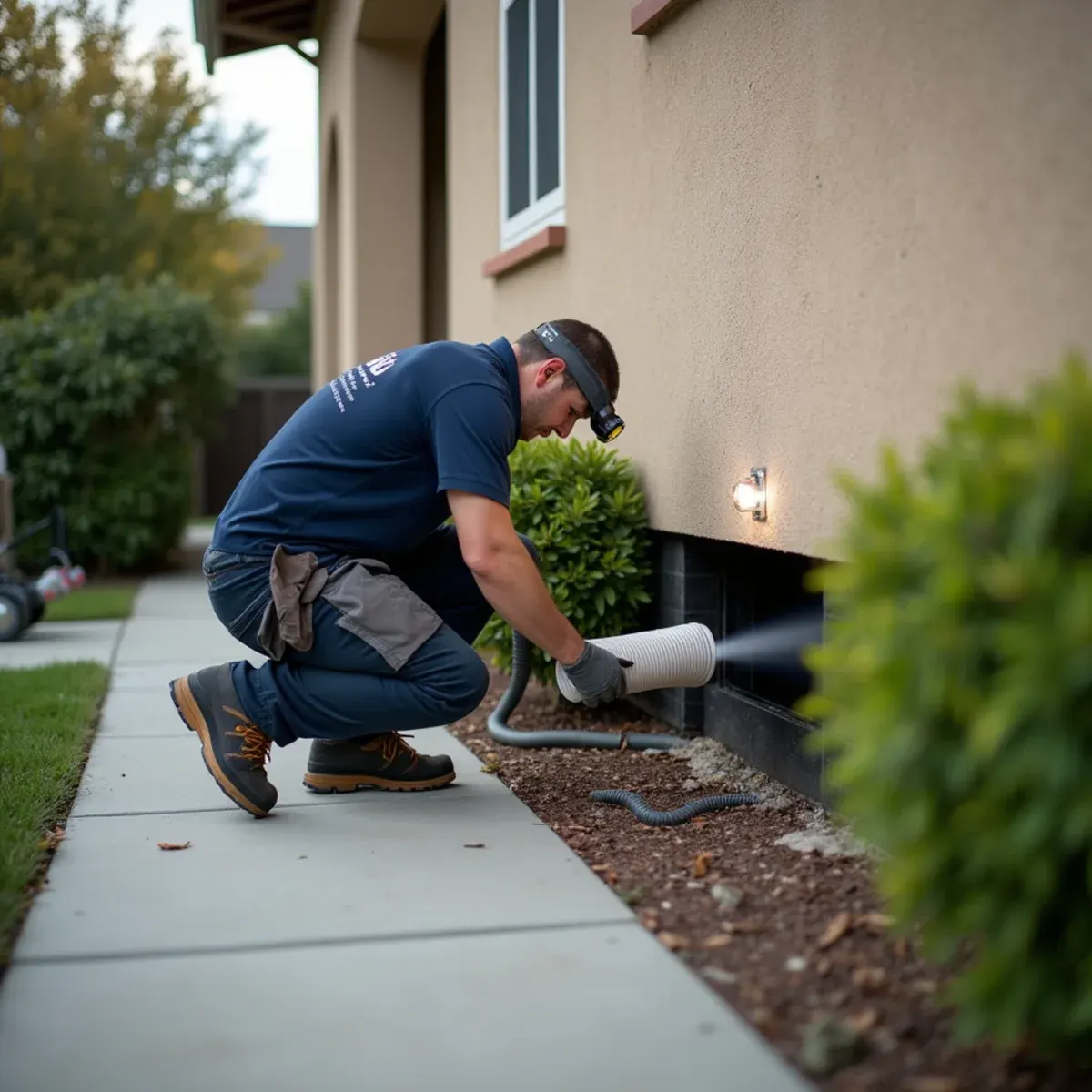
The county's oldest city has the sub-areas to show for it. Floral Park, French Park and Washington Square are full of raised-foundation houses well over a century old, sitting on brick or early concrete perimeter walls with post-and-pier supports and bare soil underneath. What runs across those piers is old-growth Douglas fir with a grain count you cannot buy at any price today. That single fact changes the whole approach: wet old-growth fir, cleaned and dried properly, is still better material than anything on a lumber rack, so the default here is save it.
Above the joists the assembly is just as unusual. Diagonal board subfloor, then old-growth oak or fir flooring, then lath and plaster walls that hold several times the water drywall does and release it on their own slow schedule. Moisture rising out of a wet sub-area moves through that stack in a way no modern house replicates, and the plaster keys behind the lath let go if it stays wet. In the designated districts, exterior and window work goes through historic preservation review, so what you are permitted to change shapes the repair plan from the start.
What Santa Ana Changes About Crawl Space Drying
1Old-growth fir joists are worth saving
Dense, tight-grained century-old fir absorbs water slowly and gives it up slowly, which reads as bad news on a meter and is actually an advantage. Where growth is surface fungal rather than structural rot, the answer is HEPA vacuuming, controlled abrasive cleaning and drying to target, not replacement. Cutting it out means putting modern dimensional lumber into a frame it does not match.
2Plaster keys let go when they stay wet
Water rising from the sub-area into wall bases soaks the plaster keys that grip the wood lath. Wet plaster is heavy and the keys shear, so the wall can look intact while it is separating behind the surface. We check the base of every wall over the wet footprint by tapping and metering, and we stabilize before drying so the drying itself does not bring a ceiling or a wall face down.
3Preservation review shapes the plan
In a designated district, replacing an original wood window or altering a visible exterior element is a review question before it is a construction question. That affects sequencing when a sub-area job reaches sills, skirt vents or porch framing. We plan around it and document conditions thoroughly, because approvals move on their own timetable and the drying cannot wait for them.
How the Work Runs
The method is the same one we use on every crawl space drying job, documented to the IICRC S500:2025 standard. Here it is in short — the full crawl space water damage & drying process explains each stage in detail.
- Get in and map the whole space
- Extract, then remove what is finished
- Build the crawl space into a chamber
- Dry the framing to a measured standard
- Deal with growth on the joists
- New barrier, insulation, encapsulation if warranted
The Santa Ana Background Worth Knowing
Lath and plaster is wood strips nailed across the studs with several coats of plaster troweled over them. The plaster that squeezes through the gaps between lath forms keys that hook over the wood and hold the whole wall in place. That construction is why plaster walls last a century — and why they behave so differently from drywall when wet.
There is more on the housing stock, drainage and plumbing history of this city on our water damage restoration in Santa Ana page.
Santa Ana at a glance
- Dominant construction era
- 1900–1970
- Foundation type
- mixed on grade
- Supply piping found here
- original early-century piping, galvanized steel, copper
- Drain line materials
- cast iron, clay
- Terrain and water table
- flat, moderate water table
- Most common local failure
- plaster key failure, where wet plaster softens and releases from the wood lath holding it to the wall
- Highest-value local prevention
- starting aggressive drying within hours on any plaster loss — waiting is the one thing that costs you the wall
What It Costs in Santa Ana
We do not quote a number over the phone before seeing the property — anyone who does is guessing. The variables that actually move the price on a crawl space drying job are access and working height, how much of the footprint got wet, water category and soil contamination, and they are broken down in full on the crawl space water damage & drying page. The assessment and the written estimate are free anywhere in Santa Ana, day or night, with no obligation.
Crawl Space Drying Questions from Santa Ana Homeowners
Usually not. On old-growth fir, most of what we find is surface growth in the outer fibers rather than decay through the section. That responds to HEPA vacuuming, abrasive cleaning and drying to a documented target, and the joist keeps the strength it always had. Replacement is the answer only where a probe shows softness through the member. We would rather clean a hundred-year-old joist than swap it for lumber that is nothing like it.
Often you cannot tell from inside, which is the whole problem. Sub-area odor rises through plumbing penetrations and the baseboard line and reads like a wall or flooring issue. The check takes about twenty minutes: a technician under the house with a light and a moisture meter. If the framing meters dry and the barrier is intact, we tell you it is not the crawl space and go look somewhere else.
Sometimes, over months, and usually not completely. The vents give you passive air exchange, which only helps when outdoor air is drier than the space. On a marine layer morning here that air is above 80% relative humidity, so the vents are bringing moisture in. Meanwhile the wet soil keeps evaporating and the subfloor above keeps taking it up. Left alone, the common outcome is growth on the joists.
Usually, if drying starts quickly. Plaster holds much more water than drywall and dries far more slowly, so it needs more equipment and often desiccant dehumidification. The risk is the plaster keys softening and releasing from the lath, which is why waiting is the one thing that genuinely costs you the wall.