
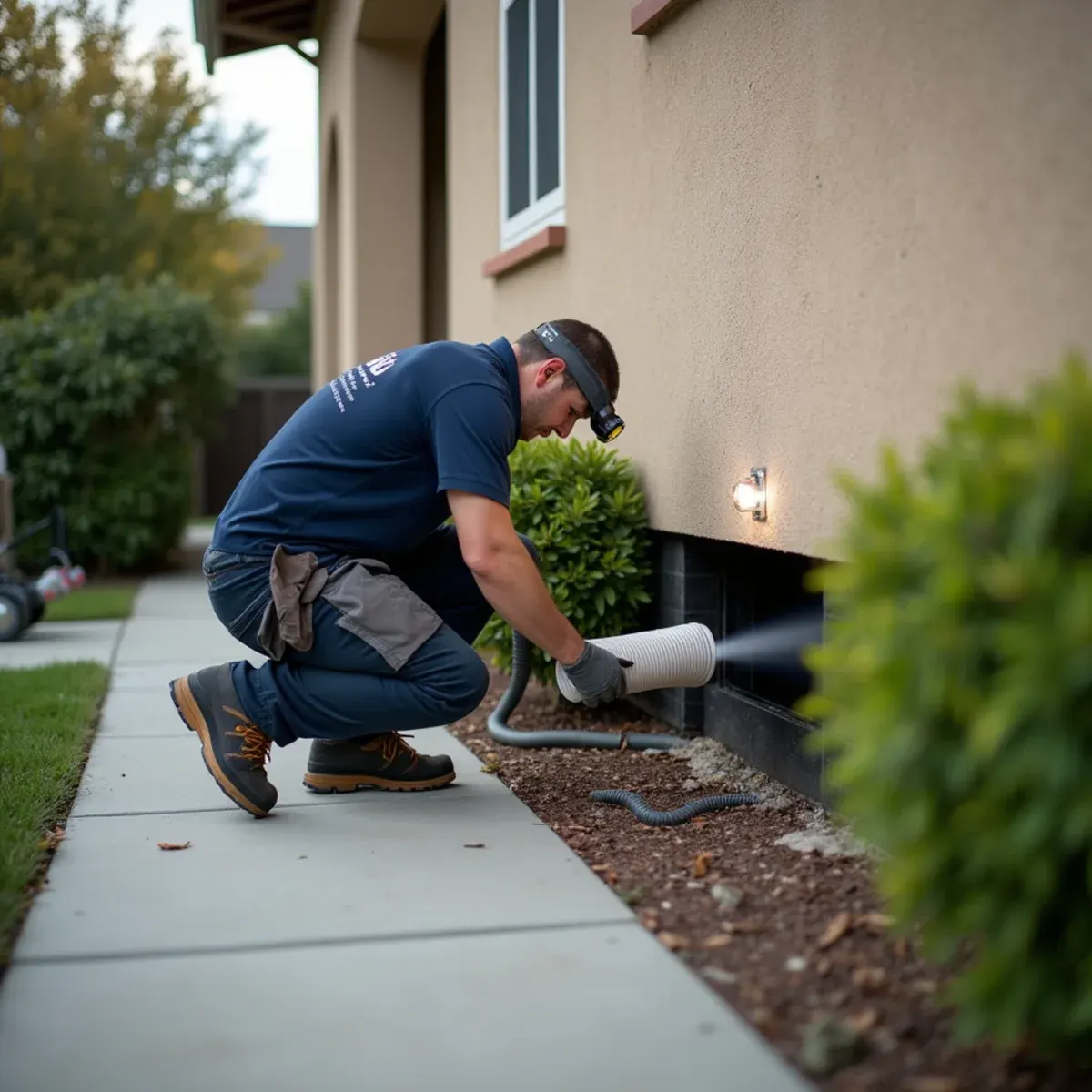
Three generations in a 1958 three-bedroom means the garage became a bedroom years ago and the back of the house grew a room. That is the ordinary Garden Grove story, and it is also where the only wood floors in most of these homes came from. To bring a converted garage level with the rest of the house, someone frames a wood deck over the old garage slab. A few inches of enclosed void, no vents, no access hatch, no ground barrier. When a line in that room fails, the water goes under the deck and disappears.
The original houses do not have crawl spaces at all. Garden Grove built out between 1950 and 1970 on slab-on-grade with galvanized and under-slab copper, from the tracts around Chapman across to Garden Grove Boulevard, so the classic vented sub-area is not part of the local stock. What is part of the local stock is load. Plumbing sized for a 1955 household is carrying a modern one: far more fixture cycles, angle stops and washer hoses worked to a schedule nobody designed for, and the laundry is very often sitting in exactly that converted space.
What Garden Grove Changes About Crawl Space Drying
1Garage conversions with a raised floor deck
This is the single most common sub-floor void in the city. The deck sits on sleepers over the old garage slab, the perimeter is closed in, and there is no way for anything that gets under it to evaporate out. We open it at the low point, dry it as its own chamber, and check whether the slab beneath is still handing moisture back up into the framing.
2Fixture cycles a 1955 house never planned for
Angle stops, risers and washer hoses in a high-occupancy home here see several times the cycles the original designer assumed. They wear out early and they fail under pressure rather than dripping politely. When that happens in a converted space with a raised floor, hundreds of gallons go under the deck in minutes and none of it shows on the finish surface.
3Written scope the whole household can use
In a multi-generational house the person who finds the water, the person who owns the policy and the person who will talk to the adjuster are often three different people. We put the moisture readings, the drying plan and the daily log in writing so whoever makes the insurance call has the same information we do, instead of relaying it secondhand.
How the Work Runs
The method is the same one we use on every crawl space drying job, documented to the IICRC S500:2025 standard. Here it is in short — the full crawl space water damage & drying process explains each stage in detail.
- Get in and map the whole space
- Extract, then remove what is finished
- Build the crawl space into a chamber
- Dry the framing to a measured standard
- Deal with growth on the joists
- New barrier, insulation, encapsulation if warranted
The Garden Grove Background Worth Knowing
A 1958 tract home was plumbed for a family of four with one bathroom in regular use, one washing machine, and a single water heater sized to match. Many Garden Grove homes today support considerably more than that, and the plumbing feels it.
There is more on the housing stock, drainage and plumbing history of this city on our water damage restoration in Garden Grove page.
Garden Grove at a glance
- Dominant construction era
- 1950–1970
- Foundation type
- slab on grade
- Supply piping found here
- galvanized steel, under-slab copper
- Drain line materials
- cast iron, clay
- Terrain and water table
- flat, moderate water table
- Most common local failure
- accelerated wear on angle stops, supply risers and washing machine hoses from far higher fixture cycle counts
- Highest-value local prevention
- shorter replacement intervals on every wear item — hoses at five years without exception
What It Costs in Garden Grove
We do not quote a number over the phone before seeing the property — anyone who does is guessing. The variables that actually move the price on a crawl space drying job are access and working height, how much of the footprint got wet, water category and soil contamination, and they are broken down in full on the crawl space water damage & drying page. The assessment and the written estimate are free anywhere in Garden Grove, day or night, with no obligation.
Crawl Space Drying Questions from Garden Grove Homeowners
It rarely stops the drying work, which is about the cause and extent of the loss, not the paperwork history of the room. Where it can matter is the rebuild, since anything reopened may need to come back to current code, and that is a conversation with your carrier rather than with us. What we can do is document exactly what we found under that floor, what was wet, and what we dried, so nobody is reconstructing it from memory later.
Often you cannot tell from inside, which is the whole problem. Sub-area odor rises through plumbing penetrations and the baseboard line and reads like a wall or flooring issue. The check takes about twenty minutes: a technician under the house with a light and a moisture meter. If the framing meters dry and the barrier is intact, we tell you it is not the crawl space and go look somewhere else.
Sometimes, over months, and usually not completely. The vents give you passive air exchange, which only helps when outdoor air is drier than the space. On a marine layer morning here that air is above 80% relative humidity, so the vents are bringing moisture in. Meanwhile the wet soil keeps evaporating and the subfloor above keeps taking it up. Left alone, the common outcome is growth on the joists.
Yes, all five ZIP codes — 92840, 92841, 92843, 92844, and 92845 — for both residential and commercial properties. Response time runs about twenty-five to thirty-five minutes depending on where in the city.