
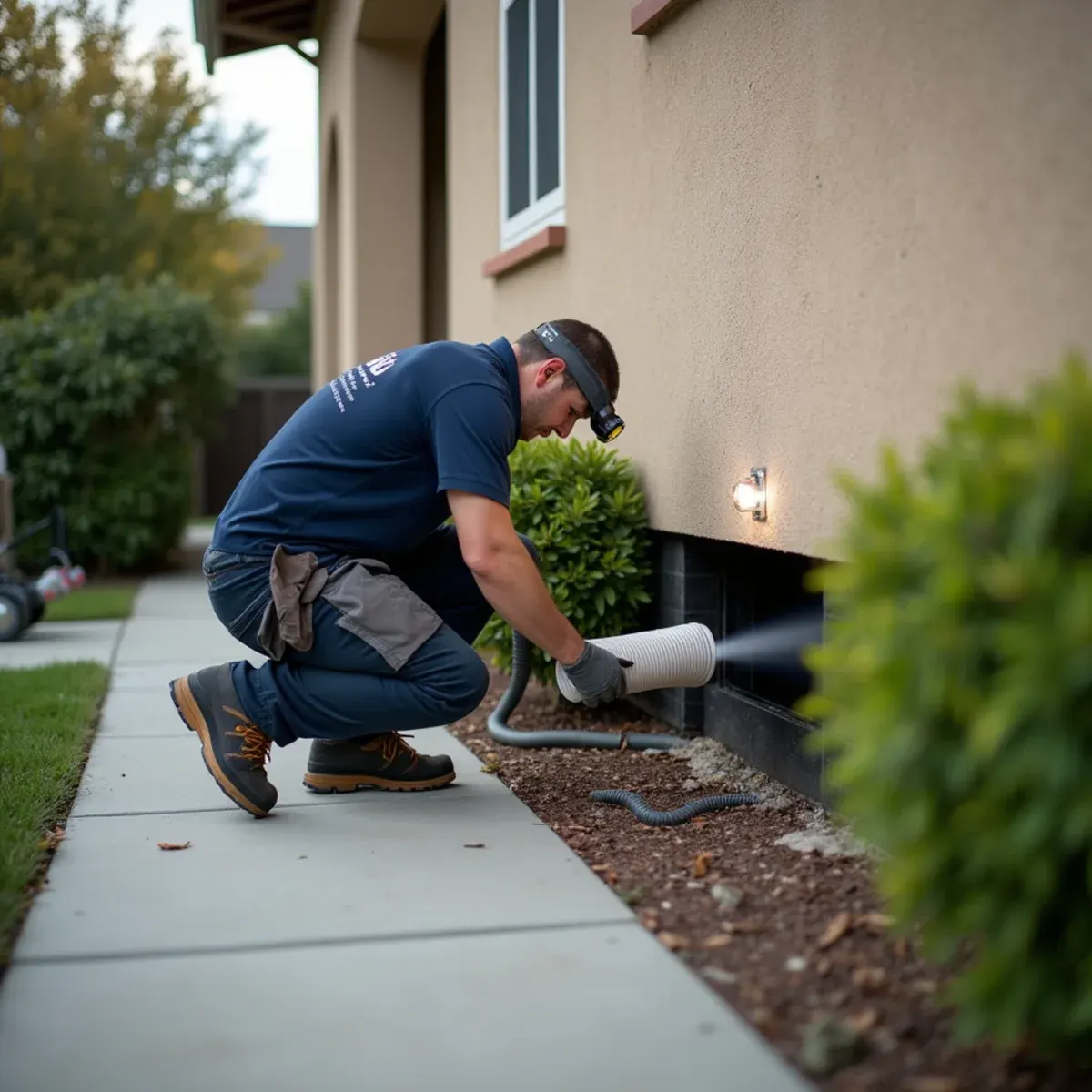
A supply line lets go under the floor of a coach in one of the Stanton parks. There is no puddle in the hallway and nothing runs out from under the skirting. The water lands in the belly wrap, the poly membrane slung under the floor joists to keep insulation and rodents in place, and that membrane does exactly what it was designed to do: it holds. Months later the particleboard decking near a wall starts to give underfoot, or the smell gets noticeably worse through August, and that is the first anyone hears about it.
Under IICRC S500 that underfloor is its own drying chamber, the same as a crawl space under a stick-built house. It just behaves worse. A vented sub-area at least breathes; a belly wrap is a bag, and by the time it is opened the fiberglass inside is fully saturated and hanging. Stanton is one of the densest cities in the county and carries a large share of manufactured and mobile homes alongside older apartments and a scattering of conventional raised houses, so the underfloor question here has two completely different answers depending on what you live in.
What Stanton Changes About Crawl Space Drying
1The belly wrap holds water, it never drains
Drying a manufactured home underfloor means cutting and dropping sections of the belly board so the trapped water actually leaves, pulling the saturated batts, then drying the joists and the underside of the decking before we re-wrap. Trying to dry through an intact belly is a waste of your money and ours, and it is the shortcut that leaves a home smelling the same in October.
2Particleboard decking is the honest limit
Most of these floors are particleboard, not plywood. Once it has been wet long enough to swell and lose bond, drying it does not restore strength, it just stops the problem spreading. We meter it, tell you which bays are recoverable and which need replacement, and we would rather say that on day one than after a week of running equipment over a floor that was already finished.
3Working under a coach in a tight park
Spacing in Stanton parks is narrow, skirting has to come off in sections, and there is often nowhere to stage a truck or run hose without crossing a neighbor's space. We coordinate with park management before equipment shows up, and we plan cord and duct routing so nobody's access is blocked for days at a time.
How the Work Runs
The method is the same one we use on every crawl space drying job, documented to the IICRC S500:2025 standard. Here it is in short — the full crawl space water damage & drying process explains each stage in detail.
- Get in and map the whole space
- Extract, then remove what is finished
- Build the crawl space into a chamber
- Dry the framing to a measured standard
- Deal with growth on the joists
- New barrier, insulation, encapsulation if warranted
The Stanton Background Worth Knowing
Mobile and manufactured homes need a genuinely different restoration approach, and the reason is what they are built from. The floor system is typically particleboard or OSB over a wood frame with insulation and a vapor barrier belly wrap underneath — and particleboard exposed to water swells, loses structural integrity, and does not recover. It cannot be dried back to serviceable the way plywood often can.
There is more on the housing stock, drainage and plumbing history of this city on our water damage restoration in Stanton page.
Stanton at a glance
- Dominant construction era
- 1950–1975
- Foundation type
- mixed on grade
- Supply piping found here
- galvanized steel, copper, manufactured-home PEX and poly
- Drain line materials
- cast iron
- Terrain and water table
- flat, moderate water table
- Most common local failure
- underfloor leaks in manufactured homes, sealed inside the belly wrap where they cannot evaporate
- Highest-value local prevention
- checking for soft spots underfoot, because a manufactured-home floor gives no other warning
What It Costs in Stanton
We do not quote a number over the phone before seeing the property — anyone who does is guessing. The variables that actually move the price on a crawl space drying job are access and working height, how much of the footprint got wet, water category and soil contamination, and they are broken down in full on the crawl space water damage & drying page. The assessment and the written estimate are free anywhere in Stanton, day or night, with no obligation.
Crawl Space Drying Questions from Stanton Homeowners
That is the classic presentation in a manufactured home. Water from a failed supply or drain line drops into the belly wrap and sits against the underside of the decking, so the first symptom is soft flooring rather than anything visible. We check from underneath, cut a small opening at the low point to see whether the belly is holding water, and meter the decking from below. If it is dry under there, we keep looking rather than start cutting.
Often you cannot tell from inside, which is the whole problem. Sub-area odor rises through plumbing penetrations and the baseboard line and reads like a wall or flooring issue. The check takes about twenty minutes: a technician under the house with a light and a moisture meter. If the framing meters dry and the barrier is intact, we tell you it is not the crawl space and go look somewhere else.
Sometimes, over months, and usually not completely. The vents give you passive air exchange, which only helps when outdoor air is drier than the space. On a marine layer morning here that air is above 80% relative humidity, so the vents are bringing moisture in. Meanwhile the wet soil keeps evaporating and the subfloor above keeps taking it up. Left alone, the common outcome is growth on the joists.
Yes, and we say so explicitly because a lot of companies will not. Manufactured homes need a different approach — opening the belly wrap to dry the floor cavity, removing saturated insulation, and honestly assessing particleboard decking, which usually cannot be dried back to serviceable.