
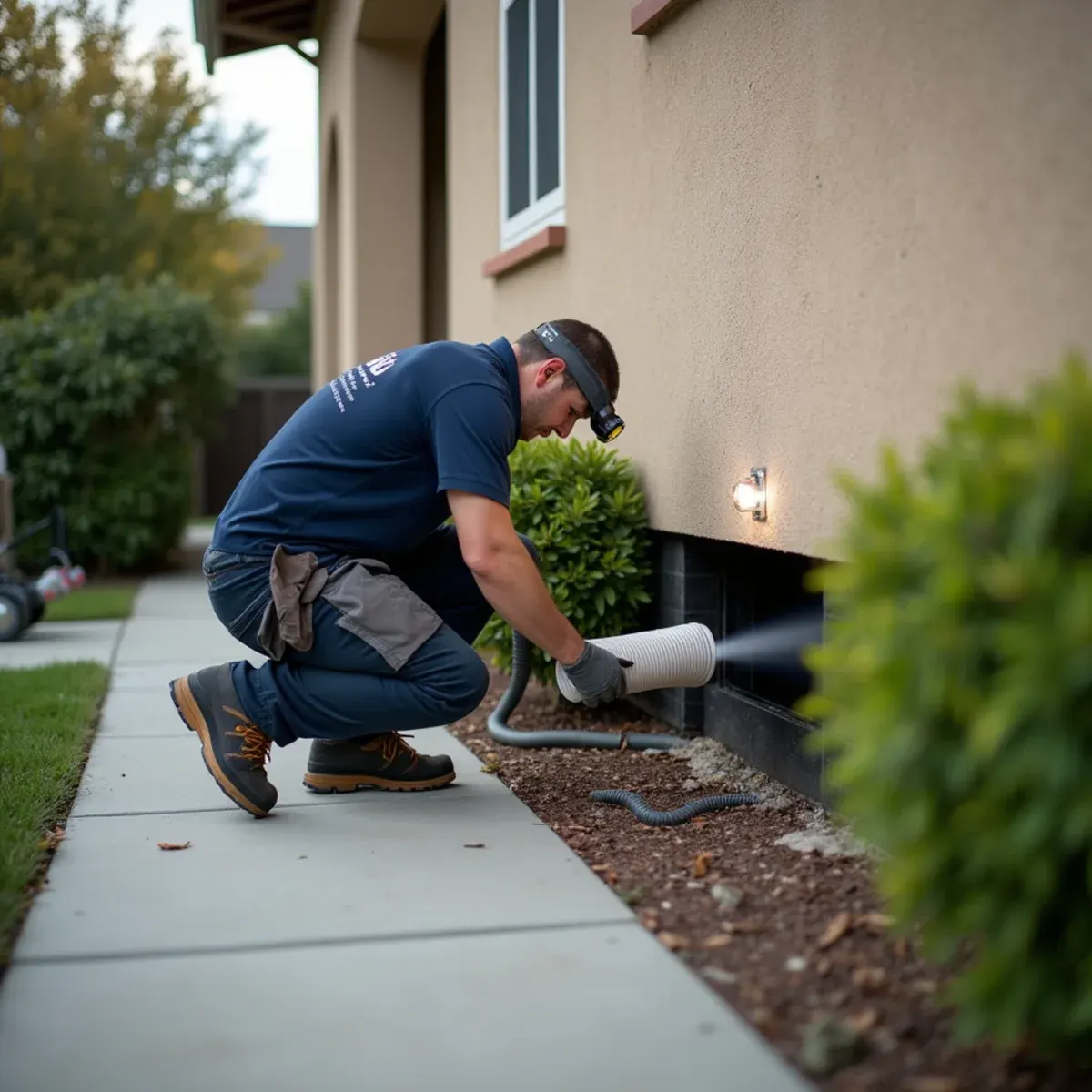
If you moved here from somewhere with a crawl space and have been hunting for the access hatch, there isn't one, and on this ground that is a mercy. Fountain Valley is dead flat, built on former wetland known locally as Gospel Swamp, and it has the shallowest water table in Orange County. A vented sub-area cut three feet into this soil would spend a good part of the year functioning as a sump. The city went up between 1960 and 1980 almost entirely on slab-on-grade, and that choice has aged well.
The sub-floor problem that actually exists here is vapor. Slab moisture emission is a routine background condition on this ground, not an anomaly, and it does two things: it gets mistaken for a plumbing leak, and it destroys flooring that was installed over a slab nobody ever tested. Where raised framing does show up here, it belongs to something added later: a bedroom extension, an enclosed patio, a family room bumped out past the original pour, sitting on a few inches of clearance above ground that never truly dries. Nothing under there ventilates and nothing drains.
What Fountain Valley Changes About Crawl Space Drying
1Additions over ground that stays wet
A room added on sleepers over grade here is sitting inches above soil with a very high moisture load. Without a barrier under it, that space feeds the framing continuously and any plumbing failure on top of that has nowhere to go. When we open one of these we are usually addressing two problems: the leak that prompted the call, and a void that was never going to stay dry anyway.
2Vapor mistaken for a leak
Damp concrete, cupped planks and a musty smell read as a leak to most people, and on this water table they are often just the slab doing what this ground makes it do. Telling them apart takes calcium chloride or relative humidity probe testing, not a moisture meter waved at a floor. Getting it wrong means jackhammering concrete to chase a leak that was never there.
3Test the slab before the flooring goes back
The most expensive failure we see in this city is not the original loss, it is the replacement floor that fails a year later because it went down over an untested slab still releasing vapor. After drying, we test, we document the result, and we tell you what the adhesive or underlayment you have chosen can actually tolerate. It adds a couple of days and saves the whole floor.
How the Work Runs
The method is the same one we use on every crawl space drying job, documented to the IICRC S500:2025 standard. Here it is in short — the full crawl space water damage & drying process explains each stage in detail.
- Get in and map the whole space
- Extract, then remove what is finished
- Build the crawl space into a chamber
- Dry the framing to a measured standard
- Deal with growth on the joists
- New barrier, insulation, encapsulation if warranted
The Fountain Valley Background Worth Knowing
Groundwater beneath Fountain Valley sits close enough to the surface that moisture vapor migration up through concrete slabs is a routine background condition rather than an anomaly. Homeowners here regularly describe a slab that feels cool and damp, or a closet on an exterior wall that never quite feels dry, without any leak at all.
There is more on the housing stock, drainage and plumbing history of this city on our water damage restoration in Fountain Valley page.
Fountain Valley at a glance
- Dominant construction era
- 1960–1980
- Foundation type
- slab on grade
- Supply piping found here
- under-slab copper
- Drain line materials
- cast iron
- Terrain and water table
- flat, shallow water table
- Most common local failure
- slab vapor emission mistaken for a leak, and flooring failures caused by installing over an untested slab
- Highest-value local prevention
- clearing the yard and area drains before the season, because a blocked drain on dead-flat ground ponds water against the house
What It Costs in Fountain Valley
We do not quote a number over the phone before seeing the property — anyone who does is guessing. The variables that actually move the price on a crawl space drying job are access and working height, how much of the footprint got wet, water category and soil contamination, and they are broken down in full on the crawl space water damage & drying page. The assessment and the written estimate are free anywhere in Fountain Valley, day or night, with no obligation.
Crawl Space Drying Questions from Fountain Valley Homeowners
On this water table, often not. Fountain Valley sits on former wetland and the soil under a shallow raised addition holds moisture year round, especially with no vapor retarder laid beneath it. We check whether the dampness is seasonal and even across the void, which points to ground moisture, or concentrated near a supply line and warmer to the touch, which points to plumbing. The fix for the first is a barrier and drainage, not a repipe.
Often you cannot tell from inside, which is the whole problem. Sub-area odor rises through plumbing penetrations and the baseboard line and reads like a wall or flooring issue. The check takes about twenty minutes: a technician under the house with a light and a moisture meter. If the framing meters dry and the barrier is intact, we tell you it is not the crawl space and go look somewhere else.
Sometimes, over months, and usually not completely. The vents give you passive air exchange, which only helps when outdoor air is drier than the space. On a marine layer morning here that air is above 80% relative humidity, so the vents are bringing moisture in. Meanwhile the wet soil keeps evaporating and the subfloor above keeps taking it up. Left alone, the common outcome is growth on the joists.
The city sits on former wetland with one of the shallowest water tables in Orange County, so moisture vapor migrating up through slabs is a normal background condition here rather than a defect. It matters most when installing flooring over the slab, which is why we test with in-situ RH probes before anything goes back down.