
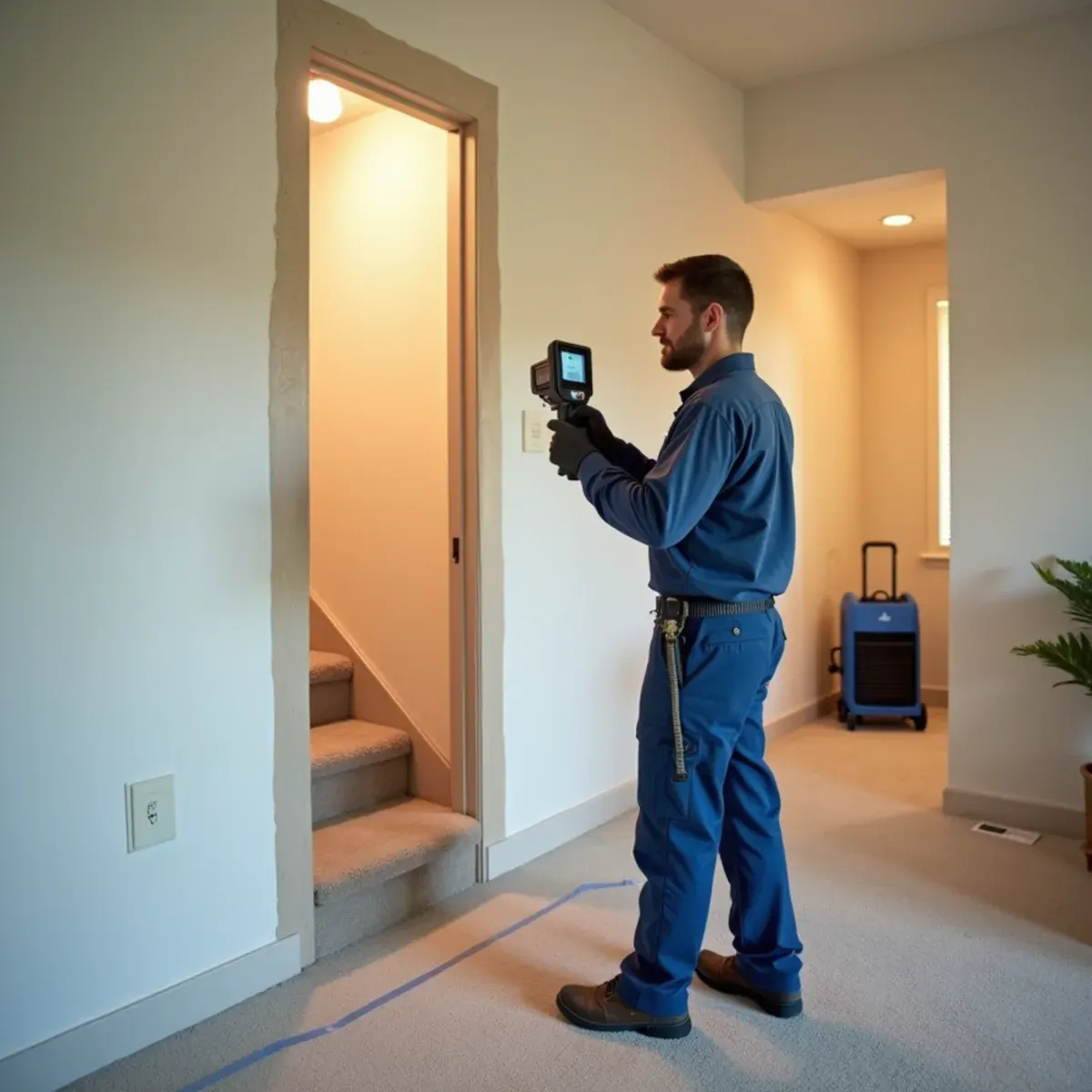
Here's a thing worth saying plainly on a drywall page: in a large part of Orange, the wall isn't drywall. Old Towne covers roughly a square mile of 1880s through 1920s homes around the Plaza traffic circle, one of the largest National Register districts in California, and those walls are lath and plaster on raised foundations. Plaster doesn't take a flood cut the way gypsum board does. Cut it carelessly and the keys break for several feet past your line. We score, remove in controlled sections, and keep original trim off in one piece where we can.
Drywall work in Orange lives mostly outside that square mile — the postwar slab tracts in El Modena and Santiago Hills, additions and garage conversions behind older houses, and the half-acre properties in Orange Park Acres where long private water lines feed barns and guest quarters. Crawl-space leaks under the older stock are their own problem: water drips into dirt for weeks with no puddle anywhere, and the first sign inside is a soft baseboard and a bloom of staining up the bottom of a remodeled wall.
What Orange Changes About Drywall Repair
1Plaster removal is not a flood cut
Old Towne's walls are plaster keyed into wood lath. Cut it like drywall and the vibration breaks the keys well past the line, turning a two-foot repair into a four-foot one. We score the perimeter first, remove in controlled sections and support the surrounding field. Rebuilding to the original thickness takes board plus a skim coat, not a sheet of half-inch and a texture gun.
2Crawl-space leaks announce themselves late
Under a raised foundation, a supply leak drips into dirt. No puddle, no sound, nothing on the floor. The first interior sign is often a soft baseboard or staining creeping up the bottom of a wall that was drywalled during a past remodel. By then the subfloor and sill area have been damp for a while, and the cut has to expose enough to check the framing.
3Orange Park Acres: long lines, outbuildings
Half-acre equestrian properties run long private water lines out to barns, tack rooms and guest quarters. Those buildings are often unconditioned, so drywall in them sees wide humidity swings and takes on water differently than a house does. A break out there can run a long time before anyone notices, and the repair usually includes checking whether the wall was ever insulated in the first place.
How the Work Runs
The method is the same one we use on every drywall repair job, documented to the IICRC S500:2025 standard. Here it is in short — the full drywall water damage repair process explains each stage in detail.
- Meter the wall first
- Decide dry-in-place or remove
- Open the cavity, not the wall
- Cut to a stud and a seam line
- Clear the cavity and dry the framing
- Tape, texture, prime, paint
The Orange Background Worth Knowing
A slab leak announces itself eventually because concrete has nowhere to put the water. A crawl-space leak has somewhere to put it. Dirt absorbs a slow drip almost indefinitely, so the loss never produces the one thing homeowners watch for, which is water on a floor. Meanwhile the humidity under the house climbs, the fiberglass insulation between the joists soaks up moisture and sags, the subfloor picks up that moisture from below, and mold begins on the joists where it is invisible and undisturbed. Everything about this failure is built to stay quiet.
There is more on the housing stock, drainage and plumbing history of this city on our water damage restoration in Orange page.
Orange at a glance
- Dominant construction era
- 1888–1975
- Foundation type
- mixed on grade
- Supply piping found here
- original turn-of-century piping, galvanized steel, under-slab copper
- Drain line materials
- cast iron, clay
- Terrain and water table
- flat, moderate water table
- Most common local failure
- crawl-space leaks under raised-foundation historic homes, running for weeks because water drips into the dirt instead of pooling on a floor
- Highest-value local prevention
- an annual crawl-space inspection, which almost nobody does and which catches nearly everything early
What It Costs in Orange
We do not quote a number over the phone before seeing the property — anyone who does is guessing. The variables that actually move the price on a drywall repair job are how much board comes out, cut height and seam count, texture type and match difficulty, and they are broken down in full on the drywall water damage repair page. The assessment and the written estimate are free anywhere in Orange, day or night, with no obligation.
Drywall Repair Questions from Orange Homeowners
Interior repairs are generally not what a historic district's design review concerns itself with — it's the exterior fabric and anything visible from the street that draws attention. Still, check with the City of Orange before work starts, especially if siding, windows or a porch is involved. On the interior we treat original trim, plaster profiles and door casings as things to remove intact and reinstall, not as demolition, whether or not anyone requires it.
No, and that assumption is why a lot of walls come out that did not need to. Gypsum board that got clean water, still reads firm under thumb pressure, and is coming down in moisture content day over day can usually be dried in place through the cavity. What forces removal is contaminated water, a core that has softened or swelled, visible growth on the paper, or insulation behind it that holds moisture against the board. We take readings before we answer that question.
Usually two feet or four feet above the floor, measured level across the whole run rather than following the stain. Board comes in four-foot widths, so a cut at either height lands the new seam where a factory edge would sit, which is far easier to hide than a seam floating mid-wall. The cut also has to end at the center of a stud on each side, so the patch has something to fasten to. Cutting to the shape of the damage looks thrifty and finishes badly.
Pick a dry day, open the hatch, and use a good flashlight. You are looking at the soil directly under the bathrooms, kitchen, and laundry for dark damp patches, at the insulation for sagging or fallen batts, and at the piers and foundation vents for rust or white staining. Trust your nose as much as your eyes. If the access is too tight or you would rather not go under, we will do the inspection and photograph what is down there.